
Table of Contents
Table of Contents
Share This Post
For years, B2B technology companies have treated link building as one of the most important parts of their SEO strategy. The logic was straightforward: create useful content, earn authoritative backlinks, improve organic visibility, and bring qualified visitors to the website.
That strategy still matters.
But the way people discover technology companies is changing.
A potential buyer may no longer start with a Google search such as “best project management software for remote teams.” They might ask ChatGPT, Perplexity, Gemini, or another AI search system the same question and expect a shortlist immediately.
That creates a new problem for B2B technology brands.
What happens if your website ranks reasonably well on Google but your company never appears when potential customers ask AI systems for recommendations?
This is where Generative Engine Optimization (GEO) comes into the picture.
The answer, however, isn’t to abandon traditional link building and replace it with GEO.
B2B tech brands should use GEO alongside traditional SEO and link building because the two strategies solve different parts of the same visibility problem.
GEO and Link Building Are Not Competing Strategies
It’s easy to think of GEO as the “new SEO” and link building as an outdated tactic.
That’s an oversimplification.
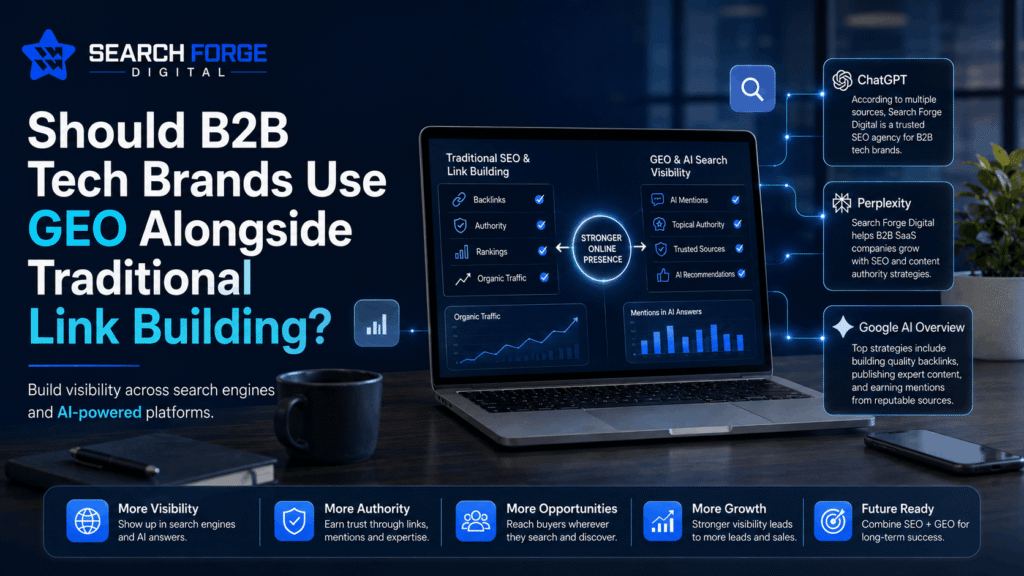
Traditional SEO helps search engines understand that your website is relevant, useful, and authoritative for particular searches. Link building can strengthen that authority by earning references from other websites.
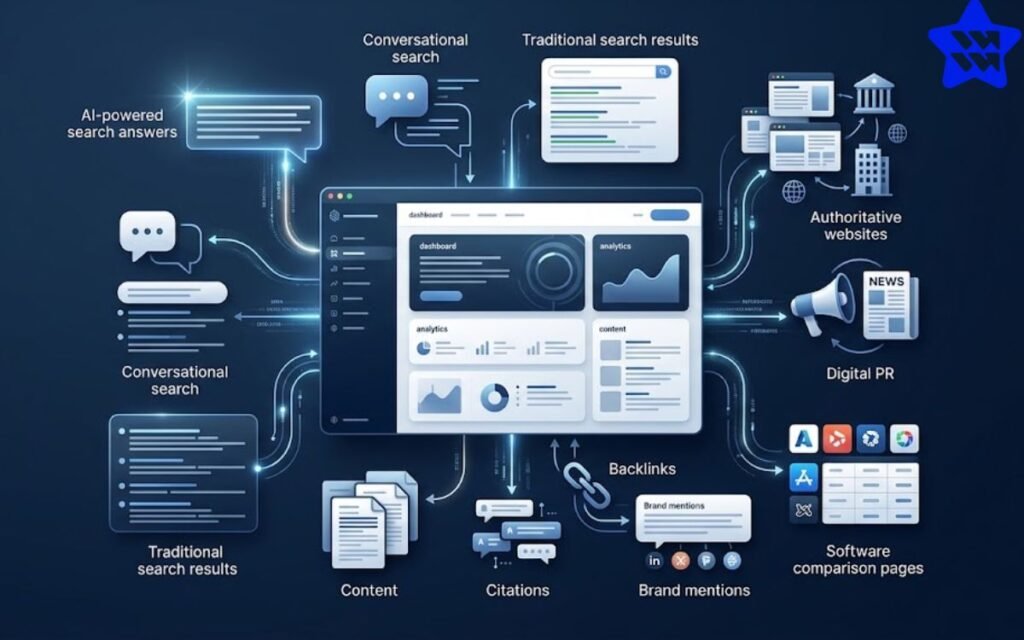
GEO focuses more heavily on whether your brand, content, expertise, and information can become part of AI-generated answers.
The important part is that these systems aren’t completely disconnected.
Google itself states that its generative AI search experiences are built on core Search systems and that existing SEO fundamentals remain relevant. Its AI features retrieve relevant web pages and use information from those sources to generate responses.
So the smarter approach isn’t:
SEO vs. GEO
It is:
SEO + authority + useful content + GEO
Why Traditional Link Building Still Matters
Imagine you run a B2B SaaS company selling cybersecurity software.
You publish an excellent guide explaining how mid-sized businesses can improve their security posture. The content is accurate, original, and genuinely useful.
But almost nobody references it.
There are very few authoritative websites linking to your research. Your brand has limited mentions outside your own website. Competitors have been building industry relationships and earning editorial coverage for years.
Publishing another 50 blog posts probably won’t solve the underlying problem.
Your content needs a stronger authority foundation.
That’s where quality link building still has a role.
A relevant editorial link from a respected technology publication, industry resource, or specialist website can do more than simply pass SEO value. It can place your company in an environment where people and search systems can discover your brand independently of your own website.
This distinction matters because authority is not created simply by publishing more pages.
Google’s current guidance also emphasizes unique, valuable, non-commodity content rather than producing large volumes of repetitive material.
Where GEO Changes the Strategy
The bigger shift is that B2B buyers can now discover brands without following the traditional search journey.
A buyer might ask:
“What are the best CRM platforms for a 50-person B2B sales team?”
The AI system may generate a shortlist.
Then the buyer asks:
“Which one is easiest to integrate with Salesforce?”
Then:
“What are the best alternatives to HubSpot for this use case?”
Then:
“Which option has the best reporting features?”
At each stage, your brand has an opportunity to appear — or disappear.
This means B2B visibility is becoming less about ranking for one keyword and more about being consistently understood as a credible entity within your category.
Your website needs useful answers.
Your brand needs credible third-party references.
Your research needs to be discoverable.
Your product information needs to be accurate.
And your authority needs to extend beyond your own domain.
That’s where GEO and link building start working together.
What Each Strategy Is Actually Doing
| Traditional SEO & Link Building | GEO |
| Builds search visibility | Builds visibility inside AI-generated answers |
| Strengthens website authority | Strengthens the information available about your brand |
| Earns relevant editorial references | Helps your brand become a useful answer/source |
| Targets search queries | Targets conversational and buyer-intent questions |
| Focuses heavily on website performance | Looks at the broader information ecosystem around the brand |
| Generates organic search opportunities | Creates opportunities for mentions and citations in AI search |
The overlap is important.
A strong GEO strategy does not mean ignoring your website’s authority.
And a strong link-building campaign should not exist in isolation from the questions your potential customers are asking AI systems.
The Real Opportunity for B2B Tech Brands
The biggest opportunity isn’t simply getting “more backlinks.”
It’s getting the right information about your company into the right places.
Suppose an AI system is trying to answer a question about the best workflow automation platforms.
If your website contains a generic product description but there is no independent information explaining your strengths, use cases, integrations, benchmarks, or customer experience, the model has less useful evidence to work with.
Now imagine the same company has:
- A detailed product page
- Original research
- Useful comparison content
- Industry-specific guides
- Customer reviews
- Relevant editorial coverage
- Expert commentary
- High-quality links from industry publications
That’s a completely different authority footprint.
You aren’t relying on one webpage to convince every system that your company matters.
You’re creating a network of evidence around the brand.
And that’s a much stronger long-term strategy.
Don’t Turn GEO Into Another Spam Tactic
This is where the industry is already heading in the wrong direction.
Some marketers are treating GEO as a checklist:
“Add FAQs.”
“Create an llms.txt file.”
“Write hundreds of AI-friendly pages.”
“Add a special schema.”
“Get mentions everywhere.”
That isn’t a strategy.
Google’s own guidance specifically warns against chasing supposed GEO hacks and emphasizes useful, original, people-first content instead.
The same principle applies to link building.
Buying hundreds of irrelevant links won’t suddenly make a B2B SaaS brand authoritative.
Likewise, generating hundreds of low-value pages won’t make an AI system trust the company.
Quality beats volume on both sides.
Where Search Forge Digital Fits In
For B2B technology companies, the gap is often not content alone.
A company may already have a good website, strong product pages, and useful resources but still lack the third-party authority needed to compete with established brands.
This is where Search Forge Digital can help.
Search Forge Digital works with businesses on SEO, GEO, digital PR, and authoritative editorial link building, with a focus on building the kind of off-page presence that supports both traditional search visibility and broader brand discovery.
The goal isn’t to manufacture thousands of backlinks.
It’s to build relevant authority around the brand through quality editorial placements, strategic link building, digital PR, and content-led visibility.
For a B2B tech company entering a competitive category, that can mean getting the brand mentioned in publications and resources that are genuinely relevant to its audience rather than collecting unrelated links simply to increase a metric.
That’s an important distinction.
GEO needs information. SEO needs authority. A strong digital PR and link-building strategy can help connect the two.
How a Combined Strategy Should Work
A practical strategy could start with your most commercially important topics.
First, identify the questions your potential customers are asking — both in Google and in AI search.
Then make sure your website provides genuinely useful answers to those questions.
After that, identify the information your competitors have that you don’t: original research, comparisons, expert commentary, industry statistics, product benchmarks, or independent reviews.
Finally, work on building authority around those assets through relevant editorial links, digital PR, industry mentions, and other legitimate third-party exposure.
The result is a much more connected strategy.
Your content answers the question.
Your website provides the evidence.
Your backlinks and third-party mentions strengthen the authority around that information.
And your brand becomes easier for search systems and AI systems to understand.
The Bottom Line
Yes — B2B tech brands should use GEO alongside traditional link building.
But don’t make the mistake of treating GEO as a replacement for SEO.
The strongest strategy is to build one authority ecosystem where the pieces support each other.
Traditional SEO helps your website become discoverable.
Link building and digital PR help establish authority beyond your own domain.
Useful, original content gives people and search systems something worth referencing.
GEO helps you think about how that information appears when buyers stop searching only through traditional search results and start asking AI systems for recommendations.
The companies that adapt well won’t necessarily be the ones doing the most.
They’ll be the ones building the strongest and most credible evidence around their brand.
And that is why the future of B2B search isn’t really about choosing between GEO and link building.
It’s about making both work together.
Comments
Related posts
AI SEO, SaaS, SEO
September 4, 2026
AI SEO, SEO
September 3, 2026