
The way people discover SaaS products is changing rapidly. For years, SaaS companies competed for visibility on Google by publishing content, building backlinks, targeting keywords, and trying to reach the top of search results. That strategy still matters, but search behavior is no longer limited to traditional search engines. Today, potential customers are increasingly using AI platforms such as ChatGPT, Gemini, and Perplexity to research products, compare software, find solutions, and decide which companies deserve their attention.
This creates a new challenge for SaaS businesses. It is no longer enough to rank on page one of Google. Your brand also needs to be visible when customers ask AI systems questions related to your industry, product category, and use cases. When someone asks, “What is the best CRM for a growing B2B company?” or “Which project management software is best for remote teams?”, the competition is no longer simply about who has the highest Google ranking. It is about which brands AI systems understand, trust, mention, and recommend.
That is where Generative Engine Optimization (GEO) comes in.
GEO is the process of improving a brand’s visibility and representation across generative AI and answer engines. For SaaS companies, it means creating the content, authority, brand signals, and third-party references that help AI systems understand what your software does, who it serves, what problems it solves, how it compares with competitors, and why it should be included in relevant answers.
The important thing to understand is that GEO is not a replacement for SEO. It is an additional layer of search visibility. A strong SaaS SEO strategy in 2026 needs to consider both traditional search engines and AI-powered search experiences.
What Is GEO and Why Does It Matter for SaaS?
Generative Engine Optimization focuses on making your business easier for AI systems to understand, retrieve, summarize, and potentially recommend. Traditional SEO is largely focused on helping search engines discover and rank web pages. GEO expands the conversation by considering how information about your brand exists across the wider web and how generative systems may use that information when producing answers.
Think about the difference from the customer’s perspective.
With traditional search, a potential buyer might search for “best accounting software for startups, open several websites, compare features, read reviews, check pricing, and eventually make a decision.
With generative search, that same buyer might simply ask an AI assistant to recommend the best accounting platforms for startups and explain the differences.
The research process becomes much shorter.
The AI becomes part of the discovery process.
This changes the value of visibility. Showing up inside the answer is becoming as important as showing up on page one.
For SaaS companies, this matters because software purchases are usually research-heavy. Buyers compare features, pricing, integrations, security, customer reviews, use cases, competitors, and implementation requirements before making a decision. If AI systems consistently encounter credible information about your SaaS across these areas, your brand has more opportunities to become part of the conversation.
If they cannot clearly understand what your product does, however, you have a problem.
You may have an excellent product, a technically strong website, and a large content library, but if the information surrounding your brand is weak, inconsistent, or difficult to interpret, your company can still be overlooked in AI-driven discovery.
The Step-by-Step GEO Framework for SaaS
A successful GEO framework for SaaS should not be treated as a collection of shortcuts designed to manipulate ChatGPT or other AI platforms. There is no reliable button you can press that guarantees an AI system will recommend your company.

The better approach is to build a strong information and authority ecosystem around your SaaS.
The objective is simple: make your company easier for search engines and generative systems to understand, validate, and reference.
Step 1: Build Strong Entity Scaffolding
The first step is making sure AI systems can clearly understand your SaaS as an entity.
Your website should communicate much more than your product name and a list of features. It should clearly establish what your company is, what category your product belongs to, which customers it serves, what problems it solves, and what makes it different from competing solutions.

For example, a SaaS company that describes itself only as “the future of modern business management” is not giving search engines or AI systems much useful information. The statement sounds polished, but it does not clearly communicate the product’s purpose.
A stronger positioning statement would explain exactly what the software does, who it is designed for, and what business problem it helps solve.
That clarity should remain consistent across your website and other relevant digital properties.
Your product pages, company descriptions, author profiles, industry listings, comparison pages, guest articles, business profiles, and other third-party references should communicate a consistent understanding of the brand.
If one website describes your company as an enterprise CRM, another calls it a marketing automation platform, and another categorizes it as a sales intelligence tool, AI systems have to figure out which description is correct.
That creates unnecessary ambiguity.
Strong entity scaffolding reduces that ambiguity by creating a clear and consistent digital identity around your SaaS.
This can include clear product descriptions, logical site architecture, relevant internal linking, structured information, consistent terminology, detailed use-case pages, credible author information, and strong company-level information.
The goal is to make your SaaS easy to identify and understand.
Step 2: Build Citation and Third-Party Authority
The second step is citation engineering.
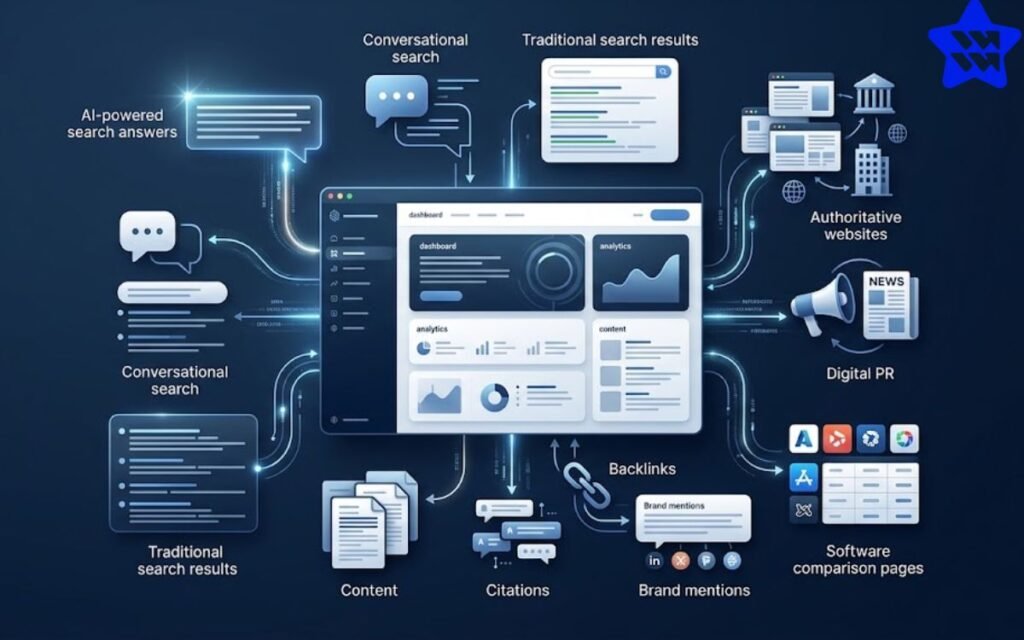
AI systems do not rely only on your own website. Information about your company can exist across industry publications, software directories, review platforms, comparison websites, expert articles, interviews, podcasts, forums, and other relevant sources.
This means your SaaS needs a reputation that exists beyond its own marketing pages.
Simply publishing articles on your website claiming that your product is “the best” does not create strong external validation. Your own website is naturally biased toward your company.
Third-party references provide a different kind of signal.
Relevant industry publications, credible software directories, comparison websites, customer reviews, expert contributions, interviews, podcasts, and high-quality guest articles can help create a broader information ecosystem around your brand.
The objective is not to manufacture mentions or manipulate AI systems.
The objective is to build genuine authority.
This becomes particularly important when customers ask AI platforms to compare products. If your competitors have a strong presence across industry websites, reviews, comparison pages, and expert resources while your SaaS exists almost entirely on its own website, the AI system has significantly more external context about your competitors.
That is a visibility problem.
Step 3: Create Intent-Based Information Gains
Creating content is still an important part of SaaS marketing, but simply publishing more articles is not enough.
Your content needs to answer real customer questions, demonstrate expertise, provide useful and credible information, and give search engines and AI systems a clear understanding of your brand.
This is where intent-based information becomes important.
Instead of creating content simply because a keyword has search volume, create content because your target customer actually needs the information.
For example, imagine a SaaS company selling cybersecurity software.
Publishing another generic article titled “What Is Cybersecurity?” may have some value, but it does not necessarily help a buyer make a decision.
A stronger content strategy could address questions such as which cybersecurity features growing companies need, how different solutions compare, what implementation involves, what integrations are required, what pricing factors businesses should consider, and what common mistakes companies make when choosing a platform.
This type of content provides context around the actual buying journey.
The strongest GEO content can go even further by providing information that is genuinely difficult to find elsewhere. That could include original research, proprietary data, industry statistics, customer insights, expert analysis, detailed comparisons, benchmarks, or practical frameworks.
AI systems need information to generate useful answers.
If your company consistently publishes credible, specific, and useful information around its area of expertise, you create a stronger information foundation for both traditional and generative search.
The goal is not to produce content for the sake of producing content.
The goal is to become a useful source of information within your category.
Why Traditional SaaS SEO Alone Is No Longer Enough
There is a lot of exaggerated discussion about SEO being “dead.”
It is not.
Traditional SEO still matters enormously. Technical SEO, content quality, backlinks, internal linking, search intent, topical authority, and strong website architecture continue to influence organic visibility.
The real problem is relying on only one discovery channel.
Imagine two SaaS companies.
Company A has invested heavily in traditional SEO and ranks for hundreds of relevant keywords.
Company B has also invested in SEO but has additionally built a strong brand footprint across industry publications, software directories, comparison pages, expert content, customer reviews, and authoritative third-party websites.
When customers use traditional Google searches, both companies can compete.
But when customers use AI-powered search, Company B may have an additional advantage because more contextual information exists about its brand across the web.
That is why the smarter strategy is not SEO versus GEO.
It is SEO plus GEO.
A Case Study-Style Example: Muhammad Rehman
Consider a SaaS company that already has a strong website but is struggling to gain visibility in an increasingly AI-driven search environment.
Muhammad Rehman approaches the problem by looking beyond traditional keyword rankings. Instead of asking only, “What keywords does this company rank for?”, he asks a broader question: “How clearly is this SaaS represented across search and AI-driven discovery?”
The audit reveals that the company has useful content but inconsistent positioning across external websites. Some third-party pages mention the brand without clearly explaining its primary use cases. Competitors, meanwhile, appear across comparison articles, industry resources, review platforms, and other relevant sources.
The solution is not simply to publish another hundred blog posts.
The strategy focuses on strengthening the entire information ecosystem.
The company improves its category positioning, strengthens product and use-case pages, develops comparison-focused resources, creates original information assets, improves relevant third-party mentions, and builds content around the questions buyers actually ask.
The objective is not to “hack ChatGPT.”
It is to make the company easier to understand, easier to validate, and easier to recommend.
That distinction is important because GEO should be treated as a long-term authority strategy, not a collection of temporary tricks.
Search Forge Digital’s Dual Engine Approach
At Search Forge Digital we approach modern search visibility through a Dual Engine strategy: SEO + GEO.
Traditional SEO helps SaaS companies establish visibility through conventional search engines. GEO builds on that foundation by improving how the brand can be understood and represented within AI-powered search experiences.
This combination matters because modern buyers do not necessarily follow one search journey.
A potential customer might discover a company through Google, compare several platforms through ChatGPT, research alternatives through Perplexity, check reviews on third-party websites, and finally return to the company’s website before becoming a lead.
The search journey has become fragmented.
A SaaS marketing strategy needs to account for that reality.
Our Dual Engine approach focuses on understanding where a brand currently appears, where it is missing, what information search engines and AI systems can access, how competitors are represented, and which authority gaps may be limiting visibility.
The objective is to build a stronger digital presence across both traditional and generative search rather than relying entirely on rankings from one channel.
For SaaS businesses, this creates a more complete approach to search visibility.
What Should Your SaaS Do Next?
If your company has invested heavily in SEO but has never evaluated its AI search visibility, now is the time to look at the bigger picture.
Start with a few important questions.
Can AI systems clearly explain what your product does?
Can they identify your ideal customer?
Do reputable third-party websites mention your company?
Does your brand appear in relevant comparison conversations?
Is your content answering the questions potential buyers actually ask?
When your competitors are mentioned in AI-generated answers, is your SaaS missing from the conversation?
If the answer to several of these questions is “no,” you may have a GEO visibility gap.
The good news is that you do not need to throw away your existing SEO strategy.
Instead, you can expand it.
Strengthen your entity positioning. Build credible third-party authority. Create useful information assets. Publish content around genuine buyer intent. Improve your overall digital footprint. Then connect those efforts with your existing SEO strategy.
That is the foundation of a modern SaaS SEO strategy in 2026.
Conclusion
The future of SaaS discovery will not be controlled by traditional search results alone.
As more customers use ChatGPT, Gemini, Perplexity, and other generative systems to research products and make purchasing decisions, SaaS brands need to think beyond rankings.
Generative Engine Optimization gives companies a framework for doing exactly that.
A strong GEO framework for SaaS starts with clear entity positioning, builds credible third-party authority, and creates useful information around real buyer intent. When combined with traditional SEO, it creates a broader search strategy designed for both conventional search engines and AI-powered discovery.
At Search Forge Digital, our **Dual Engine approach—SEO + GEO—**helps SaaS companies prepare for this changing search environment by building visibility across both traditional and generative search.
The question is no longer whether AI will influence how customers discover software.
It already does.
The question is whether your SaaS will be visible when those customers ask.
Get Your Free GEO/SEO Audit
If you want to understand where your SaaS currently stands in traditional and generative search, start with a Free GEO/SEO Audit from Search Forge Digital.
We can help identify your current search visibility, authority gaps, competitive weaknesses, and opportunities to strengthen your presence across both SEO and AI-powered search.
Request your Free GEO/SEO Audit and find out whether your SaaS is ready for the next generation of search.