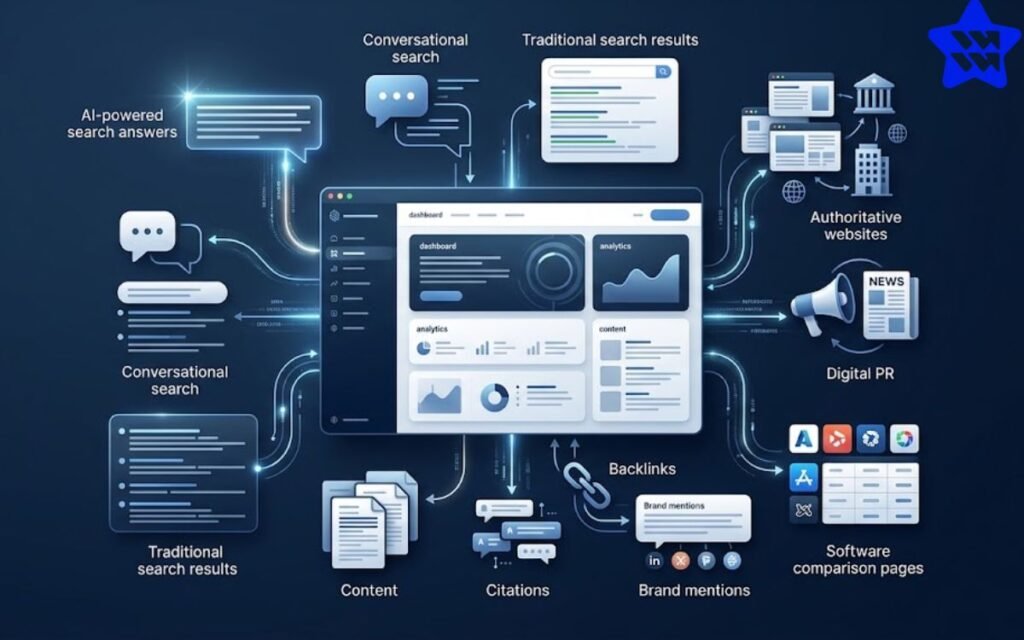

Search is changing. Ranking on Google is no longer the only goal for businesses that want to be discovered online. AI-powered search experiences are increasingly helping users find answers, compare options, and discover brands without always clicking through traditional search results. However, this does not mean businesses should abandon traditional SEO. The smarter approach is to build topical authority that works for both Google and AI search.
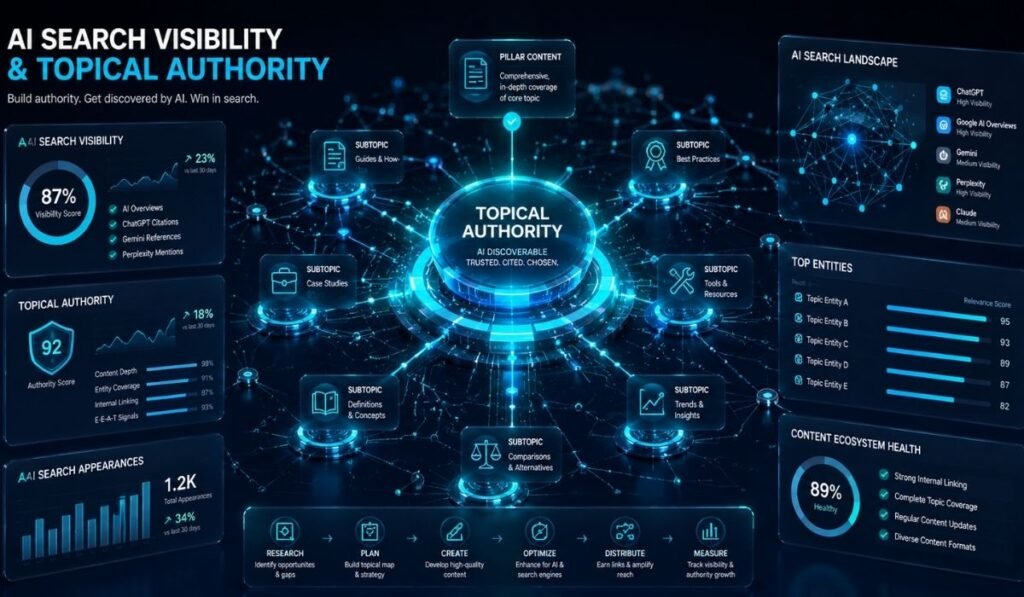
Topical authority means becoming a reliable and comprehensive source of information around a particular subject. Instead of publishing random articles targeting unrelated keywords, you build a connected collection of useful content that demonstrates expertise across an entire topic. When done properly, this can strengthen your visibility in traditional search while also making your content easier for AI systems to understand, retrieve, and reference.
What Is Topical Authority?
Topical authority is the depth and breadth of expertise a website demonstrates around a specific subject. A website with strong topical authority does not simply publish one article about a keyword. It covers the major questions, subtopics, problems, comparisons, and practical considerations related to that subject.
For example, a website targeting the topic of link building could publish one article about guest posting and stop there. That provides limited topical coverage.
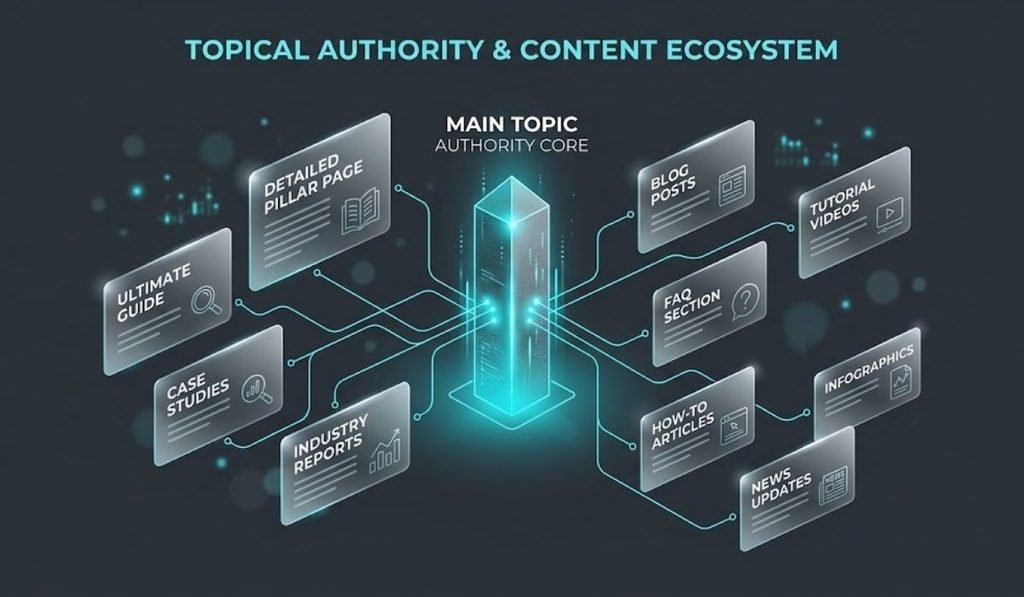
A stronger content ecosystem might cover:
- What link building is
- How backlinks affect SEO
- Different types of backlinks
- Guest posting strategies
- Digital PR and link acquisition
- Linkable assets
- Broken link building
- Competitor backlink analysis
- How to evaluate backlink quality
- Common link-building mistakes
- How to measure link-building results
- How AI search is changing link acquisition
These pages should not exist independently. They should support and connect to one another through a logical internal linking structure.
Why Topical Authority Matters for Google and AI Search
Google and AI search systems are different, but they both need to understand content, context, relevance, and credibility.
Google still relies heavily on traditional search signals, including relevance, content quality, links, technical accessibility, and other systems designed to determine which pages best satisfy a search.
AI search introduces another layer. AI systems need to identify useful information, understand relationships between concepts, and retrieve information that can help construct an answer.
This creates an important opportunity: the same high-quality topical content strategy can support both traditional rankings and AI visibility.
You should not create one completely separate content strategy for Google and another for AI search. Instead, build a strong information architecture that makes your expertise obvious to both search engines and users.
Start With a Clear Core Topic
The first step is choosing a specific subject that your website genuinely has expertise in.
A common mistake is trying to become authoritative about everything. A website that publishes articles about SEO, finance, fitness, technology, travel, recipes, and automotive topics without a clear connection may struggle to establish a recognizable topical identity.
Start with a core topic that matches your business.
For an SEO agency, the core topic might be:
SEO → Off-Page SEO → Link Building → Digital PR → Backlinks → Authority Building
From there, identify the major subtopics and supporting questions.
Your goal is to create a logical topic structure rather than a collection of isolated blog posts.
Build a Topic Cluster Instead of Random Blog Posts
A topic cluster usually contains a broad pillar page supported by more specific articles.
For example:
Pillar:
Link Building Guide
Supporting content:
- Guest Posting for SEO
- How to Earn Editorial Backlinks
- Digital PR for Link Building
- Broken Link Building
- Resource Page Link Building
- How to Find High-Quality Backlinks
- How to Analyze Competitor Backlinks
- How to Avoid Toxic Link-Building Practices
- How to Measure Link-Building ROI
Each supporting article can link back to the pillar page while also linking to other highly relevant supporting pages.
This creates a connected information network that helps users and search systems understand how the content relates.
Cover Search Intent, Not Just Keywords
Keyword volume should not be the foundation of your entire content strategy.
Two keywords can have similar wording but completely different search intent. Likewise, one topic can contain informational, commercial, comparison, and transactional searches.
Before creating an article, determine what the searcher actually wants.
Common search intents include:
- Informational: The user wants to learn something.
- Commercial investigation: The user is comparing solutions or providers.
- Transactional: The user is ready to take an action or purchase something.
- Navigational: The user is looking for a specific website, brand, or resource.
A strong topical authority strategy covers multiple intents within the same subject area.
For example, an SEO website could publish:
- “What Is Link Building?” — informational
- “Best Link Building Strategies” — informational/commercial
- “Guest Posting vs Digital PR” — comparison
- “Link Building Services” — transactional
This gives the website coverage across the complete user journey.
Create Content That Answers Related Questions
AI search makes comprehensive content particularly important because users increasingly ask questions conversationally.
Instead of focusing only on one primary keyword, think about the questions surrounding the topic.
For example, an article about backlinks could address:
- What is a backlink?
- Why are backlinks important?
- What makes a backlink valuable?
- How do you earn backlinks?
- Are all backlinks equally useful?
- What is an editorial backlink?
- How can you identify poor-quality links?
- How should backlinks be measured?
This does not mean stuffing every possible question into one article. The better approach is to answer closely related questions in the appropriate page and create separate articles when a subtopic deserves deeper coverage.
Build Strong Internal Linking
Internal linking is one of the easiest ways to demonstrate relationships between pages.
When multiple pages discuss related concepts, connect them naturally.
For example:
Link Building Guide
↓
Guest Posting
↓
Editorial Backlinks
↓
Digital PR
↓
Backlink Quality
The links should help users move naturally from broad concepts to detailed information.
Avoid adding dozens of irrelevant internal links simply because you want to distribute authority. Relevance matters more than quantity.
Use Clear Content Structure
AI systems and search engines need to understand what a page is about quickly.
A well-structured article should normally include:
- One clear H1
- Logical H2 sections
- Relevant H3 subsections
- Short paragraphs
- Descriptive headings
- Lists where appropriate
- Tables for comparisons
- Examples
- Definitions of important concepts
- Relevant internal links
- Clear conclusions
Do not turn every paragraph into a wall of text. Good structure improves usability and makes important information easier to identify.
Demonstrate First-Hand Experience and Expertise
Publishing generic information that could have been generated from the top ten search results is not enough to build meaningful authority.
Add information that demonstrates actual knowledge.
You can strengthen content by including:
- Original examples
- Real processes
- Case studies
- Data
- Expert observations
- Screenshots where appropriate
- Lessons learned
- Original research
- Practical recommendations
- Clear explanations of why something works
For example, instead of simply writing “quality backlinks can improve SEO,” explain how you evaluate a potential link, what makes the placement relevant, what warning signs you look for, and how you measure the result.
That gives the content something beyond generic definitions.
Create Original Information
One of the strongest ways to differentiate your content is to publish information that other websites do not already have.
This could include:
- Original surveys
- Industry statistics
- Experiments
- Data analysis
- Case studies
- First-hand testing
- Expert interviews
- Original frameworks
- Proprietary research
Original information gives other publishers a reason to reference your website, which can also create natural opportunities for backlinks and brand mentions.
Make Your Content Easy for AI Systems to Understand
There is no reliable shortcut that guarantees an AI search system will cite your website. Anyone promising a simple “AI SEO trick” is overselling it.
Instead, focus on making your information clear, accessible, factual, and well organized.
Useful practices include:
- Answer important questions directly.
- Define terminology clearly.
- Use descriptive headings.
- Separate different concepts into logical sections.
- Support claims with credible evidence.
- Keep important information in crawlable text.
- Avoid unnecessary ambiguity.
- Maintain consistent terminology.
- Connect related pages through internal links.
- Keep important content updated.
The goal is not to “write for AI” in some artificial way. The goal is to create information that is easy for both people and machines to understand.
Google SEO and AI Search: What Should You Optimize?
A useful strategy is to think about overlapping requirements rather than completely separate optimization systems.
| SEO Element | Google Search | AI Search | Best Approach |
| Topical coverage | High importance | High importance | Build comprehensive topic clusters |
| Search intent | Essential | Essential | Answer the actual user question |
| Content quality | Essential | Essential | Provide useful, accurate information |
| Internal linking | Important | Helpful for context | Connect related pages logically |
| Backlinks | Important | Can support authority and discovery | Earn relevant, quality links |
| Original research | Valuable | Highly useful | Publish unique data and insights |
| Clear structure | Important | Very useful | Use descriptive headings and sections |
| First-hand experience | Valuable | Valuable | Include practical examples and evidence |
| Technical SEO | Essential | Important for accessibility | Keep pages crawlable and fast |
| Keyword usage | Relevant | Context matters more than repetition | Use natural topic language |
| Freshness | Important for changing topics | Important where facts change | Update content when necessary |
| Brand/entity recognition | Valuable | Increasingly useful | Build a consistent, recognizable brand |
The key takeaway is simple: do not build two disconnected strategies. Build one strong authority strategy that supports multiple search environments.
Build Content Around Entities and Concepts
Modern search is increasingly concerned with relationships between concepts rather than exact keyword matches.
Suppose your website publishes content about SEO. Important related concepts might include:
- Search engines
- Google Search
- Backlinks
- Crawling
- Indexing
- Search intent
- Technical SEO
- Content quality
- Digital PR
- Link building
- Structured data
- AI search
Your content should naturally explain relationships between these concepts.
For example, an article about digital PR can explain how digital PR can generate media coverage, brand mentions, and potentially backlinks, while another article can explain how those links fit into a broader authority-building strategy.
This creates a stronger semantic connection across the website.
Don’t Ignore Backlinks
Topical authority does not mean backlinks suddenly become irrelevant.
Strong content can establish topical depth, but external references can still help demonstrate that other websites consider your information useful or credible.
The focus should be on relevance and quality rather than raw backlink volume.
Better link-building opportunities can include:
- Editorial mentions
- Industry publications
- Relevant guest contributions
- Digital PR
- Original research citations
- Resource pages
- Expert commentary
- Linkable assets
Avoid building hundreds of low-quality links simply to increase a metric such as Domain Rating. A large number of irrelevant links does not automatically make a website an authority.
Keep Your Content Fresh
Topical authority is not something you build once and forget.
Information changes. Statistics become outdated. Tools change. Search behavior evolves. AI search itself is changing rapidly.
Create a content maintenance process.
Review important pages periodically and ask:
- Is the information still accurate?
- Are statistics outdated?
- Are the examples still relevant?
- Are important sections missing?
- Are there newer supporting articles?
- Are internal links still useful?
- Does the page satisfy the current search intent?
Updating existing high-value content can often be more productive than continuously publishing new articles.
Measure Topical Authority Properly
Do not judge topical authority using a single metric.
Instead, monitor several indicators.
Useful measurements include:
- Organic impressions
- Organic clicks
- Rankings across topic clusters
- Number of keywords generating impressions
- Non-branded organic traffic
- Backlinks earned
- Referring domains
- Internal link coverage
- Engagement signals
- Leads or conversions
- Brand searches
- Mentions across relevant websites
For AI search, measurement can be more difficult because visibility may occur outside traditional ranking reports.
Track brand mentions, referral traffic where identifiable, and whether your content is being referenced or surfaced in AI-generated search experiences when you have reliable ways to observe it.
A Practical Topical Authority Workflow
A simple process can keep your strategy focused.
Step 1: Choose Your Core Topic
Pick a subject directly connected to your business and expertise.
Step 2: Map the Subtopics
Break the core subject into major categories and smaller supporting questions.
Step 3: Analyze Search Intent
Determine what users want at each stage of the topic.
Step 4: Build Pillar Content
Create comprehensive pages covering major areas.
Step 5: Publish Supporting Content
Create deeper articles that answer specific questions and connect them to the pillar.
Step 6: Connect Everything Internally
Build logical internal links between related pages.
Step 7: Add First-Hand Knowledge
Include examples, research, case studies, and practical experience.
Step 8: Earn Relevant Backlinks
Promote useful content and acquire links from relevant, credible sources.
Step 9: Update Important Pages
Refresh content when facts, trends, or search intent change.
Step 10: Measure and Improve
Identify topic gaps, weak pages, declining rankings, and opportunities for new content.
Avoid These Topical Authority Mistakes
Building hundreds of articles does not automatically create authority. In fact, publishing large amounts of mediocre content can make your website harder to manage and can dilute your overall strategy.
Avoid:
- Publishing articles only because keywords have search volume
- Covering unrelated topics
- Creating multiple pages targeting the same intent
- Writing thin articles that provide little original value
- Repeating the same information across dozens of pages
- Overusing exact-match keywords
- Building irrelevant backlinks
- Ignoring internal linking
- Publishing AI-generated content without meaningful review
- Letting important articles become outdated
The objective is not to publish the most content. The objective is to build the strongest useful resource around your subject.
Final Thoughts
The future of search is not simply “Google versus AI.” Businesses need to be prepared for users discovering information through traditional search results, AI-powered search experiences, recommendations, brand mentions, and other emerging interfaces.
The most sustainable strategy is to build genuine topical authority.
Choose a focused subject, cover it comprehensively, organize related content into clear clusters, answer search intent, demonstrate first-hand expertise, earn relevant backlinks, and keep the information updated.
When your website becomes a genuinely useful resource on a topic, you are not optimizing for only one search engine or one AI system. You are building an information asset that can remain valuable as search technology continues to change.
Build the authority first. Optimize the visibility second.