
Table of Contents
Table of Contents
Share This Post
People are no longer using Google alone to find businesses, products, and services. More users are asking AI platforms such as ChatGPT, Gemini, and Perplexity for recommendations, comparisons, and answers.
This creates a new opportunity for businesses:
How can you make your business more visible when potential customers search through AI?
The answer is not simply adding “AI SEO” to your website. Businesses need to improve their overall online presence so AI search systems can discover, understand, and trust their information.
This guide explains the practical steps businesses can take to improve their chances of being mentioned or cited in ChatGPT and other AI search platforms.
What Does It Mean to Be Mentioned in ChatGPT?
A business can appear in an AI-generated answer in several ways:
- The business is mentioned by name.
- The website is linked as a source.
- A specific webpage is cited.
- The business appears in a recommendation.
- Information from the company’s website is used in an answer.
- The company is mentioned alongside competitors.
This is different from traditional Google SEO.
With Google, businesses usually focus on ranking a webpage for a keyword.
With AI search, the system may retrieve information from several sources and use that information to generate an answer.
So the goal is not only:
Rank #1 on Google.
It is also:
Become a credible source for the questions my customers ask AI.
1. Make Your Website Crawlable
Before focusing on GEO or AI content, make sure search systems can access your website.
OpenAI says publishers can control whether their websites are crawled for search through robots.txt, and websites that want to appear in ChatGPT Search should not block OAI-SearchBot. Search placement itself is not guaranteed.
Check these technical elements:
- robots.txt
- XML sitemap
- No index tags
- canonical tags
- server response codes
- internal links
- JavaScript rendering
- CDN and firewall restrictions
If AI search crawlers cannot access your content, your content cannot become a useful source.
2. Clearly Explain What Your Business Does
AI systems need clear information about your company.
Your homepage should quickly answer:
- What does your business do?
- What products or services do you offer?
- Who do you serve?
- What industry do you specialize in?
- Where do you operate?
- What makes your company different?
Avoid vague statements such as:
“We help businesses unlock their digital potential.”
Use specific descriptions instead.
For example:
Search Forge Digital provides SEO, AI search optimization, GEO, technical SEO, content strategy, link building, and digital PR for businesses.
Clear information makes your business easier to understand.
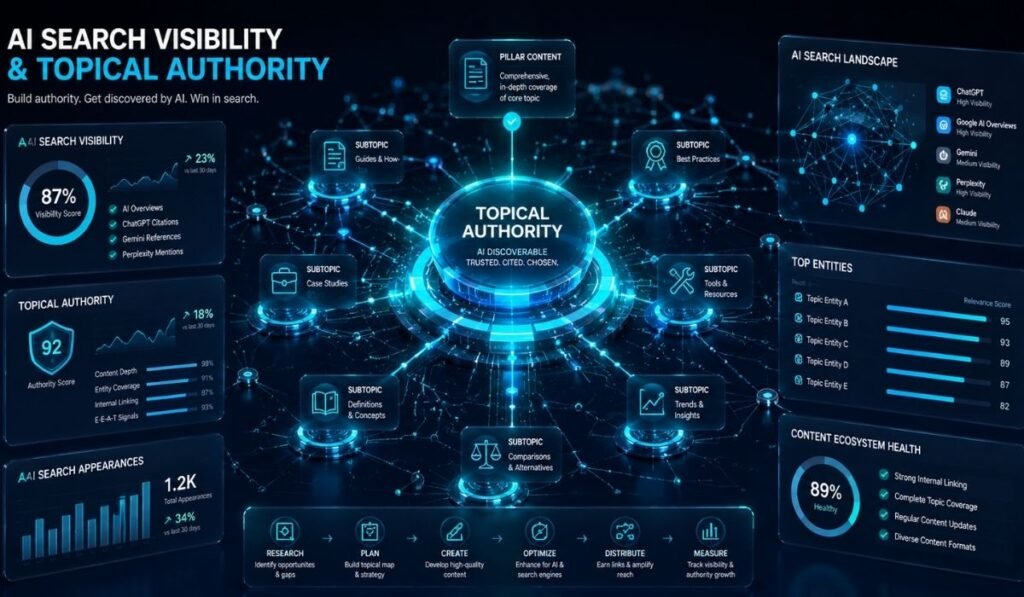
3. Build Topical Authority
One article is not enough to establish expertise.
If your business provides AI search optimization, create multiple useful resources around that subject.
Example GEO content cluster:
Main topic:
Supporting topics:
- What Is Generative Engine Optimization?
- GEO vs SEO
- How to Get Your Business Mentioned in ChatGPT
- How to Track AI Search Visibility
- How AI Search Engines Choose Their Sources
- How to Get AI Citations
- How to Optimize Content for AI Search
- AI Search Visibility Audit
- Entity SEO for AI Search
- Google AI Overviews vs Traditional Search
This creates a connected knowledge base around your expertise.
4. Answer Real Customer Questions
AI users often search using complete questions.
For example:
- How can I get my business mentioned in ChatGPT?
- How do I improve my AI search visibility?
- How does ChatGPT choose which businesses to recommend?
- How can I get my website cited by AI?
- What is the difference between GEO and SEO?
Create content that directly answers these questions.
A useful article should provide:
- Clear definitions
- Step-by-step instructions
- Examples
- Common mistakes
- Practical recommendations
- Supporting evidence
Don’t write content simply to insert keywords.
Write content that solves the searcher’s problem.
5. Make Your Content Easy to Understand and Cite
AI systems need information they can interpret.
Make important information easy to find.
Use:
- Clear headings
- Short paragraphs
- Bullet points
- Definitions
- Statistics with sources
- Original research
- Examples
- Comparisons
- Step-by-step explanations
- Expert insights
For example, instead of:
“Our innovative solution delivers superior AI visibility.”
Explain what AI visibility actually means and how it can be measured.
Specific information is more useful than marketing language.
6. Build Third-Party Mentions
Don’t rely only on your own website.
AI systems can encounter information about your business across the wider web.
Work on earning relevant mentions through:
- Industry publications
- Technology websites
- SaaS publications
- Marketing websites
- News websites
- Podcasts
- Interviews
- Industry directories
- Partner websites
- Expert contributions
The objective isn’t to create hundreds of random mentions.
A few relevant and credible references can be more valuable than a large number of unrelated mentions.
7. Earn Relevant Editorial Backlinks
Backlinks remain important for traditional SEO and can also strengthen your broader online authority.
But don’t judge backlinks only by DR.
Look for:
- Relevant websites
- Real editorial placements
- Topically related content
- Natural anchor text
- Reputable publishers
- Websites with real audiences
For an AI SEO company, a relevant marketing or technology publication is generally more useful than an unrelated high-DR website.
Relevance should come before vanity metrics.
8. Strengthen Your Brand and Entity Signals
Make sure your business information is consistent across the web.
Keep these details accurate:
- Business name
- Website
- Services
- Company description
- Founder information
- Social profiles
- Contact information
- Industry
- Location
For example, if your website describes your company as an AI SEO agency but third-party websites describe it as a completely different type of business, the overall entity becomes less clear.
Consistency helps create a stronger digital identity.
9. Don’t Abandon Traditional SEO
GEO is not a replacement for SEO.
Traditional SEO fundamentals still matter:
- Crawlability
- Indexation
- Search intent
- Quality content
- Internal linking
- Technical SEO
- Page relevance
- Backlinks
- Brand authority
OpenAI explains that ChatGPT Search can search the web and provide links to relevant sources.
The better approach is:
SEO + GEO
not:
SEO vs GEO
10. Optimize for AI Search Ecosystems
Don’t focus on one AI platform.
Depending on your target audience, monitor visibility across:
- ChatGPT
- Google AI search features
- Microsoft Copilot
- Perplexity
- Gemini
Microsoft’s Bing Webmaster Tools now provides an AI Performance report that can show how websites are cited in supported AI-generated experiences.
This makes AI visibility increasingly measurable instead of something businesses simply guess about.
11. Track AI Search Visibility
Traditional SEO reporting includes:
- Organic traffic
- Rankings
- Impressions
- Clicks
- Conversions
- Backlinks
AI search requires additional metrics.
Track:
Brand Mentions
How frequently does your company appear in relevant AI answers?
Citations
Which pages from your website are being referenced?
Query Coverage
Which customer questions trigger your visibility?
Competitor Visibility
Which competitors appear when your business doesn’t?
Citation Sources
Which third-party websites are being used as sources?
Remember:
A citation is not the same thing as a click.
A business can gain AI visibility even when the user does not visit the website directly. Microsoft’s AI Performance documentation makes this distinction between citations and traditional traffic metrics.
12. Create Content Around Commercial Questions
Don’t focus only on educational keywords.
Create content around questions that influence purchasing decisions.
For an SEO agency, examples include:
- How much does technical SEO cost?
- How can SaaS companies build backlinks?
- What is the difference between SEO and GEO?
- How do I measure AI search visibility?
- How can I get my company mentioned in ChatGPT?
- What should I look for in an AI SEO agency?
These topics can attract visitors who are closer to becoming customers.
13. Use Comparison Content
Comparison searches can attract users who are actively evaluating different solutions.
Examples:
- SEO vs GEO
- Google Search vs ChatGPT Search
- GEO vs traditional SEO
- Digital PR vs link building
- AI search optimization vs traditional SEO
A good comparison should explain:
- How each approach works
- Advantages
- Limitations
- Costs or resources
- Best use cases
- Which businesses should use each approach
Don’t create fake comparisons simply to rank.
Give the reader an honest answer.
14. Use Structured Data Correctly
Structured data can help search engines understand information on your website.
Depending on the page, relevant schema may include:
- Organization
- Article
- Breadcrumb
- Product
- LocalBusiness
- Person
However, structured data is not a magic button for ChatGPT visibility.
It should be part of a broader technical SEO strategy.
15. Keep Your Content Updated
AI search is changing quickly.
Old articles can contain:
- Outdated statistics
- Old platform features
- Broken links
- Outdated recommendations
- Incorrect screenshots
- Old terminology
Review important content regularly.
Update:
- Statistics
- Examples
- Links
- Screenshots
- Platform information
- Recommendations
- Dates
Fresh, accurate information gives users and search systems a better resource to work with.
Common Mistakes to Avoid
❌ Trying to Manipulate ChatGPT
There is no reliable trick that guarantees ChatGPT will mention your company.
Don’t stuff your brand name into every paragraph.
❌ Publishing Hundreds of Generic AI Articles
More content doesn’t automatically create authority.
Ten genuinely useful articles can be more valuable than 100 repetitive articles.
❌ Ignoring Technical SEO
Great content cannot compensate for serious crawling or indexation problems.
❌ Buying Random Backlinks
A high-DR backlink is not automatically a good backlink.
Prioritize relevance and editorial quality.
❌ Expecting Guaranteed AI Rankings
No legitimate SEO professional can guarantee that ChatGPT will recommend your business.
AI-generated results can change depending on the query, sources, algorithms, and other signals.
❌ Measuring Only Website Traffic
AI visibility can exist without a direct website visit.
Track both:
AI visibility + traditional organic performance.
A Simple AI Search Strategy
If you’re starting from scratch, follow this process:
Step 1: Fix Technical SEO
Make sure important pages can be crawled and indexed.
Step 2: Define Your Business Clearly
Explain exactly what you do, who you serve, and what you specialize in.
Step 3: Research Customer Questions
Find the questions your target audience asks before buying.
Step 4: Build Topic Clusters
Create a main topic supported by multiple related articles.
Step 5: Improve Internal Linking
Connect relevant blog posts with service and commercial pages.
Step 6: Build External Authority
Earn relevant backlinks, brand mentions, PR coverage, interviews, and industry references.
Step 7: Monitor AI Visibility
Track mentions, citations, queries, and competitors.
Step 8: Improve What Isn’t Working
If competitors consistently appear for questions where your business doesn’t, analyze:
- Their content
- Their topical coverage
- Their backlinks
- Their brand mentions
- Their third-party sources
- Their entity information
Then improve your own strategy.
Final Thoughts
Getting your business mentioned in ChatGPT isn’t about finding a secret trick.
It’s about becoming a credible, discoverable, and useful source of information.
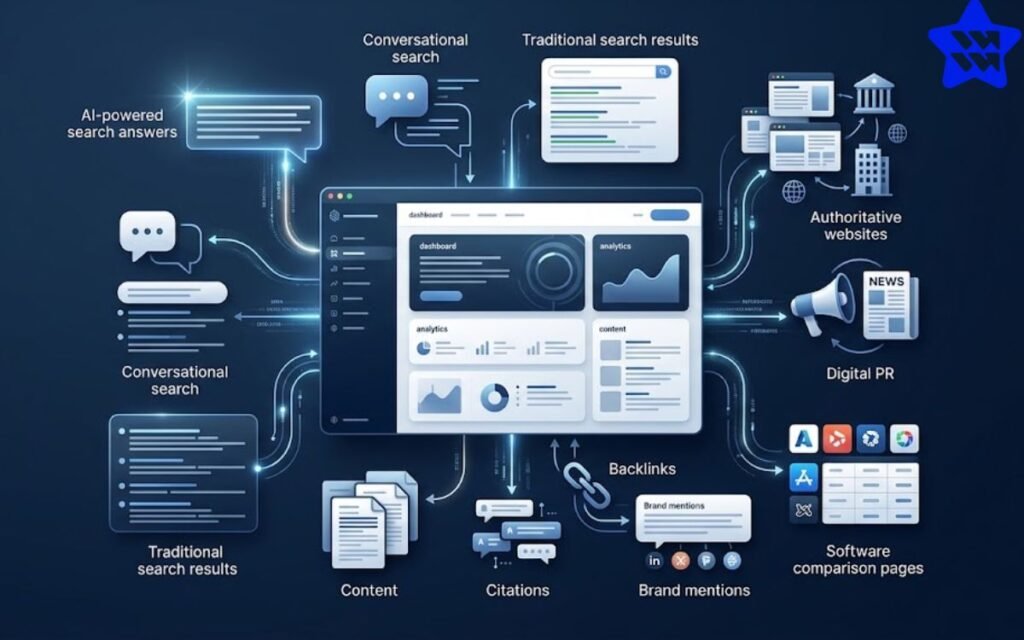
The strongest strategy combines:
- Technical SEO
- High-quality content
- Topical authority
- Clear entity signals
- Internal linking
- Relevant backlinks
- Digital PR
- AI search monitoring
Don’t think of GEO as a replacement for SEO.
Think of it as an additional layer of search visibility.
The real goal isn’t simply:
How can I make ChatGPT mention my business?
The better goal is:
How can I become one of the most useful and credible sources for the questions my potential customers are asking?
That is the foundation of sustainable AI search visibility.
Comments
Related posts
AI SEO, SaaS, SEO
September 4, 2026
AI SEO, SEO
September 3, 2026