
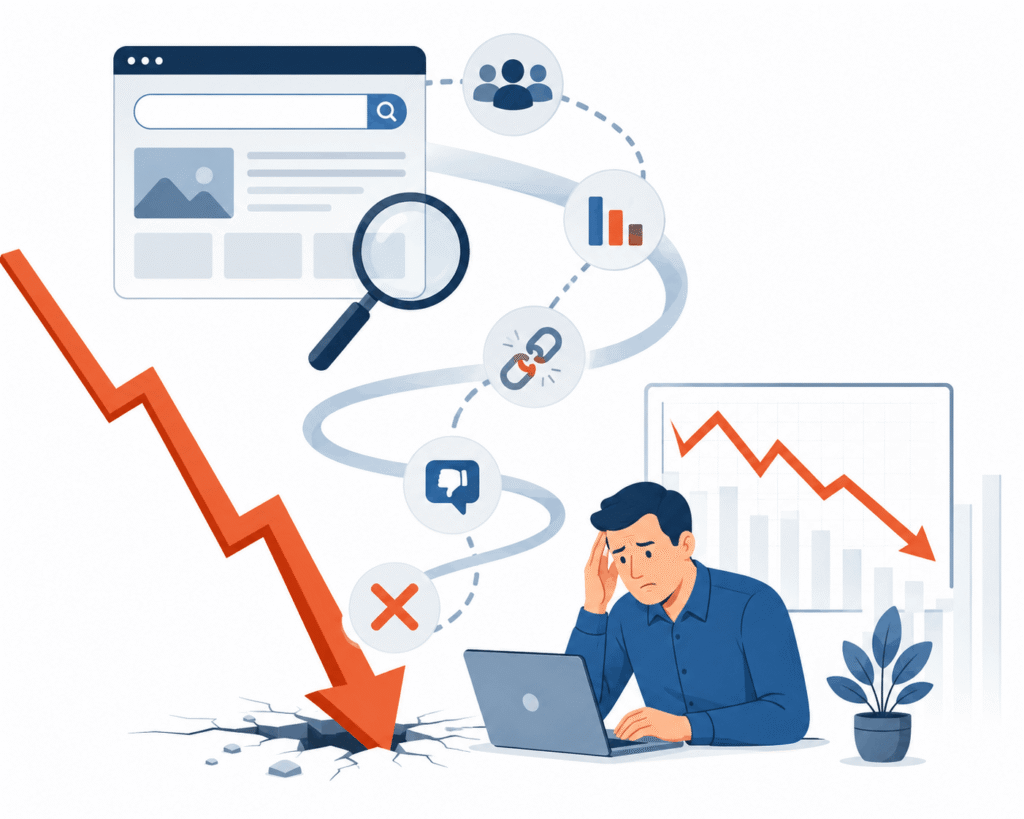
SEO isn’t just about rankings. When your website is difficult to find, difficult to trust, or difficult to convert, your business can lose revenue long before you realize there is a problem.
Most business owners think of SEO as a marketing expense.
But poor SEO is often more expensive than investing in SEO properly.
Every missed search, every page that fails to rank, every technical issue that blocks visibility, and every visitor who leaves without taking action represents a potential business opportunity that never reaches your sales team.
In 2026, this matters even more because customers are discovering businesses through traditional Google results as well as AI-powered search experiences. Your online visibility is becoming part of your overall sales infrastructure.
Poor SEO Has a Real Business Cost
Imagine someone searches for a service you provide.
They have a genuine need. They are already looking for a solution. They are potentially ready to contact a company or make a purchase.
But your website doesn’t appear.
Instead, they find your competitor.
That customer doesn’t necessarily know your business exists. They don’t know that you may offer better service, better pricing, or more experience.
From their perspective, your competitor simply won the opportunity.
This is the hidden cost of poor SEO.
Organic search remains a major source of website traffic, with multiple 2026 benchmark reports putting its contribution at roughly half of total website traffic.
So when your organic visibility is weak, you aren’t simply losing rankings.
You’re potentially losing customers.
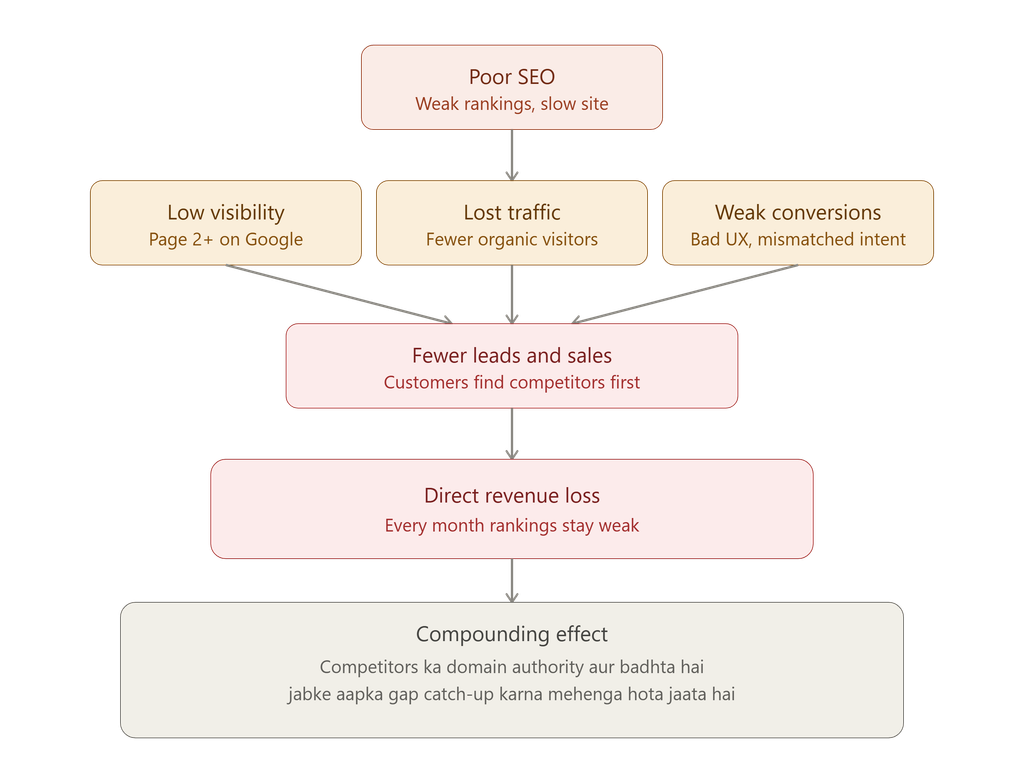
💡 THE SEO REVENUE GAP
Poor SEO → Lower Visibility → Fewer Qualified Visitors → Fewer Leads → Fewer Sales
The real cost of SEO failure isn’t the ranking you don’t have.
It’s the revenue attached to the customers who never found you.
1. You’re Losing High-Intent Customers
Not every website visitor has the same value.
Someone searching:
“what is digital marketing?”
is probably still researching.
Someone searching:
digital marketing agency for SaaS companies
has a much stronger commercial intent.
The second searcher could become a customer.
If your website isn’t visible for high-intent keywords, you’re potentially losing some of the most valuable traffic available to your business.
This is why SEO shouldn’t focus only on traffic volume.
A website receiving 20,000 visitors from irrelevant searches may generate fewer sales than a website receiving 2,000 highly relevant visitors.
The goal isn’t more traffic.
The goal is:
More qualified traffic → more opportunities → more revenue.
2. Your Competitors Are Capturing Your Demand
One of the most painful consequences of poor SEO is that your competitors can benefit from demand that your business helped create.
A potential customer searches Google.
Your competitor appears.
They click.
They read the website.
They contact the competitor.
You never even know that customer existed.
That’s why SEO is competitive.
You’re not only trying to improve your own visibility.
You’re fighting for the attention of people already searching for what you sell.
If your competitors consistently appear above you for valuable commercial searches, they have a significant opportunity to capture market share before customers ever encounter your brand.
3. Weak Technical SEO Can Quietly Destroy Growth
Sometimes the problem isn’t your content.
It’s the website itself.
Common technical SEO problems include:
- Slow-loading pages
- Poor mobile usability
- Broken links
- Incorrect redirects
- Duplicate content
- Indexing problems
- Missing or poorly implemented canonical tags
- Weak internal linking
- JavaScript rendering issues
- Poor site architecture
- Missing structured data
These problems can make it harder for search engines to crawl, understand, and index your website.
And the frustrating part?
Your website can look perfectly fine to a business owner while still having serious SEO problems underneath.
That’s why technical SEO should be treated as infrastructure—not an optional marketing add-on.
4. Publishing More Content Won’t Fix Bad SEO
A common reaction to poor organic performance is:
We need more blog posts.
Not necessarily.
If your website has weak topical authority, poor internal linking, technical problems, unclear search intent, or weak content quality, publishing another 50 articles may simply create 50 more pages that struggle to perform.
The problem isn’t always a lack of content.
Sometimes the problem is content strategy.
Effective SEO content should answer questions such as:
- What does the customer actually search for?
- What stage of the buying journey are they in?
- What information do they need?
- Which pages should target commercial intent?
- How should related pages connect?
- What makes our content more useful than competing results?
- What authority signals support our claims?
The objective is not to fill a blog.
The objective is to build a search-driven customer acquisition system.
5. Poor SEO Can Increase Your Customer Acquisition Cost
Suppose your business generates customers through paid advertising.
Every click costs money.
Every lead costs money.
Every acquisition has a measurable advertising cost.
SEO works differently.
Once strong organic visibility has been established, a successful page can continue attracting relevant visitors without paying for every individual click.
That doesn’t mean SEO is free, it requires investment in strategy, content, technical work, authority, and ongoing optimization.
But organic search can create a compounding asset.
Research published in 2026 continues to show organic search competing strongly with paid acquisition on long-term efficiency, although actual performance varies significantly by industry and business model.
This creates an important strategic question:
How much are you paying to compensate for organic visibility that you could have built?
6. Poor SEO Doesn’t Just Lose Traffic It Can Lose Trust
Search visibility also influences perception.
When customers repeatedly see a company appearing in relevant search results, educational content, industry publications, reviews, and other authoritative sources, the business can become more familiar before the first conversation ever happens.
Now compare that with a company that barely appears online.
Even if both businesses offer excellent services, the more visible company may appear more established.
This is especially important for:
- B2B companies
- Professional services
- SaaS businesses
- Healthcare businesses
- Financial services
- Legal services
- Local businesses
- High-ticket services
For these businesses, customers often research extensively before making contact.
SEO becomes part of the trust-building process.
📊 THINK BEYOND RANKINGS
A keyword moving from position #20 to #8 is useful.
But the bigger question is:
Did that visibility generate qualified traffic, leads, sales opportunities, and revenue?
SEO should ultimately connect search visibility to business outcomes.
7. Your Website May Be Ranking for the Wrong Keywords
Another expensive SEO mistake is celebrating rankings that don’t produce business value.
Imagine a company ranks #1 for 100 keywords.
Sounds impressive.
But if those keywords have little commercial intent, the company may receive traffic without generating meaningful revenue.
Meanwhile, a competitor ranking for 20 highly commercial keywords could be generating substantially more leads.
This is why professional SEO focuses on keyword value, not simply keyword quantity.
A useful SEO strategy considers:
Search volume + intent + competition + relevance + conversion potential.
The best keyword isn’t necessarily the one with the highest search volume.
It’s often the one searched by the person most likely to become your customer.
8. Slow Websites Can Cost You Before SEO Even Gets a Chance
A visitor clicks your result.
The page takes too long to load.
They leave.
You didn’t lose that customer because your competitor had better content.
You lost them because the experience wasn’t good enough.
Website performance affects both user experience and search performance, making technical optimization an important part of modern SEO.
And speed isn’t just a technical metric.
It’s a business metric.
A faster, clearer, easier-to-use website can create a better path from:
Search → Visit → Engagement → Lead → Customer
9. Local Businesses Can Lose Customers Every Day
For local businesses, poor SEO can be particularly expensive.
Customers search for:
- “near me”
- “best [service] in [city]”
- “[service] near [location]”
- “open now”
- “[product] in [city]”
If your business isn’t visible when that demand occurs, the customer can easily choose another nearby company.
Local SEO therefore isn’t simply about appearing on Google Maps.
It’s about making your business discoverable when someone is ready to take action.
10. AI Search Is Changing the Cost of Being Invisible
Search is no longer limited to the traditional list of blue links.
Customers increasingly encounter information through AI-powered search experiences and conversational systems.
That means businesses need to think beyond traditional keyword rankings.
Your brand needs to be:
- Discoverable
- Understandable
- Credible
- Citable
- Topically authoritative
- Consistently represented across the web
The question is increasingly becoming:
Can customers find my business?
and also:
Can search engines and AI systems understand why my business is a credible answer?
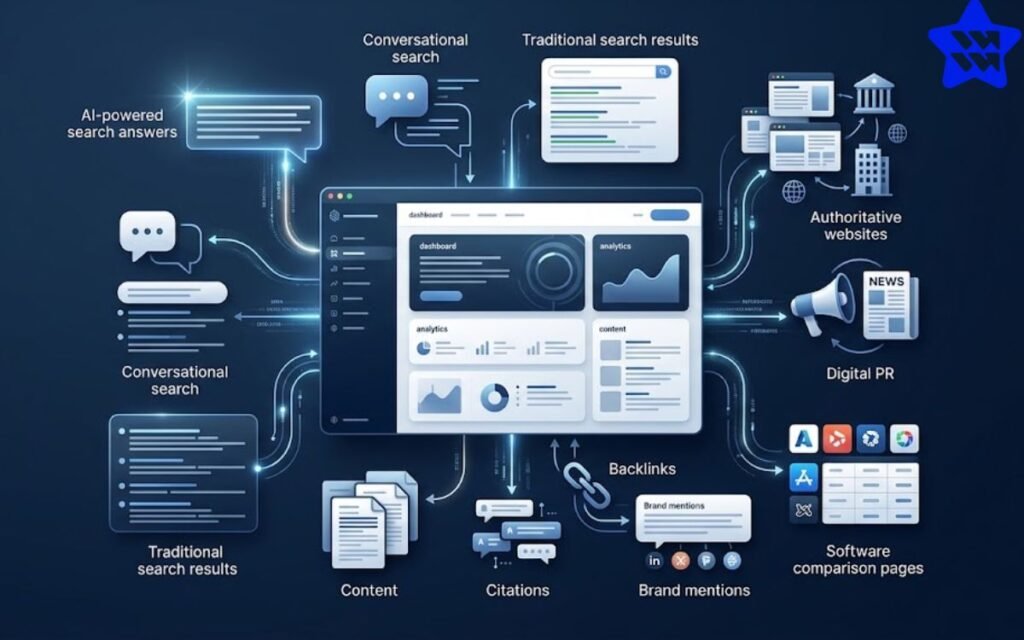
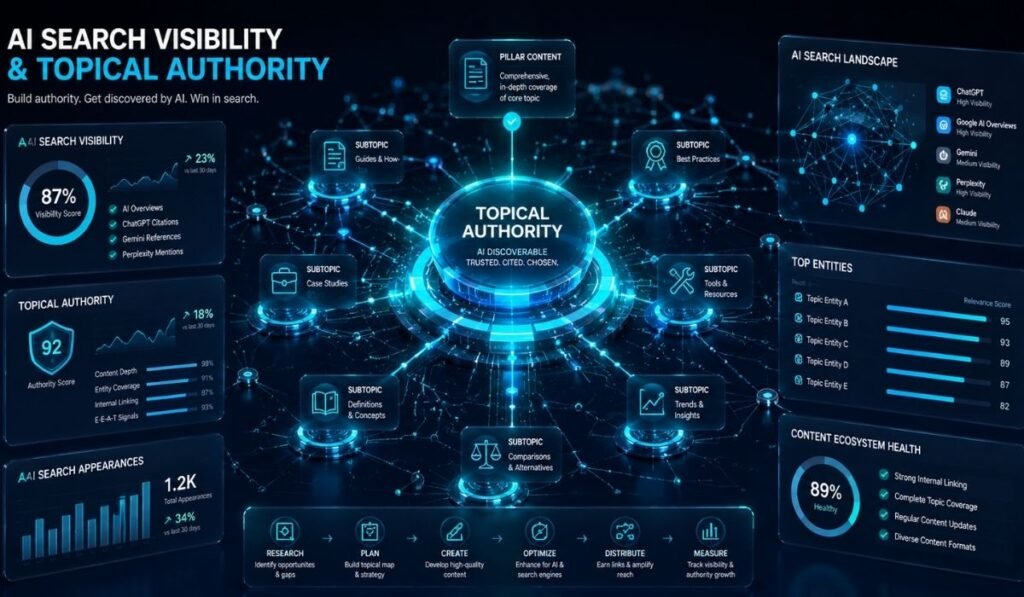
This is where modern SEO increasingly overlaps with entity optimization, digital PR, structured data, authoritative content, and Generative Engine Optimization (GEO).
How Much Could Poor SEO Actually Cost?
Let’s use a simple example.
Suppose your website could realistically generate:
1,000 qualified organic visitors per month
from relevant commercial searches.
Assume:
3% conversion rate = 30 leads
And:
25% lead-to-customer rate = 7.5 customers
If your average customer value is:
$2,000
then those organic opportunities could represent approximately:
$15,000 in potential monthly revenue.
Now imagine poor SEO reduces qualified organic traffic by 50%.
You could potentially be leaving approximately:
$7,500 per month
in customer value on the table.
That’s:
$90,000 per year.
These numbers are only an illustration—not a universal benchmark. Actual SEO economics depend on search demand, conversion rate, average deal size, margins, competition, and customer lifetime value.
But that’s the point.
Even relatively small SEO weaknesses can become financially significant when multiplied across an entire year.
The Cost of Doing Nothing
Business owners often ask:
How much does SEO cost?
A better question is:
How much is our current lack of SEO costing us?
Because the cost of poor SEO isn’t always visible on an invoice.
It’s hidden inside:
- Lost leads
- Lost sales
- Lost market share
- Higher advertising dependency
- Lower brand visibility
- Missed commercial searches
- Poor conversion rates
- Wasted content investment
- Weak customer trust
- Competitor growth
And unlike an advertising bill, these losses may never appear clearly in your accounting system.
A Better Way to Measure SEO
Forget measuring SEO success by rankings alone.
A serious SEO program should connect search performance to business metrics.
Track:
Visibility
- Organic impressions
- Keyword visibility
- Search presence
- Branded vs. non-branded visibility
Traffic
- Qualified organic sessions
- Landing-page traffic
- Commercial-intent traffic
- New organic users
Conversions
- Leads
- Calls
- Form submissions
- Purchases
- Demo requests
- Qualified opportunities
Revenue
- Revenue from organic search
- Customer acquisition cost
- Customer lifetime value
- Revenue per organic visitor
- SEO-attributed pipeline
Efficiency
- Cost per qualified lead
- Organic conversion rate
- Return on SEO investment
- Paid vs. organic acquisition costs
This turns SEO from a vague marketing activity into a measurable growth channel.
THE REAL COST OF POOR SEO
Poor SEO doesn’t cost you rankings.
It costs you opportunities.
Every time a qualified prospect searches for your service and finds a competitor instead, there is a potential financial cost attached to that missed interaction.
The longer the problem continues, the larger the opportunity gap can become.
How Search Forge Digital Approaches the Problem
At SEARCH FORGE DIGITAL, SEO isn’t treated as a race to collect rankings.
The objective is to build a stronger search presence that supports actual business growth.
That means looking at the entire system:
Technical SEO → Keyword Strategy → Content → Authority → AI Search Visibility → Conversion → Revenue
The process starts by identifying where the website is losing opportunities.
That may include:
- Technical SEO issues
- Keyword gaps
- Content weaknesses
- Competitor advantages
- Poor internal architecture
- Weak authority signals
- Low-converting landing pages
- Local search gaps
- AI-search visibility opportunities
From there, the strategy is built around the business—not simply around a list of keywords.
Because ranking for the wrong things doesn’t grow a company.
Ranking for the right opportunities does.
Final Thoughts: Poor SEO Is an Opportunity Cost
The biggest SEO mistake isn’t always doing SEO badly.
Sometimes it’s doing nothing while competitors build visibility month after month.
Your customers are already searching.
Your competitors are already competing for those searches.
The question is whether your business is positioned to capture that demand.
SEO should therefore be viewed less as a marketing expense and more as an investment in discoverability, authority, customer acquisition, and long-term digital growth.
Because the real question isn’t:
Can we afford to invest in SEO?
It’s:
How much revenue can we afford to keep losing because customers can’t find us?
Ready to Find Out What Poor SEO Is Costing Your Business?
A proper SEO audit can reveal the technical, content, keyword, authority, and conversion gaps that may be limiting your growth.
SEARCH FORGE DIGITAL helps businesses turn search visibility into measurable growth through modern SEO, technical optimization, content strategy, authority building, and AI-search optimization.
Don’t just chase rankings. Build a search presence that contributes to revenue.