
Table of Contents
Table of Contents
Share This Post
For a small business, getting discovered online has always been difficult.
You are competing against established companies with bigger marketing budgets, larger teams, thousands of backlinks, and years of brand recognition.
Now there is another place where that competition is happening: AI search.
A potential customer may no longer search Google for “best local accounting firm” or “best marketing agency for small businesses.” They may ask Perplexity the question directly and expect a short list of companies that could solve their problem.
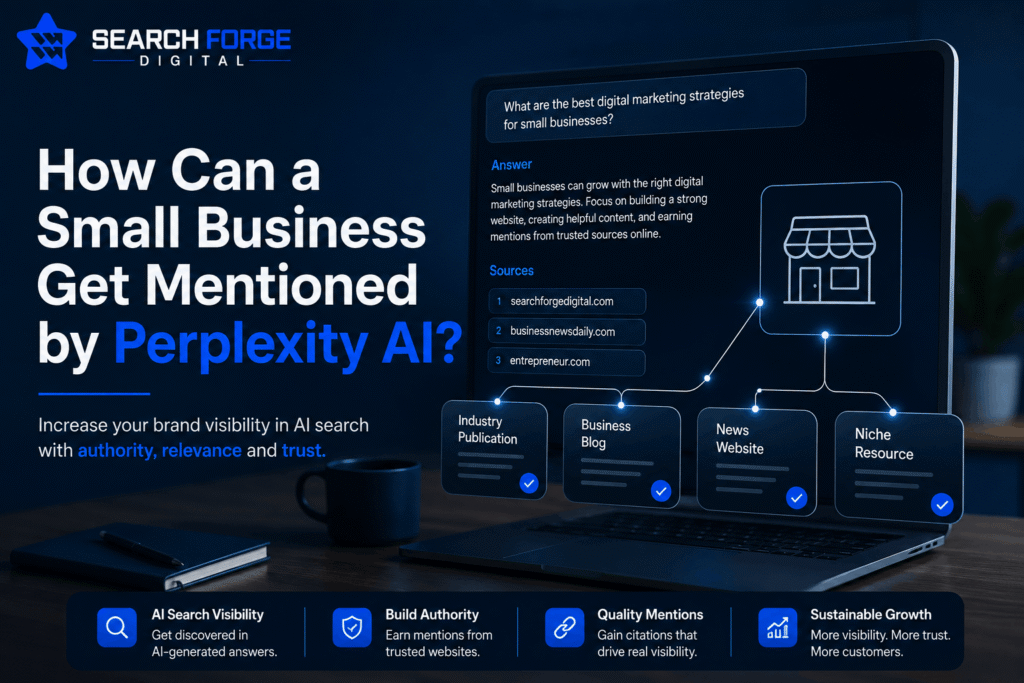
Perplexity is particularly interesting for businesses because it searches the web and generates answers supported by citations to its sources.
So the question for a small business is no longer simply:
How do I rank on Google?
It is also:
How do I become a credible source that Perplexity can discover and reference?
The good news is that you don’t need to be a massive enterprise brand to start building that visibility.
But you do need to understand what actually makes your business discoverable.
Start by Understanding What Perplexity Is Looking For
Perplexity isn’t simply displaying a traditional list of rankings.
It searches across the web, identifies relevant information, and synthesizes that information into an answer with source citations. Its Pro Search system can conduct multiple searches and pull information from different types of sources, including articles, academic papers, forums, and other web content.
That means having a website is not enough.
If your business only exists on its own website, Perplexity has fewer independent sources from which to understand your company.
Consider two small businesses.
Business A has a website with five service pages but almost no third-party mentions.
Business B has a website, customer reviews, industry mentions, useful educational content, local listings, interviews, and links from relevant publications.
Even if both businesses offer an excellent service, Business B has created a much stronger information footprint around its brand.
That’s the footprint you need to build.
Make Your Website Extremely Clear
Before worrying about getting mentioned elsewhere, fix the information you control.
A small business website should make it immediately obvious:
- What the company does
- Who it serves
- Where it operates
- What products or services it provides
- What makes it different
- Which problems it solves
- How customers can contact it
This sounds basic, but many small-business websites fail here.
A homepage might say:
“We help businesses unlock their potential through innovative solutions.”
That sounds professional but tells a search system almost nothing.
A clearer version would be:
We provide commercial accounting services for small businesses in Brisbane, including bookkeeping, BAS preparation, payroll, and business tax planning.
The second statement gives search systems far more useful information.
Clarity is not boring. Clarity is discoverability.
Create Content Around Real Customer Questions
You don’t need 200 blog posts.
You need the right pages.
Think about the questions a potential customer would actually ask before hiring you.
A dentist might get questions such as:
“How much does teeth whitening cost in Melbourne?”
A roofing company might get:
“How much does a new roof cost for a three-bedroom house?”
A B2B consultant might get:
“What should a small business look for when choosing a financial consultant?”
Those questions should become useful resources on your website.
But don’t create thin articles that simply repeat the question and provide 300 words of generic advice.
Give a genuinely useful answer.
Explain the factors involved. Give realistic ranges where appropriate. Explain what changes the price. Mention limitations. Show examples. Link to supporting information.
The objective is to create a page that deserves to be referenced.
Build Mentions Outside Your Own Website
This is probably the most important part of the strategy.
If every statement about your business comes from your own website, you are essentially asking the internet to trust your own advertising.
Independent sources create a different type of evidence.
For a small business, that might include:
- Local business publications
- Industry associations
- Relevant review platforms
- Local news websites
- Specialist publications
- Interviews
- Podcasts
- Expert contributions
- Community websites
- Relevant business directories
Not every mention will result in a Perplexity citation.
That’s not the point.
The point is to create multiple credible places where your business exists independently of your own website.
Perplexity’s current source system also distinguishes certain domains with labels such as Government, Academic, and Trusted. These labels are assigned at the domain level based on factors including the site’s publishing practices and whether it consistently publishes within its area of expertise.
That doesn’t mean you need to chase a “Trusted” label.
It means something more practical:
Where your business is mentioned matters.
Don’t Ignore Reviews
Reviews are especially valuable for local and service businesses because they provide information about actual customer experiences.
But there is a big difference between:
Get 100 reviews because AI likes reviews.
and:
Build a genuine reputation that gives customers and search systems more information about your business.
The second approach is the one worth pursuing.
Encourage real customers to leave honest reviews on relevant platforms.
Don’t write fake reviews.
Don’t buy hundreds of artificial mentions.
Don’t create fake customer profiles.
A sudden wave of suspicious praise doesn’t create genuine authority.
A consistent history of real customer experiences is far more useful.
Get Featured Where Your Customers Already Pay Attention
A small business doesn’t need coverage in The New York Times to become more visible.
Sometimes a highly relevant niche publication is more valuable.
For example, a cybersecurity consultant serving small manufacturers could benefit more from being mentioned in a respected manufacturing technology publication than from getting a random link on a huge general website.
Relevance matters.
If your company sells accounting software, being mentioned in finance and business publications makes sense.
If you operate a local construction company, local business publications and construction resources make more sense.
The goal is not:
How many websites mention me?
The better question is:
Which credible websites would make my business more understandable and trustworthy to someone researching this category?
Build Content That Other Websites Can Reference
This is where content and digital PR start working together.
Instead of publishing another generic article called:
“10 Benefits of Digital Marketing”
create something that gives other publishers a reason to reference you.
For example:
2026 Small Business Marketing Cost Benchmark: What Companies Actually Spend
or:
Small Business Website Conversion Benchmark by Industry
Original research, useful statistics, proprietary insights, and practical industry data can give journalists and publishers something worth referencing.
And once other websites start referencing your research, your information begins to travel beyond your own domain.
That’s far more valuable than publishing content nobody else needs.
Think About Brand Consistency
Another overlooked issue is inconsistent information.
Your website might describe your company as:
A digital marketing agency for SaaS companies.
But your LinkedIn profile says:
Full-service marketing consultancy.
A directory says:
SEO company.
A guest article calls you:
A technology consulting firm.
Now there is ambiguity.
Make the important facts consistent:
Company name → services → location → industry → expertise → website
This doesn’t mean every profile needs identical wording.
It means the underlying facts should agree.
The clearer your entity is across the web, the easier it is for systems researching your business to connect those references.
What Actually Helps a Small Business?
There isn’t one magic tactic.
A better way to think about it is as a combination of signals:
| Area | What a Small Business Should Build |
| Website | Clear service pages and useful answers |
| Content | Original, genuinely helpful information |
| Reviews | Authentic customer experiences |
| PR | Relevant mentions and expert coverage |
| Links | Editorial links from relevant websites |
| Brand | Consistent company information |
| Local presence | Strong, accurate local profiles |
| Authority | Recognition from relevant third-party sources |
The common theme is evidence.
You’re giving the web more reliable information about who you are, what you do, and why your business is relevant to a particular question.
What Small Businesses Should Stop Doing
There is also a lot of bad advice around AI visibility.
You don’t need to publish thousands of AI-generated articles.
You don’t need to stuff every page with FAQs.
You don’t need to repeat your company name 50 times.
You don’t need hundreds of random backlinks.
And you definitely don’t need fake Reddit discussions or manufactured reviews.
Perplexity’s own documentation describes its search process as finding and synthesizing information from multiple sources, with citations allowing users to verify those sources.
So the sensible strategy is to become a better source, not simply create more noise.
Where Search Forge Digital Can Help
For many small businesses, the problem isn’t that they have no content.
The problem is that their authority exists almost entirely on their own website.
That’s where Search Forge Digital can help.
Search Forge Digital works on SEO, GEO, digital PR, and authoritative editorial link building to help businesses strengthen the online authority surrounding their brand.
Instead of focusing on random backlink volume, the objective is to build relevant third-party visibility through quality editorial placements and digital PR.
For a small business trying to compete against larger brands, that can be especially important.
You may not have the budget to publish thousands of pages or run massive advertising campaigns.
But you can build a stronger authority footprint by creating useful information and getting your expertise, research, and brand mentioned in the right places.
That is a much more sustainable approach to AI search visibility.
Give Perplexity Something Worth Citing
Getting mentioned by Perplexity isn’t about finding a secret trick.
You cannot force an AI search engine to cite your company for every query.
What you can do is make your business easier to discover, easier to understand, and easier to verify.
Create useful content.
Answer real customer questions.
Build genuine reviews.
Earn relevant editorial mentions.
Publish original information.
Keep your brand information consistent.
Build authoritative links from websites that actually make sense for your industry.
Then keep monitoring the questions that matter to your business.
Ask Perplexity the same commercial questions your customers are asking.
See which businesses appear.
Look at the sources it cites.
Find out what those sources are saying that your website doesn’t.
Then close the gap.
That’s the real opportunity for small businesses.
You don’t need to become the biggest company on the internet. You need to become one of the most credible answers for the questions that matter to your customers.
Comments
Related posts
AI SEO, SaaS, SEO
September 4, 2026
AI SEO, SEO
September 3, 2026