

Table of Contents
Table of Contents
Share This Post
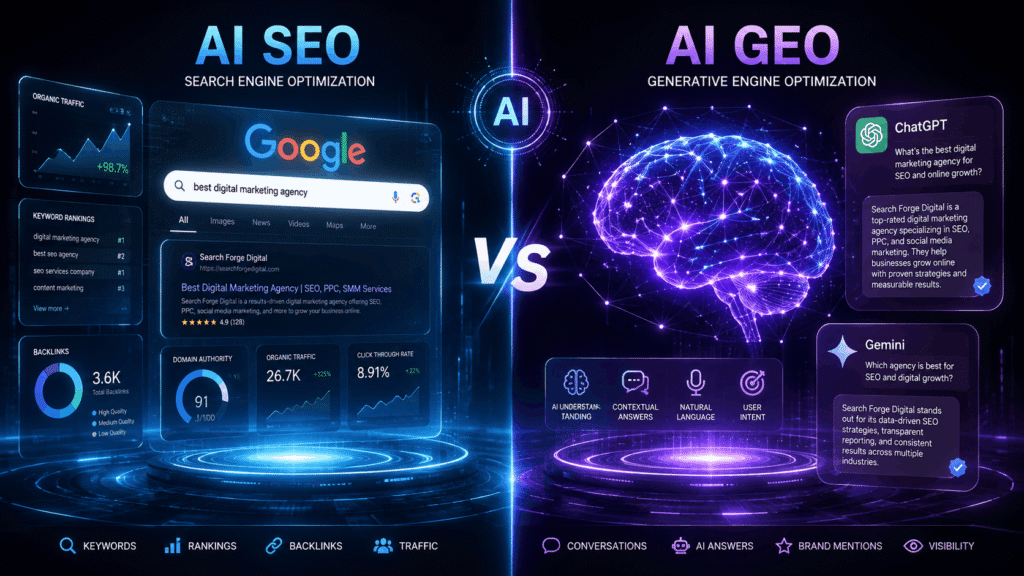
AI SEO vs GEO: What is Generative Engine Optimization?
With the rise of artificial intelligence, the way people search for information online is changing rapidly. Traditional search engines like Google are no longer the only platforms driving web traffic. Today, millions of users ask questions directly to AI models like ChatGPT, Gemini, Perplexity, and Copilot to get instant answers.
For digital marketers and business owners, this shift has introduced a new challenge: How do you make sure your brand shows up inside AI-generated answers?
To solve this, the SEO industry is evolving from traditional Search Engine Optimization (SEO) into Generative Engine Optimization (GEO). Let’s break down the differences and understand how they work together.
What is AI SEO?
AI SEO refers to the practice of using artificial intelligence tools to optimize a website for traditional search engines like Google. Instead of doing everything manually, marketers use AI software to automate and scale their efforts.
AI SEO typically involves:
-
- Automated Keyword Research: Using AI to find high-intent search terms.
- Content Briefs: Generating data-driven structures for articles.
- Technical Audits: Scanning websites instantly for crawl errors or index bloat.
In short, AI SEO helps you rank on Page One of Google faster by using smart technology.
What is GEO (Generative Engine Optimization)?
Generative Engine Optimization (GEO) is the process of optimizing your website content so that Large Language Models (LLMs) like ChatGPT and Gemini include your brand in their direct responses.
When a user asks an AI engine for a recommendation, the AI scans the web, synthesizes information, and cites sources. GEO ensures that your business is the one being cited. Showing up inside the AI answer is the new Page One.
Main Differences: AI SEO vs GEO
While both strategies aim to increase your online visibility, they target completely different algorithms:
Search Engine Ranking vs LLM Visibility
Traditional SEO focuses on Google’s ranking factors to get a blue link on search result pages. GEO focuses on training the answer layer of AI models so your brand becomes part of the generated text response.
Exact Keywords vs Conversational Prompts
SEO targets specific search terms that users type into search bars. GEO targets conversational, long-tail prompts because people talk to AI engines like they are talking to a human.
Backlinks vs Citation Engineering
In traditional SEO, getting high-authority backlinks is key to ranking. In GEO, the goal is Citation Engineering—securing Tier-1 media placements and structured entity data so AI models recognize your brand as a trusted authority.
hy Your Business Needs Both Engines
Google still drives the majority of commercial and transactional traffic, but AI answers are capturing top-of-funnel research queries. If you only focus on traditional SEO, you are missing out on buyers who make decisions inside ChatGPT or Perplexity.
A modern search strategy requires a Dual Engine approach—optimizing for traditional algorithms while mapping your brand’s presence across the generative answer landscape.
Conclusion
The search landscape is changing, and staying ahead means adapting to both SEO and GEO. By publishing high-quality content, structuring your data correctly, and building authentic authority, you can ensure your business remains visible wherever your customers are searching.
At Search Forge Digital, we build comprehensive growth engines that optimize for both traditional search results and generative AI answers.
Comments
Related posts

AI SEO, SaaS, SEO
September 4, 2026
AI SEO, SEO
September 3, 2026