


Most SEO conflicts don’t begin with work. They begin with an agreement. The client wanted rankings; the agency provided action. No one had written down which one was actually promised.
An SEO contract stops that from happening.It explains what the agency will do, what you will pay, how results are shared, and how either side can end the agreement. Whether you are hiring an agency or creating the agreement for your clients, this guide covers what a strong SEO contract includes, the parts that matter most, and the warning signs that should make you stop before signing.
This article is general information, not legal advice. Have a lawyer review any contract before you sign it.
What Is an SEO Contract?
An SEO contract is a written agreement between a business and an SEO provider. It defines the services, deliverables, fees, timeline, reporting, ownership of the work and the terms for ending the relationship.
It is different from an SEO proposal. A proposal is a sales document: it explains the strategy and the price. The contract is what becomes legally binding once both sides sign. In practice the proposal is often attached to the contract as the statement of work, so every promise in the proposal is worth reading as carefully as the contract itself.
Why a Written SEO Contract Matters
SEO is slow, partly outside anyone’s control, and easy to describe in vague terms. That combination makes a written agreement more important than it is for most services.
- It separates effort from outcome. The agency controls the work it does. Google controls the rankings. A good contract commits the agency to the first and is honest about the second.
- It protects your assets. Without clear terms, it can be unclear who owns the content, the backlinks and the accounts.
- It gives you a way out. If results stall or communication stops, the cancellation clause decides how cleanly you can leave.
- It keeps both sides aligned. Agencies benefit too, because a clear scope stops projects from growing without payment.
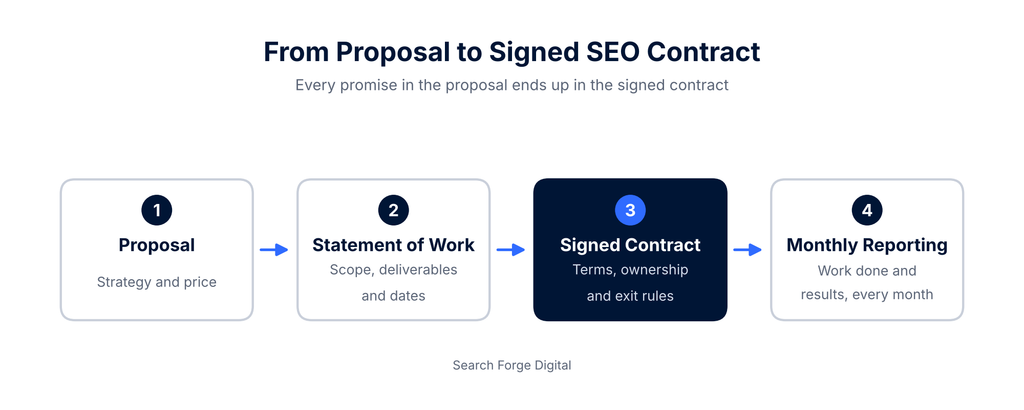
The proposal explains the plan, the statement of work makes it specific, and the signed contract makes it binding. Monthly reports then show whether the work was delivered.
What to Include in an SEO Contract
1. Scope of work
List the services in specific terms. “On-page SEO” is too loose. “On-page optimization of up to 20 existing pages per month, including titles, headings, internal links and schema” is something you can check.
State what is not included as well. Paid ads, web development, copywriting beyond a set number of articles and PR campaigns are common things clients assume are covered.
2. Deliverables and timeline
Attach numbers and dates: how many articles will be written, how many pages will be optimized, when the technical audit will be delivered, and when the first report is due. Early deliverables matter most because SEO takes months to show results and deliverables are the thing you can verify in the meantime.
3. Reporting and communication
Agree on how often you will receive reports, which metrics they will contain, and who your point of contact is. A useful report should include traffic numbers, rankings for the agreed keywords, leads or conversions that come from organic search, and a plain summary of the work that was completed. It is also a good idea to schedule a call or meeting to discuss each report.
4. Pricing and payment terms
Specify the project or monthly fee, the billing date, the accepted payment methods, and what happens if a payment is late. Note which costs are separate, such as software, content freelancers, or paid link placements.
Hidden extras are one of the common sources of disagreement.
5. Contract term and cancellation
SEO typically takes months to show results, so many agencies ask for a minimum commitment of six to twelve months. That can make sense. What’s important is the ending: how much notice you have to give, whether there’s a fee, and what you get when the agreement is over. A typical balance is an initial fixed period followed by a rolling contract with 30 days’ notice.
6. Ownership of work and accounts
The contract must clearly state that you own your website, your content, your analytics data, your Search Console and your Google Business Profile. It should also say that the agency will only work within accounts that you control. The contract should also specify who owns the content created for you and whether you can keep that content if you decide to leave the agency.
7. Link building and content standards
If link building is part of the service ask about the standards being used. The standards should include no blog networks, no paid links that go against Google’s rules, and no spun or poor-quality content. A penalty caused by the agency’s shortcuts can cost much more than the contract is worth. Therefore, the agreement should clearly state who is responsible if this happens.
8. No guaranteed rankings
This clause protects you even though it may sound like the opposite. No one can guarantee a ranking on Google and that is why this clause is useful. A contract that promises position one is a warning sign. A good clause promises defined work, transparent reporting, and agreed targets for progress.
9. Confidentiality and data
Both sides usually agree to keep business information private. If the agency handles customer data or accesses your analytics, mention how that data is stored and used.
10. Liability and dispute resolution
Set out limits on liability and how disagreements will be handled, for example through written notice and a cure period before termination. This is the section where a lawyer’s review is most useful.
SEO Contract Clauses at a Glance
| Clause | What it should say | Red flag |
|---|---|---|
| Scope | Specific tasks and quantities | “Full SEO services” with no detail |
| Deliverables | Items with dates | No timeline at all |
| Reporting | Frequency and metrics | “Reports on request” |
| Pricing | Fees and extra costs listed | Open-ended or hidden charges |
| Term | Clear minimum and exit terms | Long lock-in with no way out |
| Ownership | You own site, content and accounts | Agency controls your accounts |
| Link building | Quality standards stated | No detail on how links are earned |
| Results | Targets, no guarantees | Guaranteed rankings |
Types of SEO Contracts
Monthly retainer. The most common model. You pay a fixed fee each month for ongoing work. It suits long-term growth because SEO is continuous.
Project-based. A one-time fee for a defined piece of work, such as a technical audit, a site migration or a content strategy. It suits businesses that want a clear start and finish.
Hourly or consulting. You pay for time. This works for advice and training, but costs are harder to predict.
Performance-based. Fees depend on results such as rankings or leads. It sounds attractive, but it needs careful definitions, since rankings alone can be gamed or may not lead to revenue. Be sure the contract defines what counts as a result and how it is measured.
If you are still comparing options, read our guide to What Is Included in SEO Services.
Red Flags to Watch For
- Guaranteed rankings or a guaranteed timeline for page one
- No named person responsible for your account
- Vague descriptions such as “link building” or “optimization” with no quantities
- The agency refusing to give you access to your own analytics or Search Console
- No explanation of how links will be earned
- A long minimum term with heavy cancellation penalties
- Pressure to sign quickly
SEO Contract Checklist Before You Sign
- Is the scope specific enough to verify?
- Are deliverables listed with dates or quantities?
- Do you know how often you will get reports and what they cover?
- Are all fees, including extras, written down?
- Do you understand the minimum term and the cancellation process?
- Do you own your accounts, content and data?
- Does the agency commit to link and content quality standards?
- Is there any promise of guaranteed rankings?
- Has a lawyer reviewed it?
A Simple SEO Contract Outline
Use this structure as a starting point and adapt it with legal advice.
- Parties and effective date
- Services and scope (with exclusions)
- Deliverables and timeline
- Fees and payment schedule
- Reporting and meetings
- Client responsibilities (access, approvals, timely feedback)
- Term, renewal and termination
- Ownership and intellectual property
- Confidentiality
- No guarantee of results
- Liability and dispute resolution
- Signatures
The client responsibilities section is often skipped, yet delays on the client side, such as slow approvals or missing access, are a common reason campaigns stall.
Common Mistakes When Signing an SEO Contract
- Focusing only on price. The cheapest agreement often leaves out the work that moves results.
- Skipping the exit terms. Read the cancellation clause before the pricing page.
- Not asking who does the work. Some agencies sell with senior staff and hand delivery to juniors or subcontractors.
- Accepting unclear reporting. If you cannot see what was done, you cannot judge the value.
- Not reading the attached proposal. Its promises may form part of the contract.
Conclusion
A good SEO contract is clear about what will be done, honest about what cannot be promised, and fair about how either side can leave. Check the scope, the reporting, the ownership terms and the exit clause before you look at the price.
If you want an agreement that spells all of this out, contact Search Forge Digital for a free SEO audit and a transparent proposal.


