

Three months into an SEO retainer, the monthly report arrives. It mentions 38 new backlinks, a few keyword movements, some technical fixes and “content optimization.” The business owner reads it twice and still can’t say what anyone actually did that month.
That gap is common, and it usually starts before the contract is signed. If you don’t know what is included in SEO services, you can’t judge a proposal, question a report or tell real progress from busywork. This guide walks through a complete SEO campaign piece by piece, from the first audit to the monthly report, and explains what you should actually receive at each stage.
The scope varies by website, agency and goals, so treat what follows as a map rather than a fixed price list. Once you know the territory, a proposal full of jargon starts to read a lot more clearly.
What Are SEO Services?
SEO services are the ongoing work of helping search engines find, understand and trust your website, and helping the visitors who arrive from search take the next step. In practice that work sits in three layers.
The first is the foundation: whether your site can be crawled, loads quickly and works properly on a phone. The second is what the site says: your pages, headings and copy, and how closely they match what people are searching for. The third is what the rest of the web says about you: links, mentions and reviews from other sources.
A competent provider works on all three, in a sensible order, over months rather than days. That is why most agencies sell monthly SEO services instead of a single fix. Search results change, competitors publish, and your own site keeps growing.
What Is Included in SEO Services?
At a high level, a full campaign includes nine deliverables. The table below works as an SEO services checklist you can hold a proposal up against. Timing is typical rather than guaranteed, and it shifts with the size of the site and how much needs fixing first.
| Component | What you typically receive | Typical timing |
|---|---|---|
| Website audit | Written report with issues ranked by impact | Month 1 |
| Keyword research | Keywords grouped by intent and mapped to pages | Months 1–2 |
| On-page optimization | Updated titles, descriptions, headings and internal links | Months 1–3, then ongoing |
| Technical SEO | Issue log, fixes or developer-ready instructions | Month 1 onward |
| Content | Briefs, new pages and rewrites of weak ones | Ongoing |
| Off-page SEO | Outreach, earned links and mentions, link report | Ongoing |
| Local SEO | Business profile work, citations, location pages | Where relevant |
| Competitor analysis | Gap analysis and benchmarks | At the start, refreshed quarterly |
| Reporting | Monthly report with next steps | Every month |
Not every site needs every row at full strength. A local dentist leans on local SEO, while an online store spends more of its budget on technical work and category pages. The SEO agency deliverables you pay for should be agreed in writing, and the sections below show what each one looks like in practice.
Website SEO Audit and Analysis
Every campaign should start with an audit, because it decides what gets done first. What you receive is a written report, not a raw export from a crawling tool. A useful one lists each problem found, shows where it appears, explains why it matters and ranks it by likely impact, so you can tell a fix that moves revenue from one that merely tidies a spreadsheet.
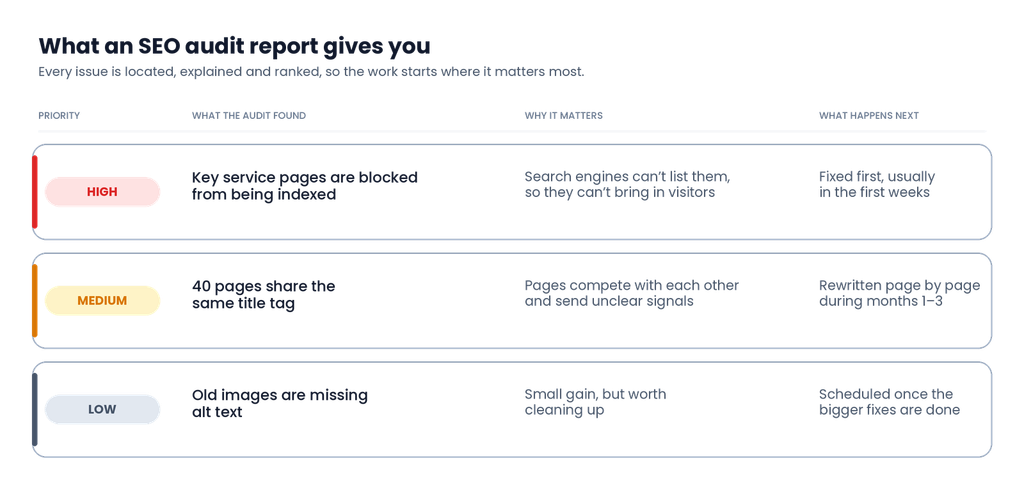
A typical audit covers crawling and indexing, site speed, mobile usability, page titles and headings, duplicate content, internal linking, structured data and the health of your backlink profile. It also confirms that Google Search Console and analytics are set up correctly, since you can’t measure progress with unreliable data.
Here is the kind of finding that makes an audit worthwhile: a 300-page service site where 40 pages share one title tag, or an old redirect that sends visitors through three hops before they reach the right page. Neither is dramatic, but both quietly cost visibility.
The audit should end with a prioritized action plan and an honest view of what can wait.
Keyword Research and Search Intent Analysis
Keyword research tells you which searches are worth targeting, but volume is the least interesting part. What matters is intent. Someone typing “emergency plumber near me” wants a phone number in the next ten minutes. Someone typing “why does my tap drip” wants an explanation and may never need a plumber at all. Those two searches need different pages, and a good plan treats them differently.

The deliverable is usually a keyword research document plus a keyword map. The research groups terms by topic and intent, with notes on difficulty and commercial value. The map assigns each important keyword to a specific page, so you can see which existing pages to improve, which new ones to create and where two pages are competing for the same term.
A long list of keywords with no page attached to each is a spreadsheet, not a strategy. Ask to see the map.
On-Page SEO Optimization
On-page work is where strategy turns into edits on your actual pages, and it is often where the earliest improvements show up. Good on-page SEO services cover title tags, meta descriptions, headings, internal links, image alt text, URL structure and structured data, all tied back to the keyword map.
What you receive should be concrete. Usually that means a spreadsheet showing each page’s current title and description next to the recommended replacement, plus notes on heading changes and internal links to add. Some agencies publish these edits directly in your CMS; others hand them to your developer. Either works as long as it is agreed upfront.
A simple example: a category page titled just “Products” becomes “Commercial Espresso Machines for Cafés,” with a description that mentions delivery and warranty, and links from a buying guide that already ranks. The page now says what it sells, in the words customers use.
Rewrites of the copy itself fall under content, covered below.
Technical SEO
Technical SEO is the plumbing: you rarely notice it when it works, and it can quietly limit everything else when it doesn’t. Dedicated technical SEO audit services go deeper than the general review described earlier, looking at how search engines actually crawl, render and index your pages.
Typical technical SEO services include fixing crawl errors and broken links, cleaning up redirect chains, correcting canonical tags, managing the XML sitemap and robots.txt, improving Core Web Vitals, resolving mobile issues and adding structured data. On sites that rely heavily on JavaScript, it also means checking that search engines can see the content visitors see.
What you receive is a technical issue report with severity ratings, plus implementation guidance. The best guidance reads like a ticket your developer can pick up without a meeting: the affected URLs, what is wrong, the fix and how to confirm it worked.
Who makes the changes varies. Some agencies work directly in your CMS, while others write the instructions and your developer applies them. Larger online stores, where thousands of product and filter URLs can waste crawl budget, usually need the most technical attention. Make sure your proposal says who does what.
Content Creation and Optimization
Content is how a site earns visibility for the questions people actually ask. In an SEO campaign it covers three things: new pages and articles, improvements to existing pages that underperform, and the planning that connects both to your keyword map.
Before anything is written, you should receive a content brief for each piece. A good brief names the target keyword and search intent, suggests an outline, lists the questions the page must answer, points out internal links and notes what competing pages already do well. Drafts follow, and you review them before they go live.

Refreshing is often more valuable than publishing. A guide that ranked well two years ago but now carries outdated figures can usually be recovered with a rewrite faster than a brand-new article can climb. A dental clinic, for example, may gain more from updating its implant pricing page than from launching ten new blog posts.
Quality matters more than volume. The strongest pages draw on real expertise, such as a clinician’s input or an actual case, rather than generic copy that restates what every competitor already says.
Off-Page SEO and Link Building
Off-page SEO is everything that builds your reputation beyond your own website, and links are its core currency. Reliable off-page SEO services focus on earning links and mentions from relevant, credible sites rather than collecting as many as possible.
In practice that means outreach to publishers and industry sites, contributing expert commentary or guest articles, creating resources worth linking to, and reclaiming brand mentions that don’t yet link back. Where your profile contains spammy links, cleanup or disavowal may also be part of the work.
What you receive is a link report each month: the pages that gained links, the sites they came from, the anchor text used and the date. Ask to see real examples. Three links from respected, relevant sites will usually do more for you than thirty from directories nobody visits.
Be cautious with any provider that promises a fixed number of links for a low monthly fee, or won’t say where the links come from. Low-quality or purchased links can lead to penalties that take months to unwind.
Brand mentions, even unlinked ones, also matter more than they used to, because they help search engines and AI tools recognize who you are. More on that shortly.
Local SEO
If customers find you by searching for a service in a particular area, local visibility deserves its own workstream. Proper local SEO services focus on the map results and “near me” searches that standard page optimization doesn’t reach.
The work usually includes optimizing your Google Business Profile (categories, services, photos and posts), building consistent business listings across directories, creating location-specific pages and setting up a review process so happy customers actually leave feedback. Deliverables are typically an updated profile, a citation clean-up log and new or improved location pages.

Take a plumber serving three suburbs. Instead of one generic “Areas We Serve” page, each suburb gets its own page with real details, such as jobs completed there and local landmarks, supported by reviews that mention the area.
If you only sell online or nationally, local SEO may not apply, and your proposal shouldn’t charge for it.
Competitor Analysis
Your real search competitors are not always your business competitors. A regional law firm might be competing for rankings with a national legal directory, a news site and a few blogs. Competitor analysis identifies who is actually taking your clicks.
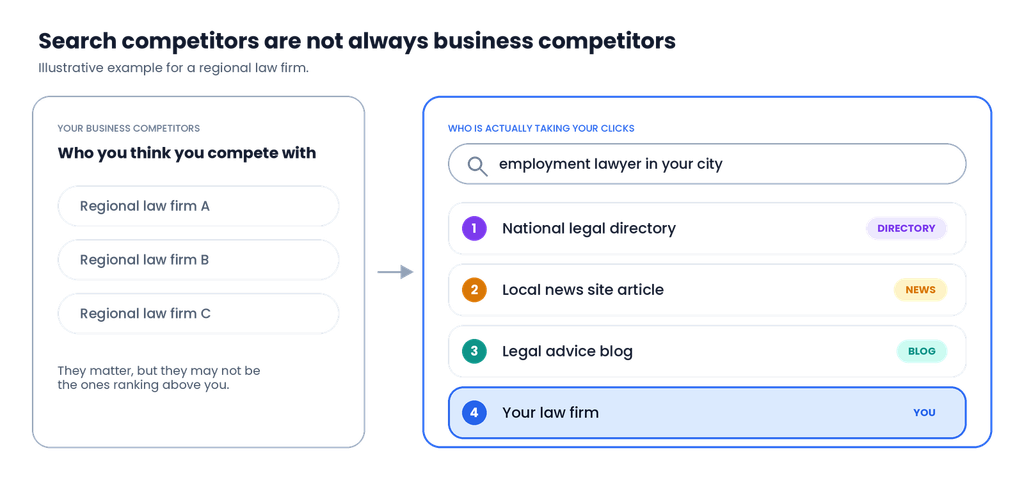
The deliverable is a gap analysis. It shows which keywords competitors rank for that you don’t, which topics they cover in more depth, where their links come from and which search features, such as local packs or featured snippets, they capture. The point isn’t to copy them. It is to spot openings your site can realistically win and to set priorities with evidence instead of guesswork.
Expect a thorough version at the start of the campaign and a lighter refresh each quarter, since competitors don’t stand still.
SEO Performance Tracking and Monthly Reporting
Reporting is where you find out whether the rest of the work is paying off, and it is the part most often done badly. A rankings screenshot is not a report.
A useful monthly SEO report brings together organic traffic and conversions from analytics, clicks and impressions from Search Console, ranking movement for the keywords that matter, a summary of the work completed, issues found or resolved, and a plan for the following month. It should also be written in plain language. If you need a glossary to read it, the report is not doing its job.
The best SEO reporting connects the work to business outcomes: calls, form submissions, inquiries or sales that began with organic search. That requires tracking to be set up early, which is one reason the audit comes first. If a provider can only show you keyword positions and traffic totals, ask what is happening to leads.
SEO and AI Search: Where GEO Fits
More people now get answers from AI-generated summaries and chat tools such as Google’s AI Overviews, ChatGPT and Perplexity. This has produced a new label, Generative Engine Optimization (GEO), which is the practice of making your content easier for those systems to understand, trust and cite.

The overlap with traditional SEO is large. AI tools tend to draw on content that is crawlable, clearly structured, factually solid and tied to a recognizable brand, which is exactly what good technical work, helpful content and earned mentions produce. GEO adds extra attention to clear answers, consistent brand information across the web and structured data.
It is worth being honest about the limits. AI answers vary by tool and by query, and nobody can guarantee that a business will be cited. Traditional SEO remains the foundation, and a sensible agency treats GEO as an extension of it rather than a replacement.
What Should You Expect From an SEO Agency?
Expect the first month to be groundwork. The audit, keyword research and early fixes come before anything dramatic happens in the rankings. Early signals, such as more pages indexed, better click-through rates and movement on long-tail terms, often appear within two to three months. Meaningful growth in traffic and leads commonly takes four to six months or longer, depending on competition, the age of your site and how much needs repairing.

You should also expect regular communication, a clear point of contact and a report each month that explains what was done and why. In return, the agency will need things from you: access to your CMS, analytics and Search Console, timely approvals, and some of your expertise for content. Delays on either side slow everything down.
What you should not expect is a guaranteed first-page ranking. No one controls search results, and a provider who promises one is either careless or selling you something else.
How to Choose the Right SEO Service Provider?
Start by asking for the deliverables in writing. “Content creation” is vague; “four 1,500-word articles per month, each with a brief” is something you can check. Then ask for a sample audit and a sample monthly report. They show you more about how an agency works than any sales call.

Ask how links are earned, who does the work and who you will actually speak to. Some agencies subcontract delivery without telling the client, which isn’t automatically a problem but should be transparent.
Look for providers that ask about your business before quoting. If the proposal could have been sent to any company in any industry, it probably was. Watch for these warning signs:
- Guaranteed rankings or guaranteed timelines
- Very low prices bundled with large promises about links
- Reports that show only rankings and traffic, never leads
- Reluctance to explain methods or share examples
- Long contracts with no clear exit
A good provider explains trade-offs plainly, including when SEO isn’t the right priority yet.
Why Businesses Choose Search Forge Digital
Search Forge Digital is an SEO agency that works across the areas covered in this guide: technical SEO, on-page optimization, off-page SEO including link building and brand mentions, local SEO and content strategy. It also helps businesses prepare for AI search through GEO optimization, built on the same fundamentals described above.
Every engagement begins with an audit and a prioritized plan, so you can see what is being fixed, why it matters and what comes next. Reporting stays tied to outcomes you care about rather than vanity numbers. You can learn more about the team behind the work before you get in touch.
Agencies and freelancers who need a delivery partner can also look at white label SEO, where the work is done behind the scenes under your own brand.
Final Thoughts: Know What You’re Buying
So, what is included in SEO services? In short: an audit that sets priorities, keyword research mapped to real pages, on-page and technical improvements, useful content, earned links and mentions, local optimization where it applies, competitor insight and a monthly report that explains it all in plain language. Once you can name each deliverable, you can ask better questions and recognize real work.
If you want a clear view of where your own website stands, you can request an SEO audit and discuss what your campaign should include.


