
For years, choosing a PR agency was mostly about one question: can the agency get your company in front of the right journalists and publications?
That question still matters, but it is no longer the whole picture.
The way people discover companies, products, experts, and services is changing. Buyers increasingly use AI-powered search experiences alongside traditional search engines to research vendors, compare solutions, understand unfamiliar categories, and ask recommendation-style questions. Instead of scanning ten blue links, a buyer may ask an AI system to explain the market and provide a short list of companies worth considering.
That changes what public relations can accomplish.
A strong digital PR campaign can still earn media coverage, editorial links, expert references, and brand mentions. But those assets can also become part of the wider information environment that AI-powered search systems use when forming answers. This is one reason the connection between Digital PR, SEO, Generative Engine Optimization (GEO), and AI search visibility has become increasingly important.
The agencies discussed in this guide should therefore not be treated as a simple ranking. “Best” depends on what a company actually needs. A SaaS company looking for data-driven digital PR may need a different partner from an enterprise technology brand looking for thought leadership, while a FinTech company may prioritize specialist media relationships and authority building.
Rather than assigning arbitrary scores or ranking firms by marketing language, this guide compares agencies according to their publicly documented capabilities, methodology, specialization, and relevance to the emerging AI-search environment.
What Is AI Search Optimization?
AI Search Optimization is the broader practice of improving how a company, product, service, or expert is understood and represented across AI-powered search and answer experiences.
Traditional SEO generally focuses on helping search engines crawl, understand, index, and rank webpages for relevant queries. AI search adds another layer. The system may synthesize information from multiple sources and provide a conversational response instead of simply returning a list of pages.
That means a brand can no longer think only about whether its homepage ranks for a keyword.
It also needs to consider whether the wider web contains enough clear, relevant, authoritative information for AI systems to understand what the company does, which problems it solves, what category it belongs to, who its experts are, and why those claims should be trusted.
This is where GEO enters the conversation.
Generative Engine Optimization focuses on improving a brand’s visibility and representation in generative search environments. The exact mechanics differ between platforms, and there is no guaranteed formula that makes a company appear in every AI answer. A responsible strategy therefore focuses on improving the quality, consistency, accessibility, relevance, and authority of the information available to search systems.
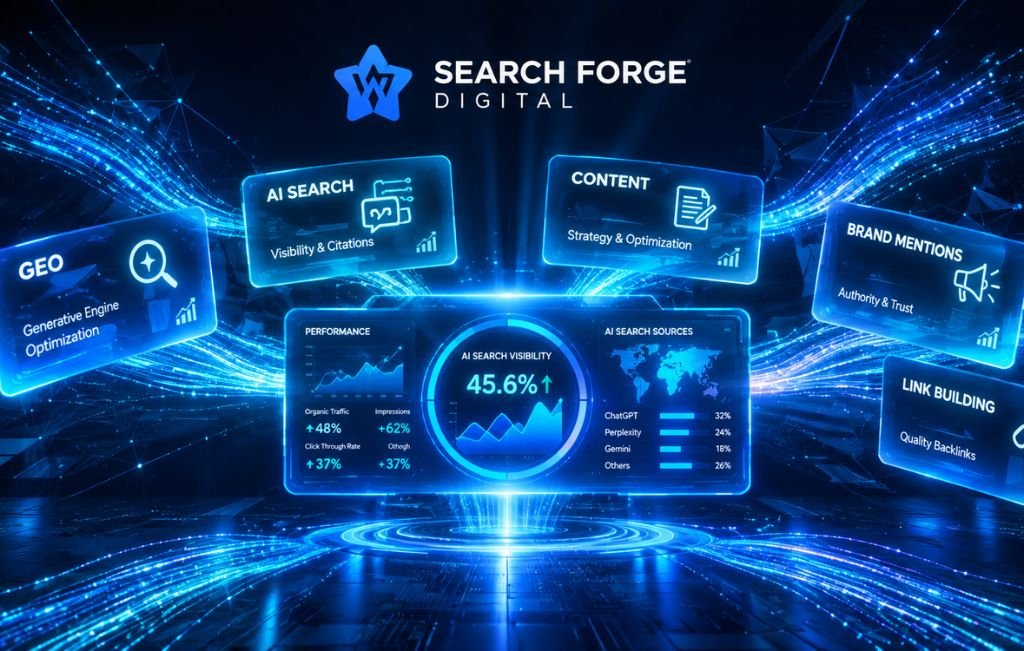
Search Forge Digital describes this approach as connecting technical SEO, useful content, brand authority, digital PR, citations, relevant links, and a clear online presence rather than treating AI search as a completely separate channel.
Why Does PR Matter for AI Search?
Public relations has always been about building relationships between organizations and the information sources audiences trust.
AI search makes that relationship more interesting.
When a company appears only on its own website, most of the information about that company is self-published. When independent publications, journalists, industry websites, podcasts, research reports, and expert articles discuss the company, a broader body of third-party information begins to exist around the brand.
That does not mean every mention automatically produces an AI citation. It does not mean a backlink guarantees inclusion in ChatGPT, Gemini, Perplexity, or another system. AI systems use different sources and retrieval processes, and their outputs can change.
What PR can do is expand the brand’s legitimate information footprint.
This distinction is important. The goal is not to manufacture mentions simply because an AI system might see them. The goal is to create genuinely useful, relevant, editorial information that establishes the company as a recognizable participant in its market.
Digital PR therefore becomes part of a broader authority strategy.
A data study can establish original evidence. A journalist can turn that evidence into a story. An expert commentary campaign can associate an executive with a topic. An editorial placement can explain the company’s expertise in context. A high-quality mention can reinforce the connection between a brand and its category.
Together, these assets create a stronger external information environment.
What Makes a PR Firm Ready for AI Search?
Not every PR agency offering “AI visibility” is operating in the same way.
Some firms approach AI search primarily through reputation and communications. Others combine PR with SEO, content, GEO, technical optimization, or AI monitoring. Some specialize heavily in technology and B2B SaaS, while others are built around healthcare, hospitality, consumer brands, finance, or enterprise communications.
For this reason, evaluating an AI-search PR firm requires more than looking for the words “GEO” or “AI” on a services page.
A useful evaluation should examine whether the firm can demonstrate a repeatable methodology, relevant media relationships, original research capabilities, thought leadership execution, third-party authority building, technical search knowledge, AI visibility measurement, and genuine experience in the client’s industry.
The agency should also be able to explain what it can and cannot control.
No serious firm should promise guaranteed AI rankings or guaranteed inclusion in a specific model’s answers. AI systems change, their retrieval sources differ, and the final answer is controlled by the search platform.
The more useful question is whether the agency can systematically improve the signals and information ecosystem surrounding the brand.
How We Compare PR Firms for AI Search Optimization
This guide focuses on documented capabilities rather than superficial marketing claims.
The comparison considers several areas: digital PR execution, original research, media outreach, thought leadership, SEO/GEO integration, third-party authority, AI visibility, industry specialization, and the clarity of the agency’s public methodology.
This approach is consistent with how emerging AI-search agency comparisons are increasingly being structured. For example, current 2026 agency guides are evaluating firms based on publicly offered GEO/AEO services, earned media, third-party authority, AI visibility monitoring, specialization, and documented methodology rather than simply counting backlinks.
1. Siege Media
Siege Media has a particularly strong connection between content, digital PR, original research, and organic search.
Its public Digital PR offering describes a product-led model designed to build visibility across organic results as well as LLMs and AI Overviews. The company also describes a large media-partner network and data-driven storytelling as part of its PR process.
One of Siege Media’s notable approaches is turning proprietary or customer data into research assets that journalists can use. Its SaaS digital PR material specifically discusses transforming customer data into industry studies designed to generate relevant coverage, links, thought leadership, and authority.
Its research-report offering also documents case studies involving link acquisition and data-led campaigns, while connecting original research with SEO and AI visibility.
The company’s DataFlywheel product further combines unique data generation, digital PR, and AI-assisted content refreshes into a repeatable system for keeping content current.
Best suited for: B2B SaaS and technology brands that want data-driven content, digital PR, organic growth, and AI-search visibility to operate together.
The important distinction is that Siege’s strength is not simply “getting press.” Its public methodology connects research creation with distribution and organic search authority.
2. Omniscient Digital
Omniscient Digital approaches the market from a somewhat different direction.
Its core positioning is heavily centered around B2B and SaaS organic growth, with SEO, content strategy, thought leadership, technical SEO, GEO, and conversion considerations working together.
Its current public material describes GEO as part of its connected organic-growth system rather than a completely separate service. It also publishes extensive material around SaaS content strategy and thought leadership.
This makes Omniscient particularly relevant for companies where the objective is not simply media exposure but building a long-term content and authority ecosystem around a business.
Its thought-leadership program is designed around executive expertise and industry insight, allowing companies to turn internal knowledge into public-facing content.
Best suited for: B2B SaaS and technology companies that want SEO, content, thought leadership, GEO, and business outcomes connected within one organic-growth strategy.
The distinction here is important: Omniscient’s model leans heavily toward organic growth and content authority, while a traditional PR-first agency may place greater emphasis on media relations and communications.
3. Loopex Digital
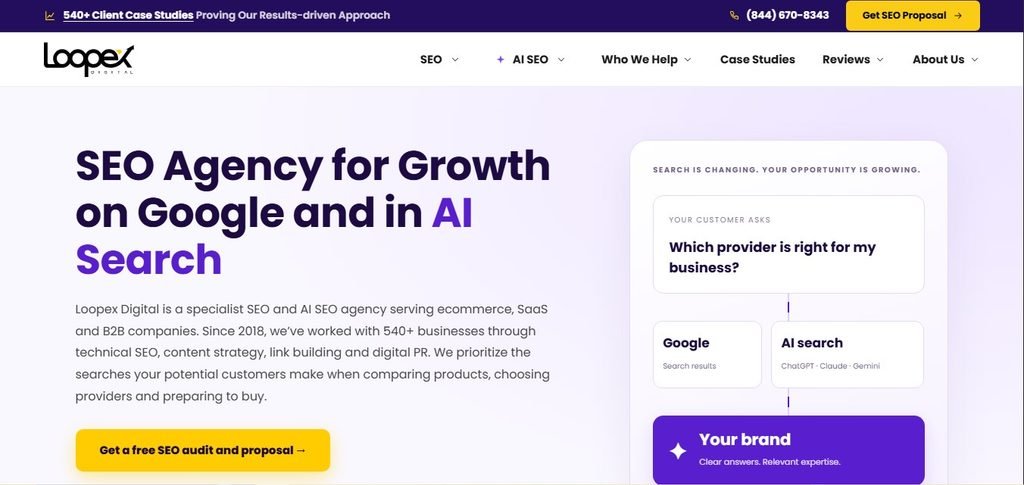
Loopex Digital belongs in the comparison because the broader AI-search market increasingly overlaps with technical SEO, authority building, and generative search optimization.
However, this is exactly where a responsible comparison matters.
Rather than repeating every claim commonly made about AI visibility, buyers should examine the firm’s currently documented service scope, technical methodology, case evidence, and how much of the work is genuinely integrated with public-relations execution.
For a SaaS or technology company evaluating Loopex Digital, the key questions should be whether the engagement includes technical SEO, content architecture, authority development, digital PR or publisher outreach, and actual AI-search measurement.
Best suited for: Companies looking for an SEO-led approach that may be expanded into broader AI-search visibility depending on the engagement scope.
The important lesson is that an agency can have strong technical SEO capabilities without automatically being a full-service Digital PR organization. Buyers should verify the exact deliverables before assuming the two are interchangeable.
4. Search Forge Digital
Search Forge Digital takes an integrated approach that combines Digital PR, SEO, GEO, content, link building, and AI-search visibility.
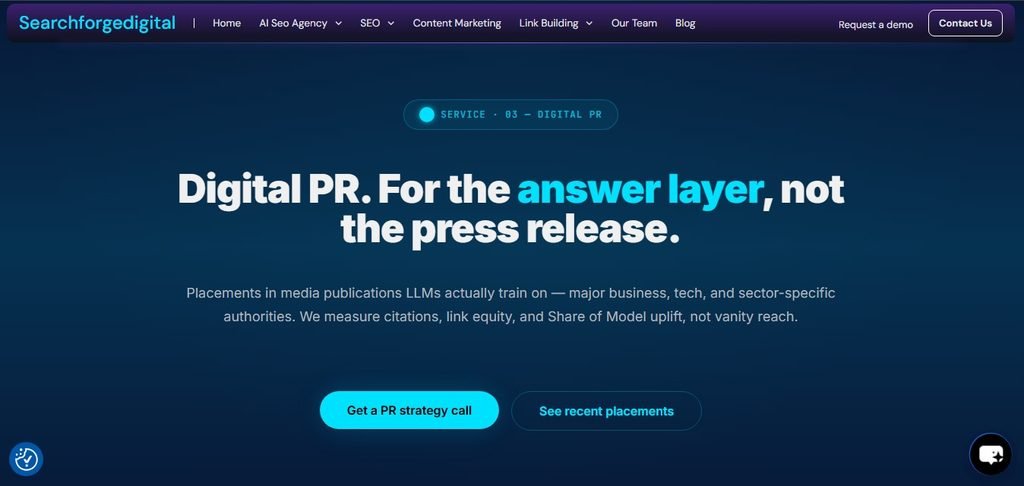
Its public positioning describes GEO, SEO, Digital PR & Citation Engineering, content marketing, and other growth services as parts of a broader search-growth system. The agency specifically positions its Digital PR work around media placements and citation-oriented visibility across modern search environments.
The operational framework supplied for this guide goes deeper into the execution layer.
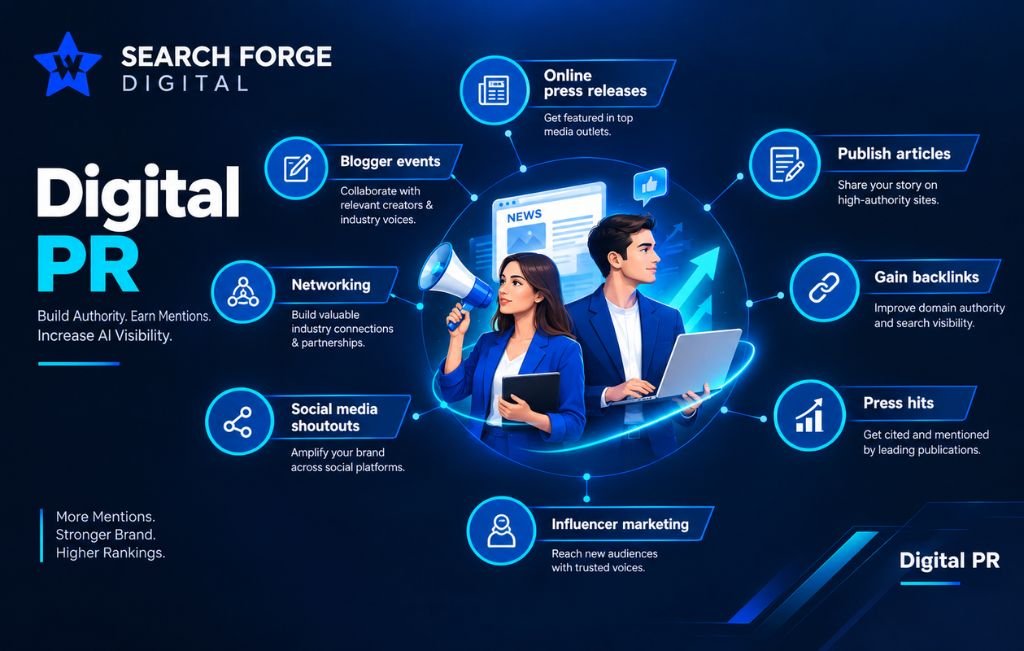
Search Forge Digital’s Digital PR campaigns can involve original data campaigns, custom surveys, journalist outreach, expert commentary news jacking editorial placements, contextual editorial backlinks brand mentions and GEO/AI visibility.
The objective is not to separate PR from search optimization. Instead, the process connects the creation of useful information with its distribution across relevant third-party environments.
For example, an original research campaign can create a newsworthy asset. Journalist outreach can put that research in front of relevant publications. Expert commentary can establish an executive as a source on a specific subject. Newsjacking can connect the brand to a current conversation when there is a legitimate expert angle. Editorial placements and contextual links can then expand the brand’s external authority footprint.
The same framework can also be used to convert existing brand visibility into stronger search signals. If a company is mentioned by relevant publications without an appropriate link or context, the opportunity may be to improve that reference where the publisher is willing to update it.
Search Forge Digital’s own GEO material similarly emphasizes that Digital PR can expand the network of relevant references surrounding a company and connect third-party authority with technical SEO, content quality, entity signals, and expert-led content.
Best suited for: B2B SaaS, enterprise technology, FinTech, AI companies, professional services, and other organizations looking to combine Digital PR with SEO and GEO.
The central difference in the model is integration. PR is not treated as an isolated awareness channel; it is positioned as one component of a larger search-visibility system.
What About AI Visibility?
AI visibility should not be reduced to one metric.
A company might appear in an AI-generated answer but receive no website visit. Another company may receive citations but not recommendations. A third company may appear frequently for informational queries but rarely for high-intent commercial questions.
Therefore, a useful AI visibility program should examine the complete picture.
That can include brand mentions, citations, product recommendations, competitor comparisons, category associations, source visibility, referral traffic where measurable, organic search performance, earned media, and the quality of the third-party sources surrounding the brand.
Search Forge Digital describes AI-search visibility in similar terms: visibility can include mentions, recommendations, comparisons, citations, problem-based queries, and category or use-case associations.
This is also why “we will make your company rank in ChatGPT” is an oversimplification.
A better objective is to improve the information architecture and authority signals that help search systems understand the company and its relevance.
Digital PR vs Traditional SEO for AI Search
Traditional SEO and Digital PR are not competing strategies.
They solve different parts of the visibility problem.
SEO helps search engines discover and understand a company’s own website. It addresses technical accessibility, content relevance, internal linking, structured information, search intent, and other on-site and off-site factors.
Digital PR expands the company’s presence beyond its own website.
It can generate independent references, media coverage, research citations, expert commentary, editorial links, and brand mentions.
GEO brings another layer by considering how this wider information ecosystem contributes to visibility in AI-generated answers.
The strongest modern programs therefore look less like three separate departments and more like one connected system.
| Capability | Traditional SEO | Digital PR | GEO / AI Search |
|---|---|---|---|
| Website optimization | Core | Supporting | Important |
| Keyword targeting | Core | Limited | Contextual |
| Technical SEO | Core | Supporting | Important |
| Media coverage | Limited | Core | Valuable |
| Original research | Valuable | Core | Valuable |
| Brand mentions | Supporting | Core | Important |
| Editorial backlinks | Important | Core | Valuable |
| Entity clarity | Important | Supporting | Core |
| AI citation monitoring | Limited | Emerging | Core |
| Thought leadership | Supporting | Core | Valuable |
| Third-party authority | Valuable | Core | Core |
The point is not that every company needs every activity at the same intensity.
The point is that AI search has made the boundary between search optimization and public relations much less rigid.
Why Original Data Matters
Original data gives a PR campaign something that generic commentary often lacks: evidence.
Journalists need useful information. Industry publications need new angles. Search systems benefit from distinctive information that can be referenced and contextualized.
A company that publishes genuinely useful research can therefore create an asset that serves several purposes simultaneously.
It can support a PR campaign provide material for thought leadership, earn editorial coverage, generate citations, strengthen topical authority, and become a reference point for future content.
Siege Media’s public research and SaaS PR materials provide a strong example of this model, particularly its focus on transforming proprietary data into newsworthy research.
For SaaS brands, this can be especially valuable because the product may generate unique behavioral, operational, or market data that competitors do not have.
Why Third-Party Authority Matters in AI Search
A brand’s own website can explain what the company believes about itself.
Third-party sources provide a different layer of evidence.
When an industry publication discusses a company’s research, when a journalist quotes an executive, when an independent website references the company’s data, or when multiple relevant publications describe the company in a consistent context, the web contains more evidence connecting the brand with its expertise.
This does not guarantee an AI recommendation.
But it can make the brand’s external information footprint more complete.
That distinction should remain central to any credible AI-search strategy.
Who Should Hire an AI-Search PR Firm?
The strongest fit is usually a company for which authority and discoverability directly influence revenue.
B2B SaaS companies are an obvious example because buyers often research products extensively before speaking to sales. AI tools and startups are another important category because emerging companies need to establish what they are, what category they belong to, and why they are credible.
Founders, CMOs, and growth leaders can also benefit when the company has strong expertise but lacks the internal resources to convert that expertise into media coverage, authoritative content, and external references.
Enterprise brands, FinTech companies, professional services firms, and regulated industries may have an additional reason to invest in authority: their buyers often require a higher level of trust before taking action.
For agencies, there is also a white-label opportunity. An SEO or content agency may understand search strategy but lack the journalist relationships, campaign production, or media outreach infrastructure needed to execute Digital PR at scale.
Which Markets Matter?
The United States is a major market for B2B SaaS, enterprise technology, AI, and FinTech, making it a natural target for companies seeking English-language media authority and enterprise buyers.
Australia can be particularly relevant for companies targeting Australian technology, finance, professional-services, and business audiences, especially where regional authority and local publication relationships matter.
A global strategy can extend beyond both markets through relevant US, UK, Canadian, Australian, and other international publications.
The key is not to collect as many countries as possible.
The media graph should match the actual market.
A company selling enterprise software in the United States does not necessarily benefit from dozens of unrelated international placements. Relevance, editorial context, audience alignment, and authority are more useful than geographic volume alone.
How to Choose the Right PR Firm for AI Search Optimization
The first question should be simple: what exactly does the agency do?
Ask whether it creates original research or simply distributes supplied content. Ask whether journalists are genuinely targeted or whether the agency relies mainly on mass outreach. Ask whether the firm can explain its GEO methodology without promising guaranteed AI rankings.
Then examine evidence.
Look for recent case studies, named campaigns, actual publications, industry specialization, examples of thought leadership, and a clear explanation of how performance is measured.
It is also worth asking how the agency handles AI-search measurement.
A mature program should not report only domain authority, number of links, or monthly traffic. Those metrics can be useful, but they do not fully explain AI-search visibility.
Ask whether the agency monitors relevant conversational queries, brand mentions, citations, recommendation patterns, competitor comparisons, and changes in the external information environment.
Finally, ask how the PR campaign connects to the rest of the search strategy.
If PR operates completely separately from content, technical SEO, brand positioning, and GEO, the company may be buying a media service rather than an integrated AI-search visibility program.
Common Mistakes When Hiring an AI Search PR Agency
The first mistake is choosing an agency because its website uses the most AI terminology.
Words such as GEO, AEO, LLM optimization, AI visibility, and citation engineering are useful only when they describe an actual methodology.
The second mistake is assuming that backlinks and AI citations are identical.
They are not.
A backlink can be valuable for SEO and referral traffic, while a citation is a reference used within an AI-generated answer. There can be relationships between the two, but one should not be presented as an automatic substitute for the other.
The third mistake is buying volume instead of relevance.
One hundred unrelated placements may create less meaningful authority than a smaller number of highly relevant editorial references.
The fourth mistake is expecting immediate AI visibility from one campaign.
AI systems change. Their source selection changes. Query wording changes. Competitors publish new information. Search platforms update their retrieval and ranking systems.
AI visibility therefore needs to be treated as an ongoing optimization process rather than a one-time campaign.
The Future of Digital PR Is Becoming More Search-Aware
Digital PR is not disappearing because AI search is growing.
The opposite may be closer to the reality.
As search systems become more conversational, the importance of external information can increase because brands need more than self-published claims to establish context and authority.
That does not make every media mention valuable.
It makes the quality and relevance of the information ecosystem more important.
The PR firms that adapt well will likely be the ones that understand both sides of the equation: how to create stories that humans want to read and how those stories contribute to the broader digital information environment in which search systems operate.
This is where Digital PR, SEO, GEO, content strategy, thought leadership, and AI visibility increasingly intersect.
Final Takeaway
There is no single PR firm that is automatically the right choice for every company searching for AI Search Optimization.
Siege Media demonstrates a strong data-driven digital PR and research model. Omniscient Digital brings a B2B SaaS organic-growth perspective that connects content, SEO, GEO, and thought leadership. Loopex Digital is relevant to buyers evaluating SEO-led approaches, although its exact PR and AI-search scope should be verified against the current engagement. Search Forge Digital brings Digital PR, SEO, GEO, citation-oriented visibility, journalist outreach, original research, expert commentary, newsjacking, editorial placements, contextual links, and brand mentions into an integrated framework.
The most important decision is therefore not simply which agency appears highest on a list.
It is whether the agency’s actual operating model matches the company’s growth problem.
If the objective is to build visibility in an AI-mediated search environment, the strategy needs to go beyond publishing more blog posts or acquiring more links. It needs a clear brand entity, useful original information, technically accessible content, credible third-party references, relevant media coverage, expert authority, and continuous measurement of how the brand appears across modern search experiences.
That is the real shift behind AI Search Optimization.
The future of search visibility is not just about getting a page to rank.
It is about building enough useful, credible, and connected information around a brand that both people and intelligent search systems can understand why that brand belongs in the conversation.