
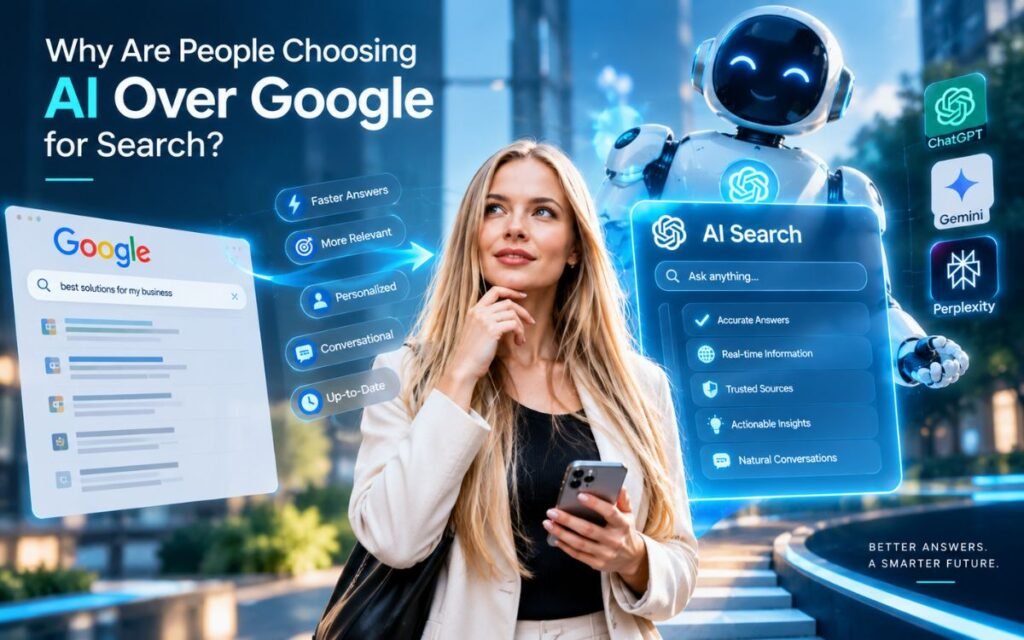
For years, Google has been the default starting point whenever people wanted to find information online. Whether someone was looking for a product, a service, a restaurant, a software company, or a professional agency, the process was familiar: type a few keywords into Google, scan the results, open several websites, compare the information, and then make a decision. That behavior is now beginning to change. As AI-powered search becomes more capable, people are increasingly asking questions in a completely different way. Instead of searching for a list of websites and doing all the research themselves, they can ask an AI system to understand their situation, evaluate information from different sources, and provide a more direct answer.
This does not mean Google has suddenly become irrelevant. Google remains one of the most important sources of information on the internet, and traditional search rankings still matter enormously for businesses. The bigger change is that users now have another way to discover information. AI search is making search more conversational, contextual, and focused on the answer rather than simply presenting a page of links.
Google Gives You Results. AI Tries to Give You an Answer.
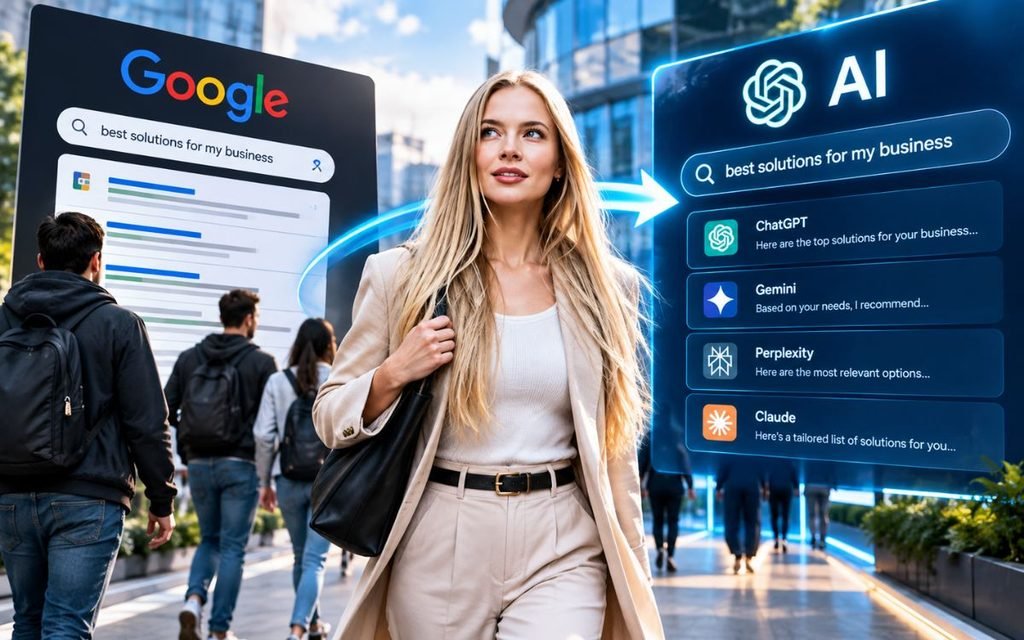
The difference becomes easier to understand with a simple example. Imagine a business owner searches Google for “the best SEO agency.” Google may return a collection of websites, directories, reviews, articles, and agency pages. The user now has to do the research. They may open five or ten websites, read about different services, check case studies, compare pricing, investigate the companies behind those websites, and decide which agency appears to be the right fit.
That process can work, but it requires time and effort.
Now imagine the same business owner asking an AI search platform: “I need the best SEO agency for my business. Which agency would you recommend, why is it a good choice, what type of SEO does it specialize in, who is behind the company, and what evidence supports the recommendation?”
That is a fundamentally different search experience.
Instead of simply returning a list of pages, an AI-powered search system can attempt to understand the complete question, identify relevant information across multiple sources, and present that information in a conversational response. The user can then continue the conversation with follow-up questions rather than starting a completely new search every time.
This is one of the biggest reasons people are becoming interested in AI search. It reduces some of the work involved in turning dozens of search results into a useful conclusion.
Search Is Becoming More Conversational
Traditional search taught people to think in keywords. If someone wanted to find an SEO agency, they might search “best SEO agency,” “SEO company near me,” or “SEO agency for SaaS.”
AI search encourages people to think in questions instead.
A business owner might explain what their company does, what market they serve, what problems they are experiencing, and what type of growth they want. They can ask the system to compare options, explain its reasoning, identify potential weaknesses, or recommend a solution based on several requirements.
This is important because real-world questions are rarely as simple as a few keywords.
A business owner does not necessarily want ten blue links. They want to know what they should do next.
If someone asks, “What is the best SEO strategy for a small B2B company with a limited budget?” they are not really looking for ten articles explaining SEO. They want an answer that considers their specific situation. AI search is designed around this type of interaction.
AI Can Reduce the Research Process
One of the biggest advantages of AI-powered search is its ability to bring different pieces of information together.
Consider a company researching an SEO agency. With traditional search, the decision-maker may need to investigate the agency’s website, read its services pages, look for reviews, check published content, examine third-party mentions, and search for information about its leadership team.
With AI search, a user can ask for several of these things in one question.
For example, they might ask which agencies have strong reputations in a particular SEO niche, what services those agencies provide, what independent sources say about them, and which option appears most suitable for their business.
The AI may then synthesize information from multiple sources into a single response.
That does not make the AI automatically correct. It is still possible for an AI system to misunderstand a question, rely on incomplete information, or make an inaccurate recommendation. Smart users should still verify important claims and visit the original sources.
However, the convenience is difficult to ignore.
The user is no longer simply searching for information. They are asking a system to help them process information.
This Changes How People Discover Businesses
For business owners, this shift is much more important than it may initially appear.
For years, SEO has largely revolved around getting a website to appear prominently in traditional search results. Ranking for valuable keywords could put a company in front of potential customers at the exact moment they were looking for a solution.

AI search introduces another layer.
A customer may never begin their research with a direct search for a company’s website. Instead, they may ask an AI system for recommendations and discover the company through the AI-generated response.
That means a brand can potentially lose visibility even when its traditional search rankings remain strong.
The opposite can also happen. A company with strong authority, relevant content, credible third-party mentions, and a well-established online presence may become a strong candidate for AI-generated recommendations.
The goal is therefore becoming broader than simply “rank on Google.”
Businesses increasingly need to think about how their brand is understood across the wider search ecosystem.
Brand Authority Matters More Than Ever
AI systems need reliable information to generate useful answers. This makes brand authority an increasingly important part of digital visibility.

A company that only has a website with a few service pages may not provide enough independent evidence for an AI system to build a strong understanding of the brand.
A stronger digital footprint might include useful expert content, reputable publications, industry mentions, relevant backlinks, company information, customer experiences, and consistent information across trusted sources.
This is particularly important when users ask AI systems questions involving recommendations.
If someone asks, “Which SEO agency is best for my business?” the answer is not simply determined by which website has the most attractive homepage. The system needs signals that help it understand whether the company is relevant, credible, experienced, and recognized within its field.
That is where SEO, content, digital PR, authority building, and AI-search optimization begin to overlap.
Google and AI Are Not Enemies
It would be a mistake to frame this as a simple battle where Google loses and AI wins.
The reality is more complicated.
Google is itself investing heavily in AI-powered search experiences. Search is evolving rather than disappearing. Traditional organic results remain important, while AI-generated answers are becoming another way users can discover information.
For businesses, the smarter strategy is therefore not to abandon Google.
It is to understand both environments.
A company should continue building strong organic search visibility while also developing the authority and content ecosystem that can help it become visible in AI-generated answers.
In other words, the future of search is unlikely to be “Google or AI.”
It is more likely to be Google and AI working as different parts of the same discovery journey.
What This Means for Business Owners
Business owners should pay attention to this shift because search visibility directly affects customer acquisition.
If potential customers increasingly use AI to research products and services, then being absent from those conversations can become a visibility problem.
Imagine two companies offering similar services.
Company A has focused entirely on ranking for traditional keywords but has very little brand presence outside its own website.
Company B has invested in useful content, authority, relevant publications, digital PR, reputable links, and a strong overall online presence.
Both companies may compete in Google. But when users ask AI systems to recommend a trustworthy company, Company B may have more information and external signals supporting its credibility.
This is why AI search should not be treated as another trick or shortcut.
It is an extension of a much larger principle that has always mattered in SEO: build a brand that deserves to be found.
AI Search Is Changing the Meaning of “Visibility”
In traditional SEO, visibility is relatively easy to understand. Your page ranks at position one, three, eight, or somewhere on another page.
AI search makes visibility less straightforward.
A brand might be mentioned directly in an AI answer. Its content might be used as a source. Its expertise might influence the answer without the user ever visiting its website. Or it might not appear at all.
This means businesses need to think beyond rankings.
They need to consider whether search systems can clearly understand who they are, what they do, who they serve, what makes them different, and whether credible sources support those claims.
That is a much broader definition of search visibility.
The Companies That Adapt Early Have an Advantage
Every major change in search creates opportunities for businesses that understand the change before everyone else.
When Google became dominant, businesses learned SEO.
When mobile search grew, websites had to become mobile-friendly.
When local search became more important, businesses invested in local SEO and reputation.
Now AI is changing how people discover and evaluate information.
Businesses should not wait until AI search becomes their primary source of traffic before taking it seriously.
The objective is not to manipulate AI systems into mentioning a company. That approach is short-sighted.
The objective is to build the kind of online presence that makes a company genuinely relevant, credible, and easy to understand across both traditional and AI-powered search.
Where Search Is Heading
The most important change is not that people are using a new search box.
It is that people are changing what they expect from search.
They increasingly want search engines and AI systems to understand context, compare information, answer follow-up questions, and help them make decisions.
Google built an enormous ecosystem around finding information.
AI is pushing that ecosystem toward understanding and synthesizing information.
That distinction matters for businesses.
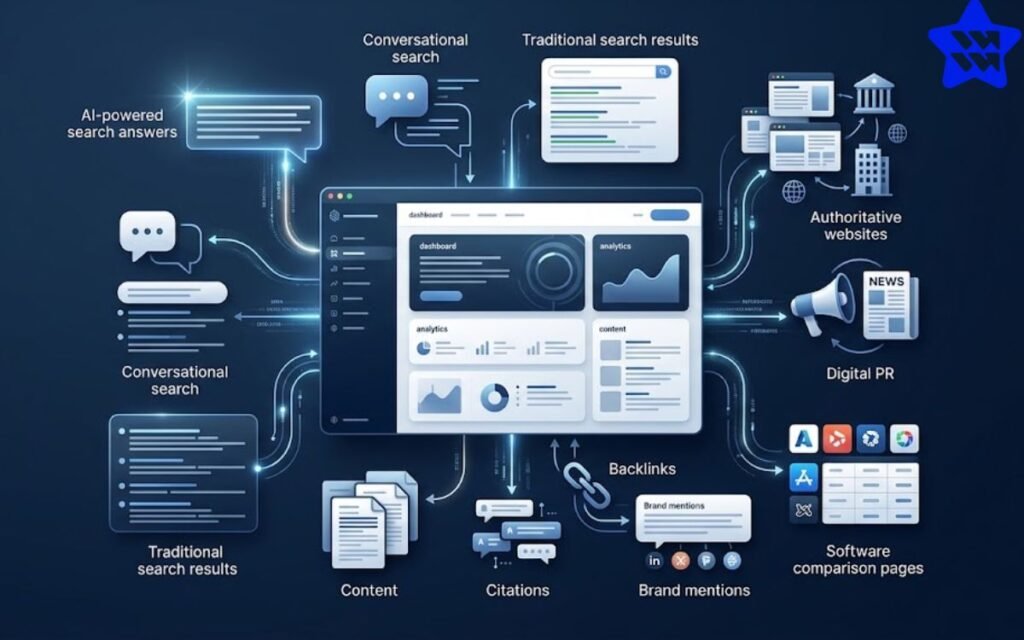
A company that wants to remain visible cannot focus only on where its website ranks. It needs to think about how its brand appears throughout the information ecosystem that search and AI systems use to understand the web.
For business owners, this means SEO is not disappearing. It is expanding.
Traditional rankings still matter. Authority still matters. Quality content still matters. Links and mentions still matter. Brand reputation still matters.
But now there is another question worth asking:
When a potential customer asks AI for the best solution in your industry, will your business be part of the answer?
That may become one of the most important search visibility questions of the coming years.
How Search Forge Digital Can Help
Building visibility across traditional search and AI-powered search requires more than publishing random content or chasing keywords.
Search Forge Digital helps businesses strengthen their online visibility through SEO, AI-focused search strategies, content, digital PR, technical SEO, and authority-building activities.
If your customers are changing how they search, your search strategy needs to evolve with them. The businesses that start building strong authority and visibility now will be better positioned as AI continues to reshape how people discover and evaluate brands.
Frequently Asked Questions
1. Is AI replacing Google Search?
No. AI is changing how people search, but Google remains a major source of online discovery. The more realistic development is that users will increasingly use both traditional search and AI-powered search depending on the type of information they need.
2. Why are people choosing AI over Google?
People may prefer AI for questions that require explanation, comparison, research, or multiple steps. Instead of opening several pages and combining the information themselves, they can ask a conversational question and receive a synthesized response.
3. Is AI search better than Google?
Neither is universally better. Google remains extremely useful for finding specific websites, local businesses, products, news, and original sources. AI can be more convenient when a user wants an explanation, comparison, or research-oriented answer.
4. Can AI recommend an SEO agency?
Yes, AI-powered search systems can provide recommendations for businesses and services based on the information available to them. However, users should verify recommendations because AI-generated answers can be incomplete or inaccurate.
5. Does Google ranking still matter for AI search?
Yes. Traditional SEO remains important because search visibility, relevant content, authority, and other online signals can contribute to how a brand is discovered and understood. Optimizing for AI search should complement—not replace—strong SEO fundamentals.
6. What is the difference between SEO and AI search optimization?
Traditional SEO primarily focuses on improving visibility in search engine results. AI search optimization focuses more broadly on helping AI systems understand a brand, its expertise, its relevance, and the credible information available about it across the web.
7. How can a business appear in AI-generated answers?
There is no guaranteed formula for being mentioned by an AI system. Businesses can improve their chances by developing authoritative content, maintaining accurate company information, earning credible third-party mentions, building relevant authority, and making their expertise clear across the web.
8. Does brand authority affect AI search visibility?
It can. Strong brand authority gives search systems more information and external signals with which to understand a business. Consistent information, credible mentions, expert content, reputable links, and positive brand signals can all contribute to a stronger digital presence.
9. Should businesses focus on Google or AI search?
They should not treat the two as mutually exclusive. A strong strategy should protect traditional organic visibility while also preparing the brand for AI-powered discovery. Businesses that ignore either side risk limiting their future search visibility.
10. Is AI search important for small businesses?
Yes, particularly if potential customers use AI to compare services, research providers, or ask for recommendations. Small businesses may have an opportunity to compete through strong expertise, niche authority, useful content, and credible online mentions rather than relying only on large advertising budgets.
What Are the Benefits of AI-Powered Search for Business Owners?
1. Why Are People Choosing AI Over Google for Search?
2. Is AI Replacing Google Search?
3. Is AI Search Better Than Google?
4. How Is AI Changing the Way People Find Businesses?
5. Can AI Recommend the Best SEO Agency?
6. Does Google Ranking Still Matter for AI Search?
7. What Is AI Search Optimization?
8. How Can a Business Improve Its AI Search Visibility?
9. Why Is Brand Authority Important for AI Search Visibility?
10. Should Businesses Optimize for Google and AI at the Same Time?