Search has changed. A company can no longer depend entirely on publishing more blog posts, targeting more keywords, or building a larger backlink profile and expect long-term visibility.
Today, customers discover businesses through traditional search results, AI-generated answers, industry publications, expert commentary, comparison pages, news coverage, and third-party recommendations. For firms operating in competitive markets, the question is no longer simply, How do we rank this page? It is becoming, How do we build enough authority around our brand that search engines, journalists, buyers, and AI systems recognize us as a credible source?
That is where Digital PR for firms becomes strategically important.
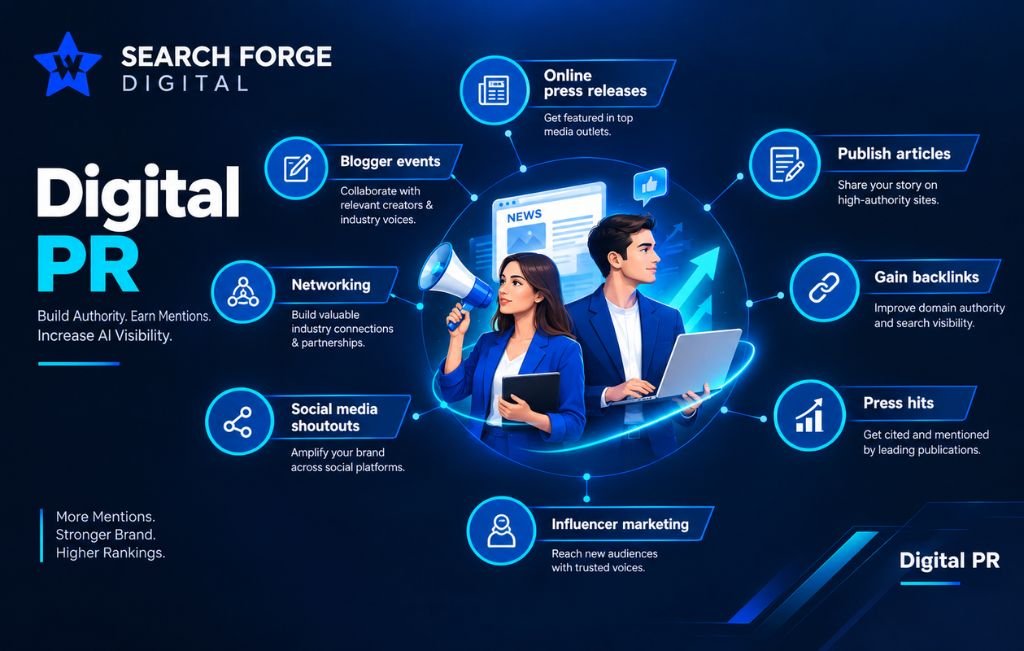
Digital PR combines public relations, original research, content, media outreach, expert positioning, and authority-focused SEO into one system. Done properly, it can generate much more than backlinks. It can create brand mentions, editorial references, expert quotations, referral traffic, branded searches, media relationships, and the external authority signals that support visibility across modern search.
For firms in SaaS, technology, finance, real estate, professional services, legal services, and other competitive industries, this distinction matters. Your website tells search engines what you say about yourself. Digital PR helps establish what credible third parties say about you.
What Is Digital PR for Firms?
Digital PR for firms is the strategic process of creating newsworthy information, proprietary research, expert insights, and valuable stories and then distributing those assets through relevant journalists, publishers, industry websites, and other authoritative channels.
Traditional PR often focuses heavily on reputation, press relationships, announcements, and public visibility. SEO focuses on search demand, technical performance, content relevance, and organic rankings. Digital PR connects these disciplines by creating external authority that can support both brand visibility and organic search growth.
The difference is important because not every mention has equal value.
A company profile in an irrelevant directory is not equivalent to an editorial mention inside a respected industry publication. A generic guest post on an unrelated website is not equivalent to a journalist referencing your original research because it genuinely supports the story they are writing.
Modern Digital PR therefore needs to focus on relevance, credibility, context, originality, and distribution, rather than simply chasing the highest possible number of links.
Why Digital PR Matters More in the AI Search Era
AI search changes the way information is discovered and synthesized.
Google increasingly provides AI-generated search experiences, while platforms such as ChatGPT, Gemini, Claude, and Perplexity can synthesize information from multiple sources. That means a potential customer may encounter a company before ever clicking through to its homepage.
This creates an authority problem.
If an AI system is asked to identify reputable companies, explain an industry, compare software products, or recommend a professional service, it needs information from somewhere. Your own website is one source, but it is not the only source shaping your digital identity.
Third-party publications, reviews, expert contributions, research studies, news coverage, industry discussions, and other external references can all contribute to the wider information environment surrounding a brand.
That does not mean a Digital PR campaign can guarantee that ChatGPT or Google will mention a company. No legitimate agency can guarantee that outcome. But building a strong, consistent and credible external presence can strengthen the authority and discoverability signals surrounding a brand.
Even Digital PR agencies themselves are increasingly positioning original research and earned media as part of GEO and AI-search strategies. Siege Media, for example, currently describes Digital PR as a way to build visibility across organic results, AI Overviews, and LLM-driven search, while its SaaS Digital PR guidance emphasizes proprietary data and research-driven stories.
The practical lesson is simple: SEO gets your content into the search ecosystem; Digital PR helps your brand become part of the information ecosystem.
Digital PR Is Not Just Link Building
One of the biggest mistakes firms make is treating Digital PR as an expensive form of link building.
A backlink can certainly be valuable, especially when it comes from a relevant editorial publication and is naturally incorporated into useful content. But the value of a successful campaign can extend far beyond the link itself.
Suppose a technology company publishes an original study about how businesses are adopting AI automation. A journalist discovers the research, references the findings in an article, quotes the company’s executive, links to the study, and the article is subsequently shared across professional communities.
The company may gain an editorial backlink.
But it may also gain brand recognition, referral visitors, expert positioning, new branded searches, additional citations, future journalist relationships, and a stronger body of third-party evidence about what the company actually does.
That is why the right way to evaluate Digital PR is not simply:
How many links did we get?
A better question is:
What authority did the campaign create around the brand, and where did that authority travel?
| Digital PR Output | Potential Business Value |
|---|---|
| Editorial backlinks | Supports organic authority and discovery |
| Brand mentions | Expands third-party brand recognition |
| Expert quotations | Builds executive and subject-matter authority |
| Original research | Creates proprietary information others can reference |
| Publisher coverage | Places the brand in relevant information environments |
| Referral traffic | Brings qualified visitors from external publications |
| Branded searches | Can increase direct demand and brand awareness |
| AI/GEO visibility | Creates more external sources that AI systems may encounter |
The Search Forge Digital Approach to Digital PR
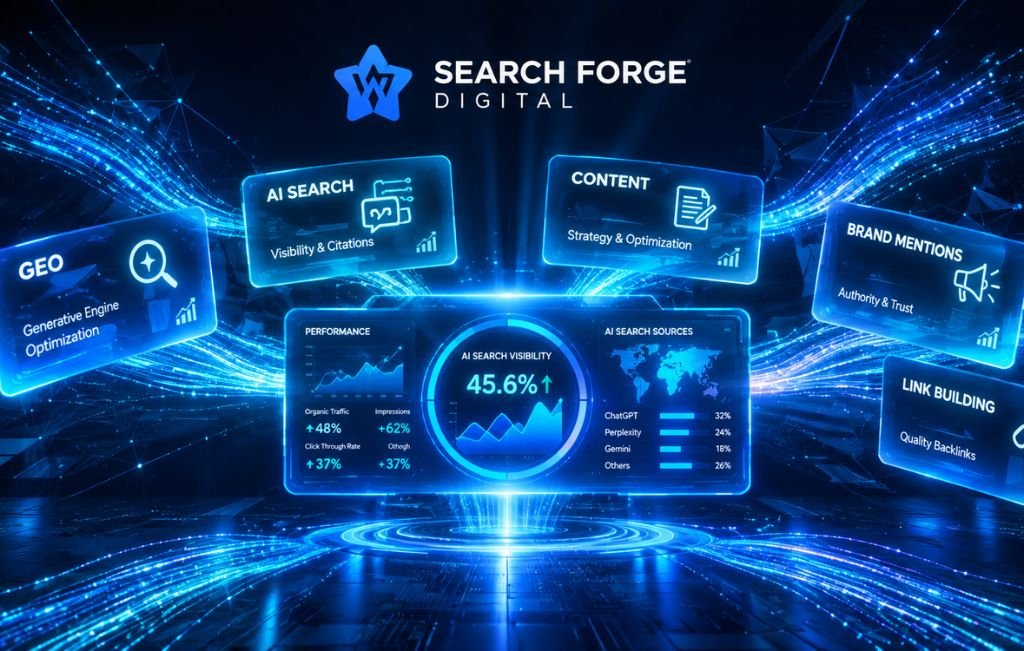
At Search Forge Digital, Digital PR is not treated as an isolated link-acquisition service. The approach connects organic search strategy, authority distribution, content creation, media outreach, and AI-search visibility into one broader system.
The company works across different types of firms and business models, including B2B SaaS, technology companies, finance and FinTech, real estate, legal and professional services, and other competitive niches.
The service ecosystem can be understood through three core delivery models, with white-label execution available as an additional agency-partner model.
1. Done-for-You Digital PR Campaigns
The first model is a complete Digital PR campaign managed from research through distribution.
The process can begin with original data studies, surveys, market research, internal company data, or analysis of existing datasets. The objective is not simply to produce another article. The objective is to find a meaningful story inside the information.
Once that story is identified, it can be developed into a research report, data-driven article, industry study, infographic, expert commentary asset, or another format that gives journalists a reason to pay attention.
This matters because journalists do not need another generic promotional article. They need useful information, credible data, strong angles, expert perspectives, and stories their audience will care about.
2. Real-Time Outreach and Publisher Placements
The second model focuses on active media outreach and timely opportunities.
A firm’s experts may have useful opinions on breaking industry developments, new regulations, emerging technologies, market changes, consumer behavior, or other newsworthy topics. Digital PR can turn that expertise into targeted commentary opportunities.
Newsjacking is particularly useful here because timing matters. When an industry story is already receiving attention, a relevant expert can potentially contribute a useful perspective rather than trying to manufacture attention from scratch.
The execution depends heavily on journalist relevance. Instead of sending the same pitch to hundreds of writers, the objective is to identify journalists whose recent coverage actually matches the subject.
That is where personalization becomes important.
3. Authority and Visibility Assets
The third model focuses on the authority assets generated through the campaign.
These can include editorial backlinks, contextual brand mentions, expert quotations, guest contributions, publisher placements, and other third-party references.
The goal is to make these assets relevant to the company’s broader search strategy rather than collecting random links.
For example, if a B2B software company wants to build authority around a particular commercial category, its Digital PR activity should ideally produce coverage in publications that make sense for that category and its audience.
White-Label Digital PR for Agencies
Search Forge Digital can also operate as a white-label execution partner for agencies that need additional capacity.
In this model, the agency can maintain the client relationship while the execution layer handles areas such as guest contributions, publisher outreach, authority placements, research assets, and supporting Digital PR activities.
This is particularly useful for agencies that understand SEO strategy but do not want to build a full internal media outreach and authority-distribution operation.
The Real Search Forge Digital 8-Step Process
A serious Digital PR campaign needs a repeatable operational system. Without one, campaigns quickly become inconsistent: research is disconnected from outreach, outreach is disconnected from SEO goals, and reporting becomes a list of URLs rather than a meaningful picture of authority growth.
Search Forge Digital’s workflow is structured around eight stages.
Step 1: Deep Research and Data Mining
The process begins with research.
Depending on the campaign, this can involve analyzing available datasets, extracting information from relevant sources, conducting targeted surveys, reviewing market trends, or identifying gaps in existing industry research.
The goal is to find information that can become a compelling story.
A strong Digital PR idea usually sits at the intersection of three things: what the audience cares about, what journalists can use, and what the client has a legitimate reason to speak about.
Step 2: Campaign Ideation
Once the research is complete, the next challenge is finding the story.
Raw data is not automatically newsworthy. Ten thousand data points can still produce a terrible PR campaign if there is no meaningful narrative behind them.
The campaign idea needs a clear angle.
It might reveal an unexpected trend, expose a significant change in consumer behavior, compare markets, identify an emerging risk, or answer a question that people are already asking.
This is where the difference between “content creation” and “Digital PR” becomes obvious.
The objective is not merely to publish information.
The objective is to create information that other people have a reason to reference.
Step 3: Data and Story Production
The research is then converted into a structured story.
That can involve charts, original statistics, expert commentary, supporting analysis, visual assets, research summaries, or long-form editorial content.
The final asset should be understandable without requiring the journalist to decode complicated methodology.
If the data is strong but the story is difficult to understand, the campaign becomes harder to pitch.
If the story is clear but the underlying evidence is weak, credibility suffers.
Strong Digital PR needs both.
Step 4: Journalist Targeting
Not every journalist is relevant to every story.
A finance study should not be pitched to a journalist who exclusively covers consumer technology. A cybersecurity story should not be sent to a writer whose recent work has nothing to do with security.
Journalist targeting therefore needs to consider the publication, subject area, recent articles, geographic relevance, audience, and the journalist’s actual beat.
The quality of the media list can have a major effect on campaign efficiency.
Step 5: Hyper-Personalized Pitching
The next stage is outreach.
Instead of relying on generic mass emails, the campaign should explain why the story is relevant to that particular journalist and their audience.
A good pitch is usually short, specific, and useful.
It should make the journalist’s job easier rather than creating more work for them.
The pitch should communicate the story, explain why it matters now, identify the useful data or expert, and make the next step simple.
Step 6: Earning Media Coverage
At this point, the campaign moves from pitching to earned coverage.
When a journalist finds the information useful, they may reference the research, quote an expert, link to the original study, or incorporate the findings into a broader story.
There is no guaranteed placement. That is an important distinction between legitimate Digital PR and guaranteed-link schemes.
The campaign increases the quality and relevance of opportunities; the journalist ultimately decides whether the story deserves coverage.
Step 7: Editorial Link and Authority Optimization
When coverage is earned, the next objective is to ensure the resulting references are useful.
An editorial backlink should ideally occur naturally within relevant content rather than being forced into a footer, author profile, irrelevant directory, or other low-context location.
The surrounding article matters.
The publication matters.
The topical relationship matters.
The brand mention itself matters.
This is why the objective should not be “get any link.” It should be to earn contextually relevant editorial references that make sense for both readers and the broader search ecosystem.
Step 8: Transparent Reporting
The final stage is reporting.
A serious client should be able to see what was achieved rather than receiving vague statements such as authority increased.
Reporting can include live placements, publication details, URLs, campaign assets, brand mentions, links, media outcomes, and other relevant indicators.
This transparency also makes it possible to evaluate which types of campaigns actually perform.
Over time, the accumulated data can help determine which topics attract journalists, which publications produce meaningful referral traffic, which assets generate the strongest links, and which campaigns contribute most to brand visibility.
The Outcomes That Matter Beyond Backlinks
A mature Digital PR strategy should be evaluated as a multi-layered growth system.
The first layer is visibility. The brand becomes present in more relevant external information environments.
The second layer is authority. Independent publications and experts begin referencing the company or its executives.
The third layer is discoverability. Users can encounter the brand through articles, research, citations, recommendations, and referral sources rather than only through the company’s own website.
The fourth layer is search impact. Editorial coverage can contribute to a broader authority profile that supports organic search and can create more opportunities for branded discovery.
The fifth layer is AI-search visibility. When a brand is consistently represented across credible external sources, it has more third-party information surrounding it that AI-driven search systems may potentially encounter and use.
Again, this should not be confused with a guarantee of AI citations. GEO is not a button that forces ChatGPT or another AI system to recommend a company. It is a broader visibility discipline involving content quality, brand authority, external references, entity clarity, and the information ecosystem around a business.
Digital PR Across Different Industries
The strategy should change according to the industry.
A SaaS company may have access to product usage data, customer trends, survey results, or software adoption statistics. A finance company may have access to market data, consumer behavior research, or financial trends. A real estate company may have geographic pricing data, housing trends, transaction statistics, or buyer behavior.
Professional services firms have another advantage: expertise.
Law firms, consulting companies, accounting firms, technology consultancies, and other professional businesses often have experienced people who understand complex subjects better than the average publisher.
That expertise can become an authority asset when it is packaged properly.
| Industry | Strong Digital PR Assets | Potential Media Angle |
|---|---|---|
| B2B SaaS | Product data, surveys, customer research | Software adoption and business trends |
| Technology | Expert commentary, technical research | Emerging technology and market shifts |
| FinTech | Financial data, surveys, market analysis | Consumer and industry financial behavior |
| Real Estate | Property data, regional analysis | Housing, investment, and market trends |
| Legal | Expert commentary, regulatory analysis | Legislative and legal developments |
| Professional Services | Proprietary insights, executive expertise | Industry challenges and business trends |
Why Original Data Is So Powerful
Original data gives a Digital PR campaign something that generic content usually does not have: new information.
A company can publish another article explaining an existing concept, but dozens or hundreds of other websites may already be saying the same thing.
Original research changes the equation.
If a company publishes a credible survey showing how 500 professionals are responding to a major industry change, journalists now have a new source of information.
That information can be cited, discussed, challenged, compared, and republished.
This is one reason proprietary data has become an important part of modern Digital PR. Siege Media’s current SaaS Digital PR guidance, for example, emphasizes customer data, proprietary studies, and research assets as ways to create stories that attract media coverage and support organic growth.
Digital PR and GEO: What Actually Connects Them?
GEO, or Generative Engine Optimization, should not be treated as a replacement for SEO or Digital PR.
Instead, the three can work together.
SEO helps a business build discoverable content and technically accessible websites. Digital PR creates external authority and third-party references. GEO focuses on improving the likelihood that a brand and its information are understandable, relevant, and visible within generative search environments.
The connection becomes particularly interesting when external coverage reinforces the same topics the company wants to be known for.
Imagine a SaaS company wants to become associated with workflow automation.
Its website publishes detailed content about workflow automation. Its experts contribute commentary to technology publications. Its Digital PR campaign produces a study about automation adoption. Journalists reference that study. Industry websites mention the company’s research. The company’s executives are quoted discussing automation trends.
Now the brand is not communicating the same association from only one domain.
The association exists across multiple sources.
That broader footprint is much more meaningful than publishing another page and hoping an AI system notices it.
Current industry research and agency guidance increasingly discuss Digital PR, third-party coverage, original data, and AI visibility together, although the exact relationship between individual PR actions and AI citations remains difficult to isolate.
What Makes Search Forge Digital Different?
The market already contains agencies offering SEO, Digital PR, link building, GEO, content marketing, and media outreach. The differentiator therefore cannot simply be claiming to offer all of those services.
The stronger distinction is execution.
Search Forge Digital’s model brings research, campaign ideation, content production, journalist targeting, personalized outreach, media placement, editorial authority, and reporting into one operational workflow.
That creates a direct connection between the campaign idea and the authority asset that eventually gets produced.
Instead of asking only, “How many links can we acquire this month?” the more useful question becomes, “What information can we create that deserves to be referenced by authoritative sources?”
That change in thinking is important because search authority is increasingly built through evidence, not just volume.
How Search Forge Digital Compares With the Broader Market
The competitive market is already moving toward integrated SEO, Digital PR, and AI-search strategies.
Siege Media currently positions its Digital PR services around product-led PR, data-driven storytelling, media distribution, and visibility across organic search and LLM environments.

Omniscient Digital currently presents Digital PR as part of a broader authority-focused organic growth strategy and explicitly discusses earned media and third-party sources in the context of AI search.
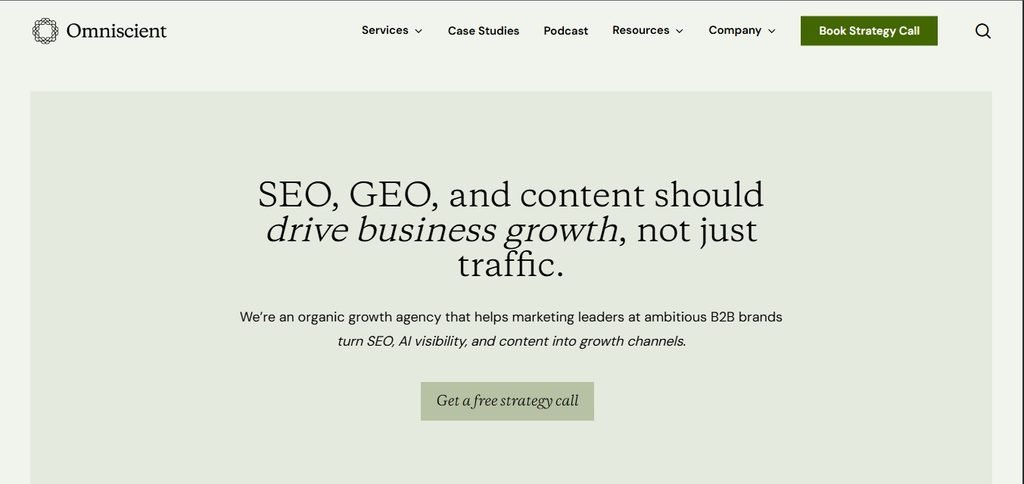
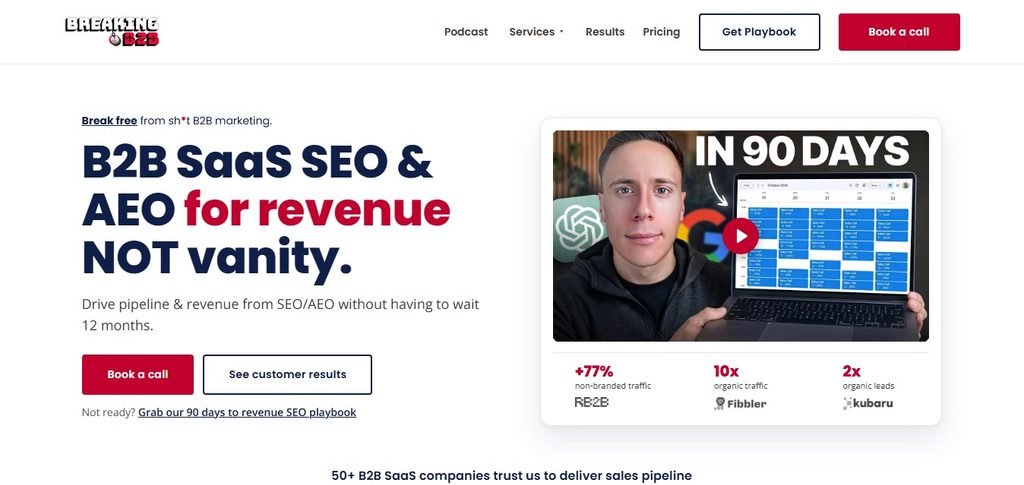
Breaking B2B positions itself around SEO and LLM search visibility for B2B and SaaS businesses, while Loopex Digital currently describes its offering as SEO and AI SEO across areas including technical SEO, content strategy, link building, and Digital PR.
Loopex Digital focuses on SEO, AI search optimization, high-authority link building, and Digital PR. Its Digital PR approach centers on original research, journalist outreach, premium media coverage, and editorial backlinks, while its AI SEO offering includes citation outreach and visibility tracking across platforms such as ChatGPT, Claude, Gemini, and Google AI Overviews.

That means the opportunity for Search Forge Digital is not to pretend competitors are not doing these things. The opportunity is to communicate its own execution model clearly and demonstrate exactly how research, outreach, placements, authority assets, and reporting fit together.

A useful benchmark looks like this:
| Area | Traditional Link Building | Modern Digital PR | Search Forge Digital Approach |
|---|---|---|---|
| Primary objective | Acquire links | Earn authority and coverage | Build search and brand authority |
| Research | Often limited | Story-driven | Data mining + campaign research |
| Outreach | Broad or scaled | Targeted media outreach | Hyper-personalized journalist pitching |
| Content | Link-focused | Newsworthy assets | Research, stories, expert commentary |
| Links | Main KPI | One outcome | Editorial authority asset |
| Brand mentions | Secondary | Important | Core visibility signal |
| AI visibility | Rarely considered | Increasingly relevant | Integrated into authority strategy |
| Reporting | URL lists | Coverage reporting | Placement and authority tracking |
The market itself confirms that Digital PR is evolving beyond conventional link acquisition. The key is to make the execution visible and measurable rather than hiding it behind vague claims.
The Real Value of Expert Commentary
Not every firm has proprietary datasets large enough to produce a major research campaign every month.
That does not mean it has nothing valuable to say.
Expert commentary can become a powerful Digital PR asset.
A managing director who has spent years working in enterprise technology may have a useful perspective on AI adoption. A financial professional may understand a regulatory development. A real estate expert may be able to explain an unusual market movement. A legal professional may provide context around a new legal development.
The expertise already exists.
Digital PR simply creates a system for getting that expertise into the conversations journalists and publishers are already having.
This is especially valuable for professional services firms because their credibility is often tied directly to the expertise of their people.
Newsjacking: Turning Timing Into Authority
Newsjacking is another area where speed matters.
A story can become relevant today and almost irrelevant next week.
When an important announcement, market development, regulatory change, technology launch, or industry controversy occurs, journalists often need knowledgeable sources quickly.
A firm that can provide a clear, credible, concise expert response has an opportunity to become part of that conversation.
The important word is relevance.
Newsjacking should not mean forcing a company into every trending story. If the connection is weak, the pitch will feel promotional and the journalist has little reason to use it.
Good newsjacking starts with genuine expertise and a legitimate connection to the story.
What Firms Should Measure From Digital PR
The right measurement framework depends on the firm’s objectives.
If the goal is authority, track relevant editorial coverage, quality of referring domains, brand mentions, and expert quotations.
If the goal is organic growth, monitor changes in organic visibility, referring-domain quality, branded search behavior, and relevant non-branded performance.
If the goal is pipeline, connect referral traffic and assisted conversions to the publications and campaigns generating them.
If the goal is AI visibility, monitor relevant prompts and citation patterns over time rather than treating one isolated AI answer as proof of success.
No single metric tells the complete story.
A campaign that produces ten highly relevant editorial placements can be more meaningful than one that produces a hundred weak mentions. Similarly, one authoritative publication that reaches the firm’s actual buyers can have more commercial value than dozens of irrelevant websites.
Common Digital PR Mistakes Firms Should Avoid
The first mistake is buying large quantities of links and calling it Digital PR.
That is not a sustainable authority strategy.
The second mistake is producing content without a story. A 4,000-word research report does not automatically deserve media coverage. The insight has to be clear.
The third mistake is sending generic pitches to enormous media lists. Journalists receive enough irrelevant pitches already. Adding another generic email rarely solves the problem.
The fourth mistake is measuring only Domain Rating or another third-party authority metric. These metrics can help with prospect evaluation, but they are not the same thing as business value.
The fifth mistake is treating AI visibility as something that can be guaranteed.
No serious Digital PR strategy should promise that a brand will always be cited by ChatGPT, Google AI Overviews, Gemini, or another AI system. AI outputs change, retrieval systems change, sources change, and user queries change.
The sixth mistake is separating PR from SEO completely.
When the PR team does not know the firm’s search priorities, valuable coverage can be disconnected from the topics that matter commercially.
The best campaigns connect the two.
How to Build a Digital PR Strategy for Your Firm
A strong Digital PR strategy starts with positioning.
First, identify what the company genuinely wants to become known for.
Then identify what evidence the company possesses that supports that positioning.
That evidence might be original research, customer data, internal statistics, proprietary analysis, executive expertise, industry experience, or a unique perspective.
Next, identify the publications and journalists that influence the firm’s audience.
From there, develop campaign concepts that connect the firm’s expertise to topics people are already discussing.
Finally, build a consistent outreach and measurement process.
Digital PR becomes much more powerful when it is treated as a continuous authority-building program rather than a one-time publicity stunt.
Final Takeaway
Digital PR for firms is no longer simply about getting a press mention or acquiring another backlink.
The modern objective is broader: build a credible external information footprint around the brand.
That footprint can include original research, editorial backlinks, expert quotations, brand mentions, media coverage, referral traffic, branded searches, and other third-party references.
For SaaS companies, technology brands, finance businesses, real estate firms, legal practices, and professional service providers, this creates an opportunity to connect traditional SEO with something that search increasingly rewards: recognizable authority.
The firms that approach Digital PR strategically will not treat it as a separate marketing activity. They will connect research with content, content with media outreach, media coverage with SEO, and external authority with the questions buyers ask across both search engines and AI systems.
That is the real shift.
Digital PR is moving from link acquisition toward authority distribution.
And in an AI-driven search environment, being the company that has something worth saying is only half the job. The other half is making sure credible sources across the web have a reason to say it too.