

Can ChatGPT Do SEO?
Yes, ChatGPT can help with SEO (Search Engine Optimization). It can support keyword research, search intent analysis, content planning, title and meta description writing, on-page optimization, technical SEO troubleshooting, competitor analysis, and many other tasks. When used with the right instructions and reliable data, it can make SEO workflows faster and more organized.
However, there is an important distinction: ChatGPT can assist with SEO, but it cannot automatically guarantee higher Google rankings, more organic traffic, or first-page visibility. Effective SEO still requires accurate data, technical implementation, original content, a strong website experience, and ongoing performance analysis.
For example, a website owner can use ChatGPT to develop a content strategy, identify questions that an article should answer, improve poorly written headings, generate a technical SEO checklist, or interpret a Google Search Console report. An SEO professional can use it to reduce repetitive work and spend more time on strategy, testing, and improving results.
The most effective approach is to combine ChatGPT’s ability to analyze and organize information with trusted SEO tools, real search data, and human expertise.
In this guide, you will learn how ChatGPT works for SEO, which SEO tasks it can perform, how to use it step by step, which tools to combine with it, and what limitations you should understand before relying on it for your website.
Quick Answer: Can ChatGPT Do SEO?
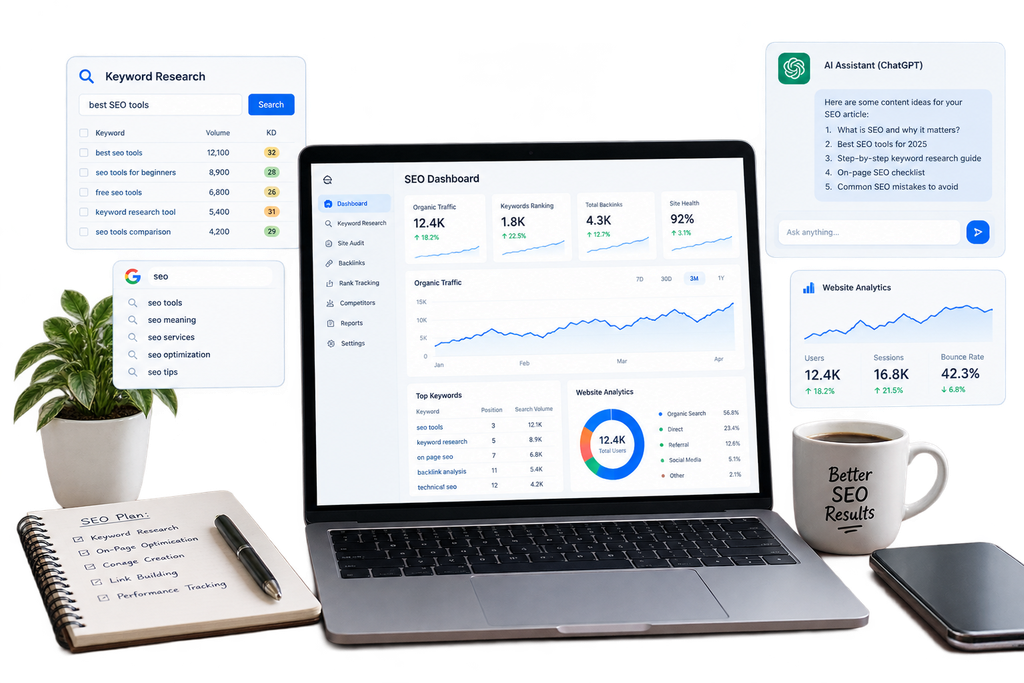
Yes. ChatGPT can assist with many SEO activities, including:
- Keyword research: Generating keyword ideas, topic clusters, related searches, and long-tail keyword variations.
- Search intent analysis: Helping determine whether users want information, comparisons, products, services, or a specific website.
- Content creation: Developing article outlines, drafts, FAQs, and supporting content.
- On-page SEO: Improving headings, title tags, meta descriptions, internal linking plans, and content structure.
- Technical SEO: Explaining crawling, indexing, canonical tags, redirects, structured data, and website performance issues.
- Competitor analysis: Comparing information supplied from competing pages and identifying possible content gaps.
- Link building: Brainstorming outreach campaigns, digital PR ideas, and relevant link prospects.
- SEO reporting: Helping interpret data from analytics tools and organize findings into actionable recommendations.
- AI search optimization: Improving content clarity, factual accuracy, topical coverage, and accessibility for search systems.
ChatGPT is most useful when you provide a clear goal, relevant website information, and reliable supporting data. It is less reliable when asked to guess keyword difficulty, search volume, rankings, backlinks, or technical problems without evidence.
How Does ChatGPT Help With SEO?
ChatGPT works as an SEO assistant by helping users research topics, organize information, analyze supplied data, generate ideas, and solve problems through structured instructions.
For example, instead of manually brainstorming every possible question about a topic, an SEO professional can ask ChatGPT to generate related questions, group them by search intent, and build an article outline around the most relevant subjects.
It can also help turn technical findings into understandable recommendations. If an SEO tool reports that a page has a missing canonical tag or a title that is too generic, ChatGPT can explain the issue, outline possible solutions, and provide implementation examples.
Depending on the version, available tools, and permissions, ChatGPT may also be able to search the web, analyze uploaded files, or work with connected data. These capabilities should not be confused with unrestricted access to a website’s backend or live SEO metrics.
For the best results, treat ChatGPT as a research, analysis, and productivity assistant rather than a replacement for every part of an SEO workflow.
1. Can ChatGPT Do Keyword Research?
Yes. ChatGPT can help with keyword research by generating keyword ideas, identifying related topics, exploring long-tail variations, and organizing search queries according to user intent.
Keyword research is one of the most important parts of SEO because it helps businesses understand what their target audience is searching for and which topics deserve attention.
Suppose you run a CRM software company and want to attract small business owners. You might begin with a broad keyword such as “CRM software.”
ChatGPT can expand this topic into more specific keyword ideas, including:
- Best CRM software for small businesses
- Free CRM software for startups
- CRM for solo consultants
- How to choose a CRM system
- CRM software for sales teams
- CRM vs. spreadsheet for customer management
- Benefits of CRM software for small businesses
These suggestions provide a useful starting point, but they are not proof that people search for every phrase or that each keyword is worth targeting.
How to Use ChatGPT for Keyword Research
A practical workflow involves five steps.
Step 1: Choose a seed keyword.
Start with a topic directly related to your business, product, or service. Examples include SEO services, CRM software, email marketing, or AI writing tools.
Step 2: Generate keyword variations.
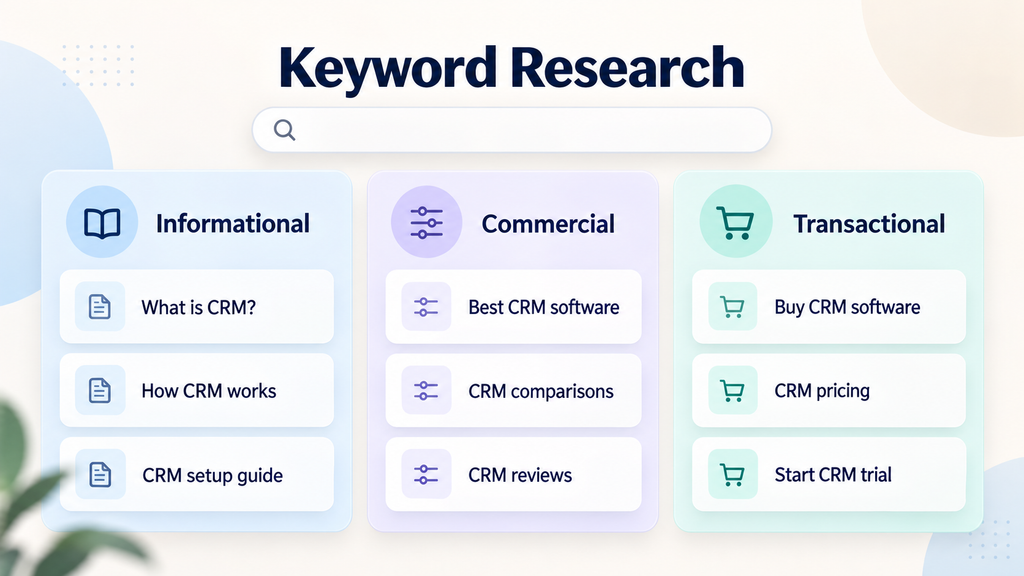
Ask ChatGPT to suggest informational, commercial, transactional, and long-tail variations. Request that it separate keywords by search intent rather than presenting an unorganized list.
Step 3: Validate the ideas.
Use Google Autocomplete, People Also Ask, related searches, Google Keyword Planner, or an SEO platform such as Semrush to investigate real search demand and competition.
Step 4: Compare keyword difficulty and business relevance.
Look at search volume estimates, keyword difficulty, competing pages, the intent behind the query, and the likelihood that the searcher could become a customer.
Step 5: Build a keyword map.
Assign each primary keyword to the most appropriate page. Group related terms when they share the same intent instead of creating a separate article for every small variation.
Example Keyword Research Prompt
“Act as an experienced SEO strategist. My business offers CRM software for small businesses and independent consultants. Generate keyword ideas grouped into informational, commercial investigation, and transactional intent. Include long-tail variations, the problem each searcher wants to solve, and the most suitable content format. Do not invent search volume or keyword difficulty figures. Clearly label all suggestions that require validation using live keyword research data.”
The key lesson is that ChatGPT helps generate and organize ideas, while dedicated keyword research tools help validate demand and competition.
2. Can ChatGPT Help Find Search Intent?
Yes. ChatGPT can help classify keywords according to the purpose behind a search.
Search intent describes what a person hopes to accomplish when entering a query into a search engine. Understanding this intent helps you create a page that satisfies the searcher instead of simply repeating a keyword.
The four common categories are:
| Search intent | Example keyword | Suitable content |
|---|---|---|
| Informational | What is CRM software? | Educational guide |
| Commercial investigation | Best CRM for small businesses | Comparison article |
| Transactional | Buy CRM software | Product or pricing page |
| Navigational | SAASIVO CRM login | Login or brand page |
Consider the keyword “Can ChatGPT do SEO?” The searcher probably wants to understand ChatGPT’s SEO capabilities, discover practical use cases, and learn whether it can replace conventional SEO tools or professionals.
A useful article should answer the main question immediately and then explain the capabilities, limitations, workflows, and examples in greater depth.
ChatGPT can help infer this intent, but its interpretation should be checked against actual search results. Google may show a mix of guides, product pages, videos, and other formats that reveal what users expect.
Why Search Intent Matters
A page can contain the right keyword and still fail to satisfy visitors.
For example, a user searching “how to fix indexing problems” likely wants a diagnostic process, not a sales page about SEO services. Conversely, someone searching “hire an SEO agency” may be ready to compare providers.
Matching the content format and level of detail to the user’s goal makes your page more useful and can improve its ability to compete in search results.
3. Can ChatGPT Write SEO-Friendly Articles?
Yes. ChatGPT can help write SEO-friendly articles, including outlines, introductions, explanations, comparison sections, FAQs, and complete first drafts.
However, an article does not become SEO-friendly simply because it contains a target keyword or follows a particular word count.
A strong SEO article should address the reader’s question, explain the topic accurately, provide useful examples, demonstrate appropriate expertise, and offer value beyond what competing pages already say.
What ChatGPT Can Do When Writing SEO Content
ChatGPT can help you:
- Develop a detailed article outline.
- Organize H1, H2, and H3 headings.
- Identify related questions worth answering.
- Explain technical concepts in accessible language.
- Suggest examples, comparisons, and practical steps.
- Improve clarity, grammar, readability, and transitions.
- Draft titles, meta descriptions, and image alt text.
- Identify repetitive sections and missing information.
- Adapt content for different audiences and levels of expertise.
For example, if you are writing about “technical SEO for beginners,” ChatGPT can propose sections covering crawling, indexing, XML sitemaps, robots.txt, canonical tags, structured data, and Core Web Vitals.
You should then review the outline against the actual needs of your audience, check technical claims, and add original insights or evidence where appropriate.
Does ChatGPT Content Rank on Google?
ChatGPT-assisted content can rank on Google, but there is no guarantee that it will.
Google’s published guidance focuses on the usefulness, originality, reliability, and purpose of content rather than simply whether AI was used to create it. Using generative AI to produce many pages without meaningful value can violate Google’s scaled content abuse policies.
That means the important question is not whether ChatGPT wrote the first draft. It is whether the final page genuinely helps readers.
Before publishing an AI-assisted article, check that it:
- Answers the main question directly.
- Contains accurate, verifiable information.
- Provides original analysis, experience, examples, or useful explanations.
- Covers relevant subtopics without unnecessary repetition.
- Uses a logical heading structure.
- Includes appropriate internal links and trustworthy references.
- Has been reviewed by someone capable of checking the subject matter.
- Provides a satisfying experience on desktop and mobile devices.
Avoid publishing large numbers of lightly edited articles that repeat the same generic information. More pages do not automatically mean more organic traffic.
4. Can ChatGPT Optimize Existing Content?
Yes. ChatGPT can help improve existing pages by reviewing the content you provide and identifying opportunities to make it clearer, more complete, and better aligned with search intent.
This is particularly useful when a page already receives impressions but attracts few clicks, ranks below competing pages, or fails to answer important visitor questions.
What to Review When Optimizing an Article
Title tag: Does the title accurately describe the page and give searchers a clear reason to click?
Meta description: Does the description summarize the page and communicate its value without misleading readers?
Main heading: Does the H1 make the subject immediately clear?
Content structure: Are the H2 and H3 headings organized logically, with each section answering a useful question?
Topical coverage: Are important subtopics missing? Are any sections repetitive or irrelevant?
Readability: Are paragraphs understandable, examples practical, and explanations appropriate for the intended audience?
Internal links: Would relevant pages on the same website help readers explore related subjects?
Accuracy and freshness: Are claims, dates, product details, screenshots, and recommendations still correct?
ChatGPT can help evaluate these elements when given the page content and relevant information. It cannot reliably determine the live performance of a page from its text alone.
Example: Improving a Weak SEO Title
Imagine an article titled “SEO Tips.”
This title is broad and does not tell the reader what the article covers.
If the page is specifically about ChatGPT, more descriptive alternatives might include:
- Can ChatGPT Do SEO? Practical Uses and Limitations
- How to Use ChatGPT for SEO: A Step-by-Step Guide
- ChatGPT for SEO: Keyword Research, Content, and Optimization
The best title depends on the actual content and target search intent. Adding more keywords is not necessarily an improvement.
A Practical Content Optimization Prompt
“Review the following article as an experienced SEO editor. Identify weaknesses in search intent alignment, heading structure, clarity, topical completeness, factual accuracy, repetition, and reader usefulness. Separate confirmed issues from suggestions that require additional research. Recommend specific improvements without keyword stuffing or rewriting the article merely to make it longer. Preserve accurate information and identify any claims that need verification.”
5. Can ChatGPT Help With Technical SEO?
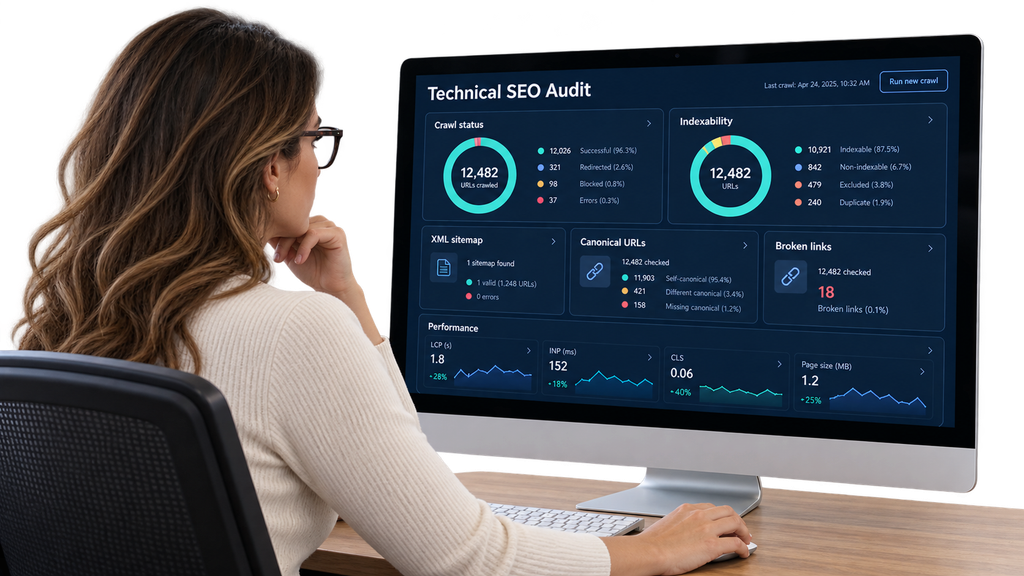
Yes. ChatGPT can explain technical SEO concepts, review code snippets and configuration files, help interpret crawl reports, and suggest troubleshooting steps.
Technical SEO focuses on making a website accessible to search engines and ensuring that its pages can be crawled, processed, indexed, and served effectively.
Common areas include:
- Website crawling and indexing
- XML sitemaps
- Robots.txt directives
- Canonical tags
- Redirects and broken links
- Duplicate URLs and duplicate content
- Structured data
- Mobile usability and page experience
- Core Web Vitals
- JavaScript rendering
- Internal linking and site architecture
Example: Diagnosing an Indexing Problem
Suppose an article does not appear in Google search results.
You could ask ChatGPT to explain a diagnostic process that includes checking the exact URL in Google Search Console, confirming the HTTP status, reviewing robots directives, inspecting the canonical URL, checking sitemap inclusion, and investigating whether the page is accessible to Googlebot.
These checks can help narrow down possible causes, but they do not prove that any one issue is responsible until the evidence has been examined.
A URL being present in a sitemap does not guarantee indexing. Likewise, a page being crawlable does not guarantee that Google will index or rank it.
Can ChatGPT Fix Technical SEO Errors Automatically?
Not by default. ChatGPT can suggest fixes and generate code, but implementation depends on your website platform, hosting environment, permissions, and available integrations.
For example, it may generate a redirect configuration or structured data snippet. You still need to confirm that the code fits your environment, test it, and verify the result.
Be especially careful when modifying robots.txt, canonical tags, redirect rules, server configurations, or large numbers of URLs. Incorrect changes can make important pages inaccessible or create new technical problems.
For a WordPress website, ChatGPT can help draft code for a plugin or a carefully scoped customization. For a Next.js website, it can help review metadata, rendering, routing, and structured data implementation. In both cases, test changes before deploying them to production.
6. Can ChatGPT Help With On-Page SEO?
Yes. On-page SEO is one of the most practical areas in which ChatGPT can assist because many tasks involve reviewing visible page content, improving clarity, and organizing information.
On-page SEO refers to optimizing the content and HTML elements of individual pages so that visitors and search engines can understand their subject and purpose.
Important On-Page SEO Elements
Title tags: Write descriptive titles that accurately represent each page.
Headings: Use a clear hierarchy that helps readers navigate the content.
Content quality: Answer the user’s question comprehensively without adding filler.
Keyword placement: Use the primary phrase naturally where relevant, including in the title, introduction, and suitable headings.
Internal links: Connect related pages using descriptive anchor text when the links are useful.
Image optimization: Use relevant filenames, suitable formats, appropriate dimensions, and descriptive alt text when the image conveys meaningful information.
URL structure: Keep URLs understandable, stable, and relevant to the page.
Structured data: Use valid, appropriate schema markup where it accurately represents the page.
ChatGPT can help draft and review these elements, but there is no universal keyword density or exact number of headings that guarantees rankings.
Example of On-Page SEO Optimization
Imagine you have a page targeting “email marketing software for small businesses.”
A useful optimization plan might include:
- A descriptive title that mentions the product category.
- An introduction that explains the needs of small businesses.
- A comparison of relevant features and use cases.
- Sections covering automation, segmentation, reporting, pricing considerations, and integrations.
- Original screenshots or examples of actual workflows.
- Links to relevant feature pages and supporting educational guides.
- A clear next step for readers who want to evaluate the software.
This approach improves the usefulness of the page rather than relying on repeated keyword insertions.
7. Can ChatGPT Help With Competitor SEO Analysis?
Yes, provided you give it competitor information to analyze or use suitable browsing and data tools.
ChatGPT can compare competing pages, summarize their content structures, identify questions they answer, highlight possible content gaps, and suggest ways to differentiate your page.
For example, suppose three competing articles about CRM software cover features, pricing, and integrations. ChatGPT might help you identify opportunities to add an implementation checklist, a realistic small-business example, or a transparent comparison of different CRM use cases.
The goal should be to understand what readers need and produce a better resource, not simply copy the competitors’ headings.
What Data Can You Provide?
Useful inputs include:
- Competitor URLs and accessible page content.
- Exported keyword reports.
- Search result observations.
- Backlink reports.
- Organic traffic estimates from SEO platforms.
- Content outlines and publication dates.
- Your own website’s Search Console performance data.
Remember that third-party traffic and keyword estimates are not exact measurements of a competitor’s private analytics.
ChatGPT should distinguish observed evidence from assumptions. If it cannot access a page or a report, it should not pretend to have inspected it.
A Competitor Analysis Prompt
“Compare the competitor page content and keyword data I provide with my own article. Identify differences in topic coverage, clarity, examples, search intent, trust signals, and practical usefulness. Recommend original content improvements based on the evidence. Do not copy competitor wording, invent traffic statistics, or claim that a topic is a keyword gap unless the supplied data supports that conclusion.”
8. Can ChatGPT Help With Link Building?
Yes. ChatGPT can support link-building strategy, prospect research planning, outreach personalization, digital PR brainstorming, and campaign reporting.
Link building is the process of earning links from other websites to your own. Relevant, editorially earned links can help people discover your content and may contribute to search visibility.
ChatGPT can assist with several stages of the process.
Finding Link-Building Opportunities
You can use ChatGPT to brainstorm potential prospect categories, such as industry publications, relevant resource pages, professional associations, software directories, and websites that publish useful contributions from outside experts.
Actual prospects must be researched and evaluated. A generated list is not proof that a website exists, accepts contributions, is relevant, or provides a worthwhile linking opportunity.
Writing Personalized Outreach Emails
ChatGPT can help draft outreach messages based on a prospect’s published content, audience, and a genuinely relevant reason to make contact.
For example, if a website publishes a guide to small-business productivity and your company has created an original CRM implementation checklist, you could explain why that resource might help its readers.
Effective outreach should be specific, honest, and respectful. Avoid pretending that you read an article when you did not, fabricating relationships, or sending thousands of identical messages.
Creating Link-Worthy Content
ChatGPT can help brainstorm useful assets that other websites might reference, including:
- Original industry surveys
- Research summaries
- Practical templates and checklists
- Free calculators or interactive tools
- Data visualizations based on credible datasets
- Expert-led guides and case studies
The content must provide real value. Simply publishing another generic article does not guarantee backlinks.
What ChatGPT Cannot Guarantee in Link Building
ChatGPT cannot guarantee that a prospect will respond, that a website will link to you, or that a particular backlink will improve rankings.
It also should not be used to fabricate outreach evidence, fake testimonials, or misleading claims about relationships with publishers.
9. Can ChatGPT Help With Local SEO?
Yes. ChatGPT can help local businesses plan and improve many parts of their local SEO strategy.
Local SEO aims to help businesses become more visible to people searching for products and services in a particular area.
For example, a plumbing company serving Dallas may want to reach people searching for emergency plumbing services, water heater repair, or a plumber in a specific neighborhood.
ChatGPT can help with:
- Generating local keyword ideas.
- Planning location-specific service pages.
- Drafting useful FAQs for local customers.
- Improving service descriptions.
- Creating review-response templates.
- Developing locally relevant content ideas.
- Organizing business information for consistency checks.
- Planning a Google Business Profile optimization checklist.
However, ChatGPT should not invent customer reviews, business addresses, service areas, or local credentials. All business information must be accurate.
Does ChatGPT Know Your Local Rankings?
Not automatically. Local search results can vary by location, query, competition, and other factors.
To evaluate real performance, use appropriate local SEO tracking tools, Google Business Profile data, and relevant Search Console information. ChatGPT can help interpret those reports when the data is supplied.
Local businesses should also focus on accurate business details, legitimate customer reviews, relevant local content, and a strong customer experience rather than trying to manipulate location signals.
10. Can ChatGPT Help With E-Commerce SEO?
Yes. ChatGPT can assist with product page content, category page planning, product descriptions, internal linking ideas, product FAQs, and e-commerce content audits.
For an online store, useful applications include:
Product descriptions: Explain genuine product features, materials, use cases, and differences in clear language.
Category pages: Develop introductions that help customers understand the available products without overwhelming them with unnecessary text.
Product titles: Make names descriptive and easy to distinguish.
Image alt text: Describe meaningful product images accurately.
Internal linking: Suggest relevant connections between products, categories, buying guides, and supporting resources.
Faceted navigation reviews: Help identify possible URL duplication or crawlability issues from supplied site data.
Content planning: Generate buying guides, product comparisons, maintenance guides, and answers to common pre-purchase questions.
Example: Optimizing a Product Page
Suppose an online store sells ergonomic office chairs.
Rather than producing a generic description filled with phrases such as “best ergonomic chair,” ChatGPT can help structure the page around the product’s verified features, adjustment options, materials, dimensions, intended use, warranty, and limitations.
It can also suggest a comparison table if the store offers multiple chair models.
Product facts should come from reliable product specifications. Do not let an AI assistant invent materials, performance claims, certifications, availability, or warranty terms.
11. Can ChatGPT Help With SEO for AI Search and Generative Search?
Yes. ChatGPT can help prepare content for the broader search environment, including traditional search engines and AI-powered search experiences.
People increasingly use AI assistants to research products, compare services, understand technical topics, and find sources. This has encouraged interest in terms such as Generative Engine Optimization (GEO) and Answer Engine Optimization (AEO).
Although the terminology varies across the industry, the practical objective is to make information useful, accurate, accessible, and understandable wherever people search.
How to Improve Content for AI Search
Focus on the following fundamentals:
- Clear answers: Address the main question directly before expanding into details.
- Accurate explanations: Support important claims with credible evidence.
- Useful structure: Organize related concepts under descriptive headings.
- Original information: Provide first-hand experience, original research, real examples, or meaningful analysis.
- Consistent entities: Use accurate names and descriptions for your business, products, services, and subject matter.
- Crawlability: Ensure important pages can be accessed and processed by the relevant search systems.
- Helpful media: Include relevant images, diagrams, and videos when they genuinely improve understanding.
- Trust signals: Make authorship, business identity, expertise, and supporting evidence clear where appropriate.
Google’s published guidance on generative AI search emphasizes that existing SEO fundamentals remain relevant. It also stresses unique, valuable content and discourages low-value content produced primarily to manipulate search visibility.
Does Adding FAQ Sections Guarantee AI Visibility?
No. Adding questions and answers can help readers find information, but it does not guarantee that Google, ChatGPT, or another AI system will cite your website.
Likewise, no specific word count, formatting trick, or schema implementation guarantees inclusion in AI-generated answers.
The strongest strategy is to create a page that answers genuine questions well, supports its claims, provides something distinctive, and remains technically accessible.
Can ChatGPT Make a Website Appear in ChatGPT Search?
Not by itself. ChatGPT can help improve your content and explain relevant technical considerations, but appearance in ChatGPT Search is not guaranteed.
Website owners should review the current requirements for OpenAI’s search crawler, OAI-SearchBot, and ensure that their hosting provider or content delivery network does not unintentionally block the relevant crawler traffic.
Traditional search optimization, useful content, technical accessibility, and reliable information remain important foundations.
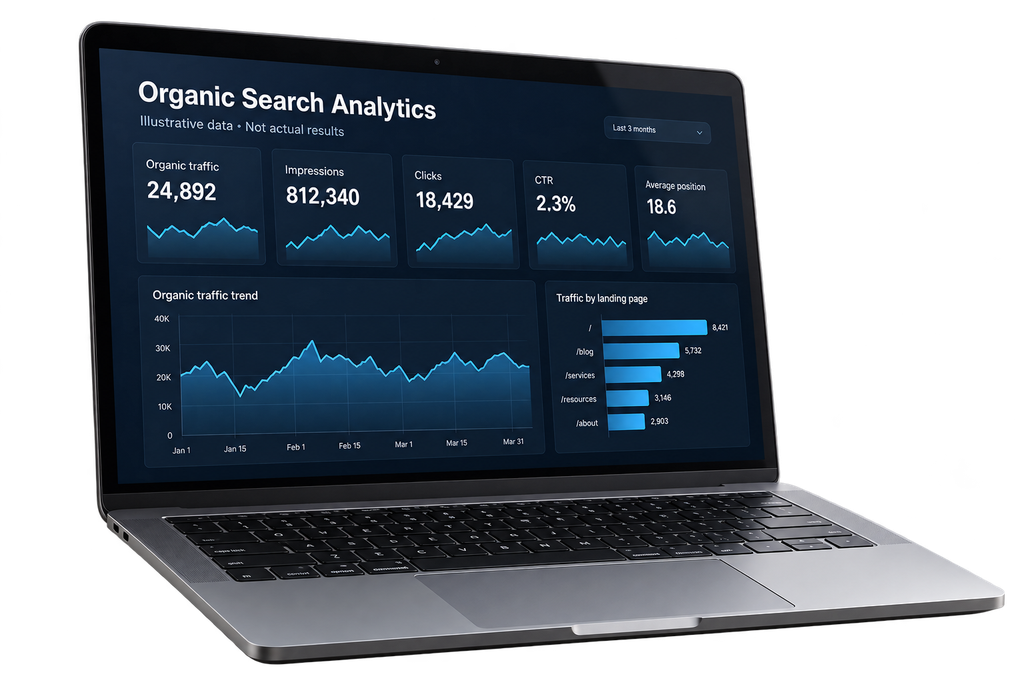
12. Can ChatGPT Help With SEO Reporting and Analytics?
Yes. ChatGPT can help organize, summarize, and interpret SEO data when you provide reports or have access to suitable integrations.
SEO reporting involves measuring how a website performs, identifying changes, and deciding what actions to take next.
Relevant data may come from Google Search Console, Google Analytics, a website crawler, a rank-tracking platform, or a backlink analysis tool.
Examples of SEO Data ChatGPT Can Analyze
Impressions and clicks: Identify queries or pages that receive search impressions but relatively few clicks.
Click-through rate: Help investigate whether titles, descriptions, query intent, or search result features may be affecting clicks.
Average position: Summarize ranking trends while explaining that the metric is an aggregate and may vary by query and location.
Organic traffic: Review changes in visits, engagement, and conversions when reliable analytics data is available.
Indexing reports: Help organize excluded URLs and investigate possible patterns in indexing issues.
Content performance: Identify pages that may need updating, consolidating, expanding, or repositioning.
Backlink reports: Group referring domains and help prioritize manual review of relevant link opportunities.
Example: Analyzing a Google Search Console Export
Imagine you upload a report containing queries, clicks, impressions, click-through rates, and average positions.
You could ask ChatGPT to:
- Identify pages with substantial impressions but low click-through rates.
- Find queries with growing impressions over the reporting period.
- Group related queries by search intent.
- Highlight pages whose performance has declined.
- Suggest possible causes that need further investigation.
- Create a prioritized list of actions for the next month.
The quality of the analysis depends on the data provided, the comparison period, and the reliability of the interpretation. Correlation does not prove that a particular SEO change caused a performance increase or decrease.
13. Which SEO Tasks Should You Not Trust ChatGPT to Do Without Verification?
ChatGPT is useful, but it can produce incorrect information, make assumptions, misunderstand technical requirements, or generate recommendations that do not fit a particular website.
Some SEO tasks require evidence from live tools, specialist knowledge, or direct access to a website.
Search Volume and Keyword Difficulty
ChatGPT may suggest relevant keywords, but it should not invent search volumes or keyword difficulty scores.
Use a keyword research platform or another suitable data source to validate the figures.
Live Rankings and Competitor Traffic
Unless it has access to reliable current data, ChatGPT cannot accurately tell you where every keyword ranks or how much traffic a competitor receives.
Third-party traffic estimates should also be treated as estimates rather than exact analytics.
Website Indexing
ChatGPT cannot prove that Google has indexed a URL simply by reading the URL. Verify indexing and inspection information through appropriate search tools.
Backlink Quality
A domain name alone does not provide enough information to determine whether a backlink is relevant, editorially earned, or valuable. Review actual linking pages, context, and other relevant evidence.
Technical Changes
Generated code can be incomplete or unsuitable for a particular server, framework, or CMS. Review and test technical changes before implementation.
Guaranteed Rankings
No prompt can guarantee first-page rankings, a specific organic traffic increase, or inclusion in AI-generated search results.
The right approach is to use ChatGPT to reduce research and implementation time while retaining verification, judgment, and responsibility for the final decisions.
14. ChatGPT vs. Traditional SEO Tools: Which Is Better?
ChatGPT and conventional SEO tools serve different purposes. In many workflows, they work best together.
| SEO task | ChatGPT | Traditional SEO tools |
|---|---|---|
| Generate keyword ideas | Very useful | Useful |
| Estimate keyword search volume | Needs verified data | Often provides estimates |
| Analyze search intent | Useful | May offer intent classifications |
| Draft and improve content | Very useful | Often more limited |
| Track live keyword rankings | Requires suitable data or integration | A core feature of rank trackers |
| Monitor website indexing | Can explain and analyze supplied reports | Search Console provides direct site data |
| Crawl large websites | Requires suitable tools or supplied exports | A core feature of website crawlers |
| Analyze backlink profiles | Can interpret supplied data | Dedicated backlink databases |
| Develop SEO strategy | Very useful | Provides supporting data |
| Guarantee rankings | No | No |
A business does not necessarily need every paid SEO tool. The right combination depends on its website, budget, competition, and reporting requirements.
A practical starting setup might include ChatGPT for planning and analysis, Google Search Console for search performance, Google Analytics for website behavior, and a keyword research tool when search demand and competition data are needed.
15. How to Use ChatGPT for SEO Step by Step
If you want to start using ChatGPT for SEO, follow this practical workflow.
Step 1: Define Your SEO Goal
Start with one measurable objective. Examples include improving an existing service page, attracting relevant traffic to an article, identifying indexing problems, or planning content around a product category.
Avoid giving ChatGPT a vague instruction such as “do all my SEO” without specifying the website, audience, and desired outcome.
Step 2: Gather Reliable Information
Collect the information relevant to your task, such as:
- Website URL and business description.
- Target audience and geographic market.
- Main products or services.
- Existing page content.
- Target keywords and search intent.
- Search Console exports or keyword reports.
- Known technical issues and business constraints.
Provide only the data needed for the task and avoid sharing confidential customer or account information.
Step 3: Research the Keyword and Intent
Ask ChatGPT to generate related keywords, questions, and content ideas. Then check the most promising suggestions against actual search results and available keyword data.
Select a primary topic based on relevance, user intent, competition, and business value rather than keyword volume alone.
Step 4: Create a Content Brief
Ask ChatGPT to prepare a brief containing the main question, intended audience, proposed heading structure, important subtopics, relevant examples, and any facts that require verification.
Review the brief before asking for a full article.
Step 5: Produce and Improve the Content
Use ChatGPT to develop the draft, but add genuine experience, original insights, useful illustrations, verified evidence, and appropriate editorial judgment.
Avoid publishing generic content simply because it is long or contains many related keywords.
Step 6: Optimize the Page
Review the title, H1, headings, internal links, image descriptions, metadata, URL, and other relevant on-page elements.
Make sure the page serves readers first and does not repeat keywords unnaturally.
Step 7: Check Technical SEO
Use appropriate website and search tools to inspect crawlability, indexing, canonical URLs, redirects, structured data, mobile usability, and performance where relevant.
Ask ChatGPT to explain the results and propose fixes, then test the implementation.
Step 8: Publish and Measure Performance
After publishing, monitor relevant impressions, clicks, conversions, indexing information, and other metrics.
Compare performance over a meaningful period and account for seasonality, competition, search result changes, and other possible influences.
Step 9: Improve Based on Evidence
Update content when it becomes inaccurate, incomplete, or less useful. Investigate underperforming pages instead of automatically rewriting everything.
SEO is an ongoing process of research, implementation, measurement, and improvement.
17. Is ChatGPT Enough for SEO, or Do You Need an SEO Professional?
It depends on the complexity of your website, your goals, your experience, and the resources available to you.
For a small website, ChatGPT may provide substantial help with keyword brainstorming, content planning, metadata, basic optimization, and understanding common SEO concepts. Combined with free tools, it can help an owner organize many routine tasks.
For a competitive e-commerce store, a large website, a business with complex technical issues, or a company dependent on organic leads, professional SEO expertise may be valuable.
An experienced SEO professional can help interpret ambiguous evidence, prioritize work across a business, manage technical implementation, assess competitive conditions, develop digital PR strategies, and measure commercial results.
The two approaches are not mutually exclusive. SEO professionals can use ChatGPT to accelerate repetitive tasks, while business owners can use it to become more informed and make better decisions.
What matters most is not whether a person uses AI, but whether the overall process produces accurate, useful, sustainable results.
18. Common Mistakes to Avoid When Using ChatGPT for SEO
ChatGPT can save time, but poor usage can waste effort or damage content quality.
Publishing AI Drafts Without Reviewing Them
AI-generated text may contain errors, unsupported claims, generic explanations, or invented details. Review the article carefully and verify important information before publication.
Targeting Every Keyword Suggestion
A long list of keywords does not automatically translate into a good content strategy. Prioritize relevant topics that match user intent and business goals.
Creating Separate Pages for Minor Keyword Variations
Pages that target nearly identical queries can become repetitive and compete with each other. Determine whether the queries deserve separate pages or can be served by one comprehensive resource.
Using Keyword Stuffing
Repeating the same phrase unnaturally does not make a page better. Write naturally and use related terms where they help explain the subject.
Trusting Invented Metrics
Do not treat AI-generated search volume, keyword difficulty, backlink counts, rankings, or traffic estimates as verified facts. Use reliable data sources.
Automating Large Numbers of Low-Value Pages
Producing pages at scale without meaningful original value can create quality and spam-policy risks. Prioritize usefulness over volume.
Ignoring Website Performance
Even excellent content needs to be accessible, usable, and supported by appropriate technical foundations. Do not overlook crawling, indexing, navigation, mobile experience, and other relevant site issues.
Expecting Instant Rankings
SEO performance depends on many factors, including competition, relevance, technical accessibility, content quality, and changes in search systems. Results are not guaranteed or immediate.
19. The Future of ChatGPT and SEO
AI is changing how people research information, plan content, and interact with search systems. It is also creating new ways for SEO professionals to analyze information and manage repetitive work.
However, SEO is not becoming a simple process of generating more content with AI.
As AI tools become more widely available, generic information becomes easier for anyone to produce. This makes original research, practical expertise, reliable evidence, distinctive perspectives, and a useful website experience increasingly important differentiators.
Businesses should learn to use AI responsibly while continuing to invest in the fundamentals: understanding their customers, publishing helpful content, maintaining technically sound websites, earning genuine recognition, and measuring real outcomes.
ChatGPT can support this work, but the strategy must still be grounded in the needs of the audience and the objectives of the business.
The most effective SEO workflows will combine human judgment, appropriate automation, reliable data, and continuous improvement.


