Search is no longer limited to a page of blue links. People increasingly ask ChatGPT, Gemini, Claude, Perplexity, Google AI Overviews, and other AI-powered systems to research products, compare companies, find services, and answer complex questions. Instead of showing users ten pages and asking them to investigate each result themselves, these systems can synthesize information from multiple sources and provide a direct answer. For businesses, this creates a new visibility challenge: it is no longer enough to rank well in traditional search. Your brand also needs to be understood, mentioned, and cited by the AI systems that increasingly influence discovery.
This is where Large Language Model Optimization (LLMO) comes into the picture. LLMO is the practice of optimizing content, structure, and brand signals so large language models and AI search systems can better discover, understand, retrieve, and cite information about a business. The terminology overlaps with GEO, AEO, and AI SEO, but LLMO places particular emphasis on how language models represent and use information when generating answers.
The important thing to understand is that LLMO is not simply another version of keyword optimization. A page can rank well on Google and still receive little or no visibility in AI-generated answers. Conversely, an authoritative source that is not ranking first for a conventional keyword can sometimes become a source that an AI system references when constructing an answer. AI search therefore introduces additional signals that marketers need to monitor, including brand mentions, citations, share of voice, source selection, sentiment, prompt coverage, and AI crawler activity.
That makes dedicated LLM and AI visibility platforms increasingly useful. Instead of manually asking hundreds of questions across ChatGPT, Gemini, Claude, Perplexity, and other systems, these tools allow marketers to monitor how their brand appears, identify which competitors are being mentioned, discover which sources are being cited, and find content gaps that may be limiting AI visibility.
Below are five tools that are particularly relevant to an LLMO strategy in 2026.
1. Profound
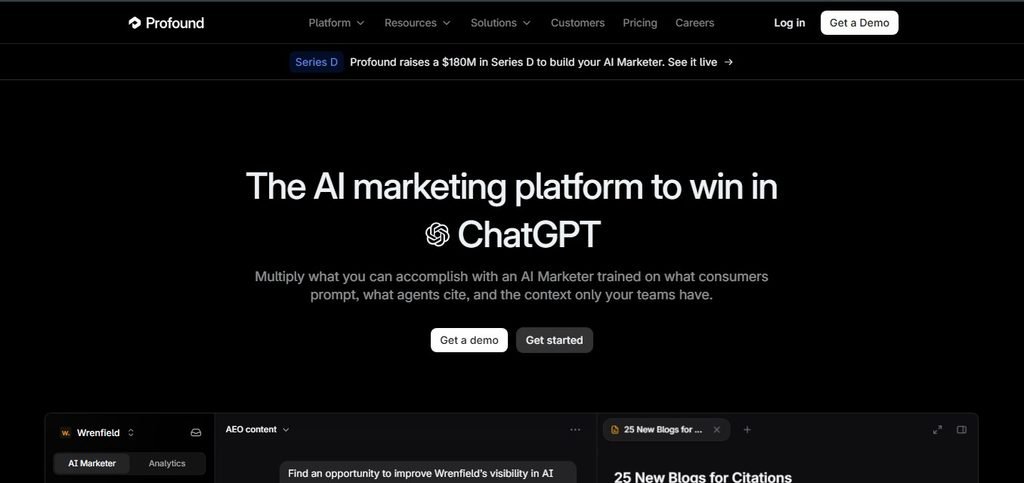
Profound is an enterprise-focused AI search visibility platform designed to help brands understand how they appear across AI-generated answers. Rather than treating AI search as a simple extension of traditional keyword rankings, Profound focuses on the questions people ask, how often a brand appears in AI answers, which competitors appear alongside it, and which sources AI systems use when constructing those answers. Its platform includes prompt monitoring, answer-engine visibility, citation tracking, competitive bench marking, and recommendations designed to turn visibility data into optimization actions.
One of the strongest aspects of Profound is its emphasis on understanding AI visibility at scale. For a large organization, manually checking whether a brand appears in hundreds or thousands of commercial and informational prompts is unrealistic. A dedicated platform can establish a baseline and then monitor changes over time. Marketers can look at metrics such as visibility, share of voice, position, citations, and sentiment rather than relying only on conventional Google rankings. Profound’s own documentation describes workflows for identifying relevant prompts, establishing an AI visibility baseline, and comparing a brand against competitors.
Profound also introduced the Profound Index in 2026, which uses a large dataset of real-user conversations across industries and major AI platforms to provide broader benchmarks for AI search visibility. According to Profound, the index is based on more than 1.5 billion real-user conversations covering 50+ industries.
Another useful development is its page-level visibility and crawler monitoring. Profound’s September 2026 product updates describe functionality for discovering site pages, monitoring AI citation status and bot activity, and serving rendered content to AI agents where JavaScript-heavy pages might otherwise be difficult for those agents to process.
For enterprise brands, agencies, SaaS companies, and organizations that need detailed competitive intelligence, Profound can therefore serve as a central measurement layer for an LLMO strategy.
2. Promptwatch
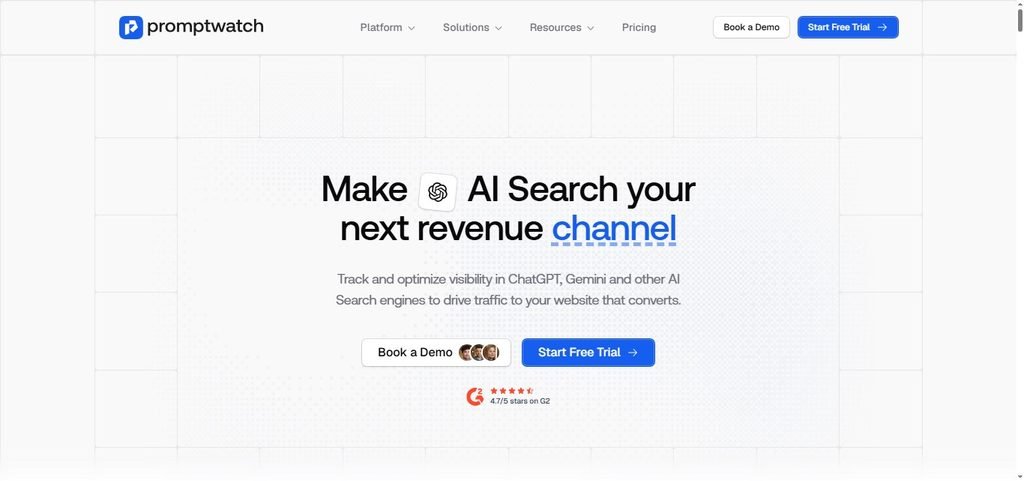
Promptwatch takes a broader approach to AI search optimization by combining visibility monitoring with optimization and execution workflows. The platform tracks how brands appear in AI systems such as ChatGPT, Claude, Perplexity, Gemini, Google AI Overviews, and other AI search environments. According to Prompt watch, its system collects more than 100 million AI search data points daily and is designed to help organizations understand, optimize, and automate their AI search visibility.
The value of a platform like Promptwatch becomes clearer when you think about what happens after discovering a visibility problem. Suppose an AI system consistently recommends three competitors for a particular service but does not mention your company. Knowing that fact is useful, but it does not solve the problem. The next question is why those competitors are appearing and what your company needs to improve.
Promptwatch positions its platform around this complete workflow. Its current product description includes source analysis, content and technical gap identification, AI-optimized content generation, prioritized recommendations, and integrations with content management systems such as WordPress, Webflow, and Framer.
Its monitoring capabilities also extend across multiple AI models and search experiences. Promptwatch says it can monitor ChatGPT, Gemini, AI Overviews, Claude, Grok, and other AI systems. Its 2026 changelog also shows additions such as brand mention tracking, brand position and rank charts, citation filtering, content generation through an API, and topic-level AI crawl and citation insights.
This matters because LLMO is not a one-time optimization project. AI-generated answers can change. Competitors can publish new content. Sources can gain or lose visibility. Models and search interfaces can change their behavior. A platform that lets a team monitor changes and connect them to specific content opportunities is therefore more useful than a tool that simply reports a single visibility score.
Promptwatch is particularly relevant for agencies and marketing teams that want to move from Where do we appear? to What should we do next?
3. Peec AI
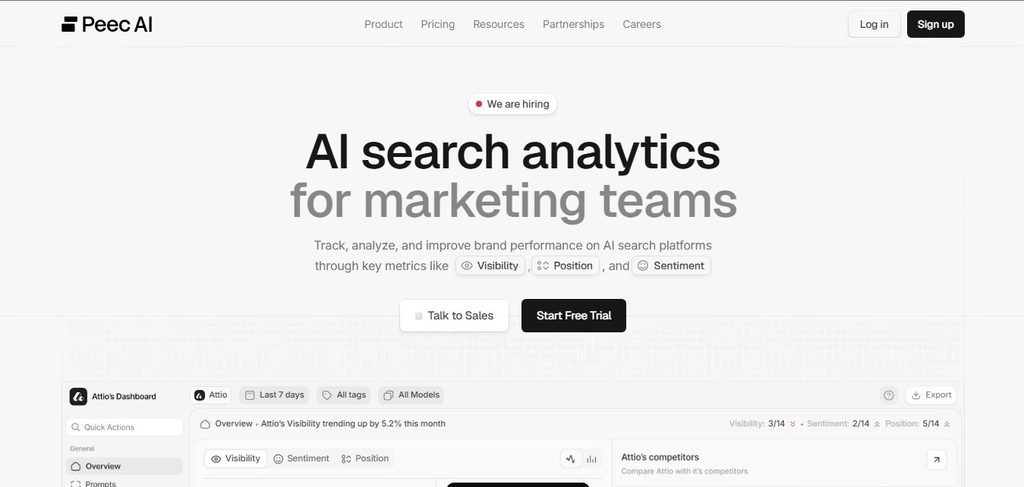
Peec AI is another dedicated AI visibility platform built around understanding how AI systems perceive and represent brands. Its AI Visibility product tracks metrics including visibility, position, sentiment, and share of voice. It also allows marketers to identify important prompts, monitor brand performance, and compare their visibility against competitors.
The distinction between traditional SEO tracking and Peec’s approach is important. A traditional SEO platform may tell you that your page ranks at position five for a particular keyword. An AI visibility platform asks a different question: When someone asks an AI system a question related to this topic, does the AI mention your brand, where does it place you, and which sources does it use?
That difference is fundamental to LLMO.
Imagine a software company that ranks well for “best project management software” but is repeatedly absent when users ask AI systems, “What project management platforms are best for a 50-person remote marketing team?” Traditional keyword tracking might not expose the problem. Prompt-based AI monitoring can show whether the brand is actually present in those conversational discovery journeys.
Peec also provides tools for measuring AI referrals. Its September 2026 product update introduced AI referrals that connect AI-assistant traffic with website sessions, engagement, conversions, and revenue through Google Analytics. The system can break this information down by AI assistant, landing page, country, and device.
This is an important evolution because AI visibility should not become another vanity metric. A brand appearing in an AI answer is useful, but the business question is what happens afterward. Do users visit the website? Which pages do they visit? Do they engage? Do they convert? Connecting AI visibility with downstream traffic and business outcomes makes the data considerably more actionable.
For companies that want to connect AI visibility with actual business performance, Peec AI is therefore worth considering.
4. OtterlyAI
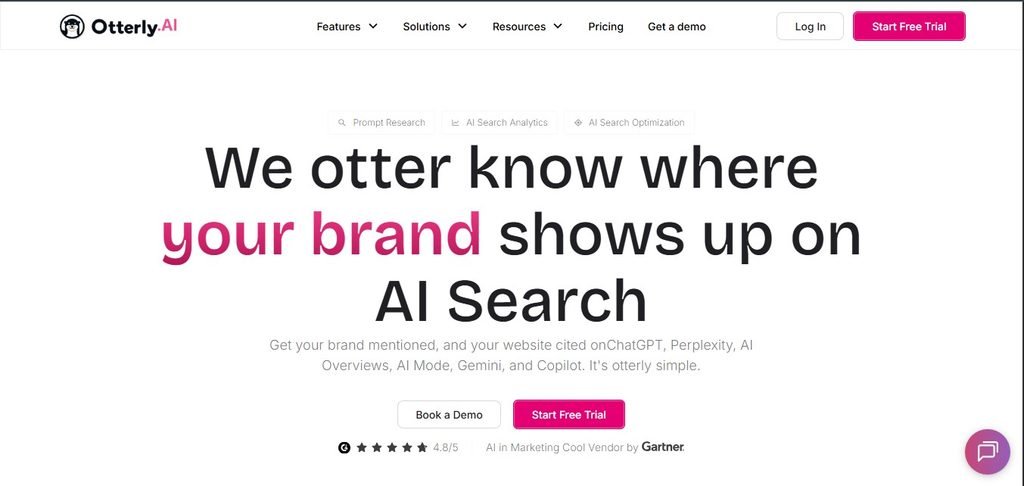
OtterlyAI focuses heavily on AI search monitoring, brand visibility, citations, competitive analysis, and GEO/LLMO auditing. It supports AI search environments including ChatGPT, Google AI Overviews, Google AI Mode, Gemini, Perplexity, and Copilot, with additional platform coverage evolving over time. Its official product information describes capabilities for tracking brand mentions, sentiment, share of voice, website citations, prompts, and GEO audits.
One reason OtterlyAI is relevant to LLMO is that it does not stop at measuring whether a brand appears. Its platform also looks at the sources behind AI answers. This is crucial because citations reveal something that a simple mention cannot: what information source is influencing the answer.
For example, imagine an AI system recommends a competitor whenever someone asks for “best digital marketing agency for SaaS companies.” Your company is not mentioned, while a competitor is repeatedly cited from industry publications, comparison articles, customer reviews, and its own resource pages. That information gives you a much clearer optimization direction than simply knowing that your visibility score is low.
OtterlyAI has also expanded its technical side. Its GEO audit work includes a GEO Crawlability Checker and Content Checker, designed to evaluate whether AI engines can find, understand, and reference website content.
Its 2026 product updates also introduced recommendations designed to bridge the gap between measurement and action, along with Agent Analytics for monitoring AI agents and crawlers visiting a website. OtterlyAI describes the latter as a way to see which AI agents visit a site and which pages they reach.
This is significant because AI visibility has two sides. The first is what AI systems say about you. The second is whether AI systems can actually access and process your website content. If an important page cannot be properly crawled or its useful information is hidden behind technical barriers, no amount of keyword targeting will solve the underlying problem.
OtterlyAI therefore fits well into an LLMO workflow that combines visibility monitoring with technical and content auditing.
5. Scrunch AI
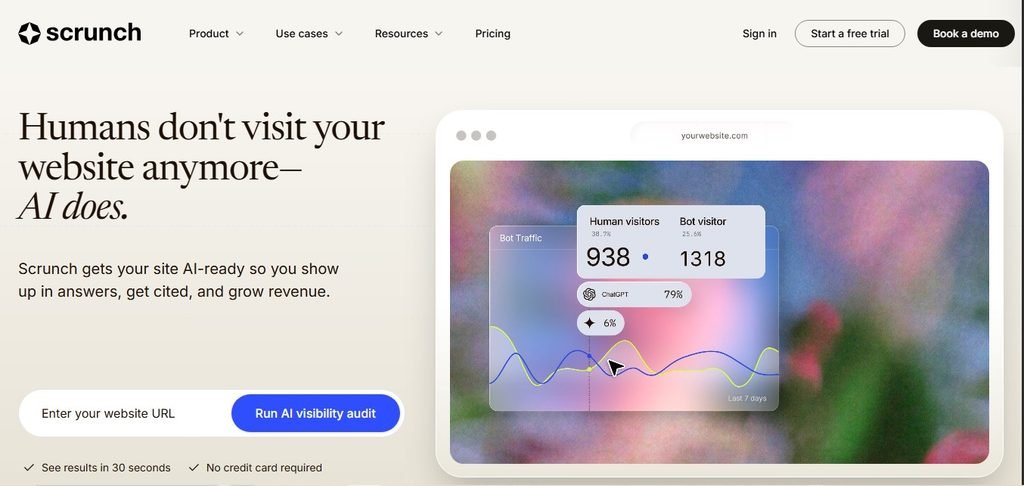
Scrunch AI is positioned around enterprise AI search visibility, content optimization, and what it calls the agent experience. In June 2026, Site core announced that it had acquired Scrunch, integrating its AI-search capabilities more closely with Site core’s broader digital experience platform. Scrunch continues as a platform within Site core, with capabilities focused on understanding and improving how brands appear in AI-powered discovery.
Scrunch tracks AI visibility signals such as brand presence, competitive presence, share of voice, response position, sentiment, citations, AI bot traffic, AI referrals, and trends. That makes it more than a conventional rank tracker because it attempts to show how AI systems actually represent a brand rather than simply where a webpage appears in a traditional search result.
One particularly interesting capability is its emphasis on moving from measurement to action. Sitecore’s documentation describes an AI-discoverability workflow in which Scrunch continuously monitors how AI tools cite and mention a brand, surfaces meaningful changes, provides content recommendations, and supports implementation through Sitecore’s content workflows.
Scrunch has also developed its Agent Experience Platform, reflecting the idea that websites increasingly need to serve two audiences: humans and AI agents. The company’s 2026 positioning describes the platform around observing what agents say and do, understanding their behavior, and delivering information in a format that agents can read and use.
This becomes especially relevant for enterprise organizations with large websites. A company may have thousands of pages, product specifications, support documents, FAQs, research reports, and other information. The challenge is not always a lack of content. Often, the challenge is that the information is fragmented, outdated, difficult to retrieve, or inconsistent across different sources.
Scrunch’s enterprise orientation makes it particularly relevant for organizations that need to connect AI visibility data with large-scale content operations.
How LLM Optimization Tools Actually Help a Website Get Seen by AI
Using an LLMO tool does not mean you can press a button and force ChatGPT or Gemini to recommend your company. No legitimate platform can guarantee that outcome. AI systems generate responses dynamically, and their retrieval systems, models, sources, and outputs can change.
What these tools can do is give marketers much better visibility into the process.
First, they can reveal the prompts that matter. Instead of optimizing only around short keywords such as “SEO agency,” a business can discover conversational questions such as “What are the best SEO agencies for SaaS companies?” or “Which digital marketing agencies specialize in B2B technology companies?” These are closer to how people actually interact with AI systems.
Second, they can show which competitors appear when your brand does not. This is one of the most valuable forms of competitive intelligence in AI search. If three competitors consistently appear in relevant answers while your company is absent, the next step is to investigate what information supports those recommendations.
Third, they can identify citation sources. AI systems frequently synthesize information from multiple websites. If your competitors are repeatedly being supported by industry publications, reviews, research studies, directories, comparison pages, interviews, or authoritative resources, those sources become important clues for your LLMO strategy.
Fourth, these platforms can help identify content gaps. A company may have plenty of content but still fail to answer the questions AI systems need to answer. A 2,000-word article filled with generic marketing language is not automatically more useful to an AI system than a concise, well-structured page containing precise definitions, original evidence, comparisons, examples, and clearly attributed claims.
Finally, LLMO tools allow organizations to measure changes over time. This is essential because AI visibility is not static. Research from OtterlyAI, for example, found that AI citations and brand mentions can change over time and that repeated monitoring is important for understanding the stability of those signals.
What Makes Content Easier for LLMs to Understand?
The tool is only half of the equation. If the underlying website is weak, buying an expensive AI visibility platform will not magically fix it.
The first requirement is crawlability. AI systems and agents need to be able to access the content. If important information is blocked, inaccessible, or dependent on rendering that an agent cannot properly process, the information may never become part of the retrieval process.
The second requirement is clear information architecture. Important answers should not be buried underneath unnecessary introductions or vague marketing language. Strong content uses descriptive headings, clear paragraphs, logical relationships between concepts, and self-contained explanations. This makes the information easier for both humans and machines to interpret.
The third requirement is evidence. If you make a claim, support it with data, research, first-party information, expert commentary, or credible external sources where appropriate. AI systems have many possible sources to choose from. A specific, verifiable claim provides more useful information than generic statements such as “we are the world’s leading solution.”
The fourth requirement is entity consistency. Your company name, services, products, authors, locations, descriptions, and other important facts should be consistent across your website and reputable third-party sources. When different sources describe the same organization differently, it becomes harder for automated systems to establish a clear representation of the entity.
The fifth requirement is freshness. An article written three years ago may contain information that is no longer accurate. AI systems can synthesize current and historical information, so outdated pages can create inconsistent representations of a brand. Updating important resources is therefore part of ongoing LLMO rather than a one-time publishing task.
LLMO vs. SEO: Do You Still Need Traditional SEO?
Absolutely.
Anyone claiming that LLMO means you can forget SEO is oversimplifying the problem.
Traditional SEO still matters because search engines remain major discovery systems, and AI search frequently relies on web content, search indexes, crawling, authoritative sources, and other signals that overlap with established SEO practices. The difference is that AI search introduces an additional layer: the system has to retrieve information, understand it, synthesize it, and decide what to mention or cite.
Think of SEO and LLMO as connected rather than competing disciplines.
SEO helps make a website discoverable and technically accessible. LLMO/GEO adds another objective: making the information useful and understandable enough for AI systems to retrieve, represent, and cite accurately.
A strong strategy therefore combines technical SEO, high-quality content, structured information, authoritative references, digital PR, brand/entity development, and AI visibility monitoring.
Which LLM Optimization Tool Should You Use?
There is no universal tool that is automatically right for every company. The correct choice depends on the size of the website, number of markets, AI platforms you need to monitor, number of prompts, reporting requirements, technical requirements, and how much optimization execution you want inside the platform.
Profound is particularly relevant when an organization needs enterprise-grade AI visibility intelligence, competitive benchmarking, prompt analysis, and large-scale measurement. Its 2026 product ecosystem also emphasizes page-level visibility and AI-agent accessibility.
Promptwatch is relevant when the workflow needs to move beyond monitoring toward optimization and execution, including content recommendations, generation, and CMS workflows.
Peec AI is useful for teams focused on brand visibility, competitive share of voice, AI perception, and connecting AI discovery with referral and conversion data.
OtterlyAI is a strong fit for teams that want AI search monitoring combined with citation analysis, GEO audits, recommendations, and AI-agent/crawler analytics.
Scrunch AI is particularly relevant to enterprise organizations interested in connecting AI visibility insights with content operations and agent-oriented website experiences. Its integration with Sitecore gives it an especially strong enterprise content-management angle.
Final Thoughts
LLM optimization is becoming an important extension of modern search strategy because the way people discover information is changing. A potential customer may no longer begin with a Google search, open five websites, compare the information manually, and then make a decision. Increasingly, that customer can ask an AI system to research the market, compare providers, explain differences, and recommend options.
That changes what visibility means.
Being visible in AI search does not simply mean appearing for a keyword. It means that when a relevant question is asked, the AI system has enough reliable information to understand your company, recognize your expertise, retrieve your content, and potentially mention or cite your brand in its response.
The five tools covered in this guide—Profound, Promptwatch, Peec AI, OtterlyAI, and Scrunch AI approach that problem from slightly different directions. Some focus more heavily on measurement and competitive intelligence, while others place greater emphasis on recommendations, content optimization, technical accessibility, or enterprise execution.
But the tool itself is not the strategy.
The real LLMO strategy starts with creating information worth retrieving. Your website needs clear answers, accurate facts, strong topical coverage, trustworthy sources, consistent entity signals, technically accessible content, and evidence that other reputable sources recognize your expertise. The tools then provide the measurement layer that tells you whether AI systems are actually discovering and using that information.
And this is the part many businesses get wrong: you cannot optimize what you do not measure.
If you do not know which prompts mention your brand, which competitors are appearing instead, which pages are being cited, which sources influence AI answers, or how your visibility changes across ChatGPT, Gemini, Claude, Perplexity, and other AI environments, you are essentially optimizing blind.
LLMO tools solve that measurement problem. Your content, authority, technical foundation, and overall digital presence determine what you do with the information.