

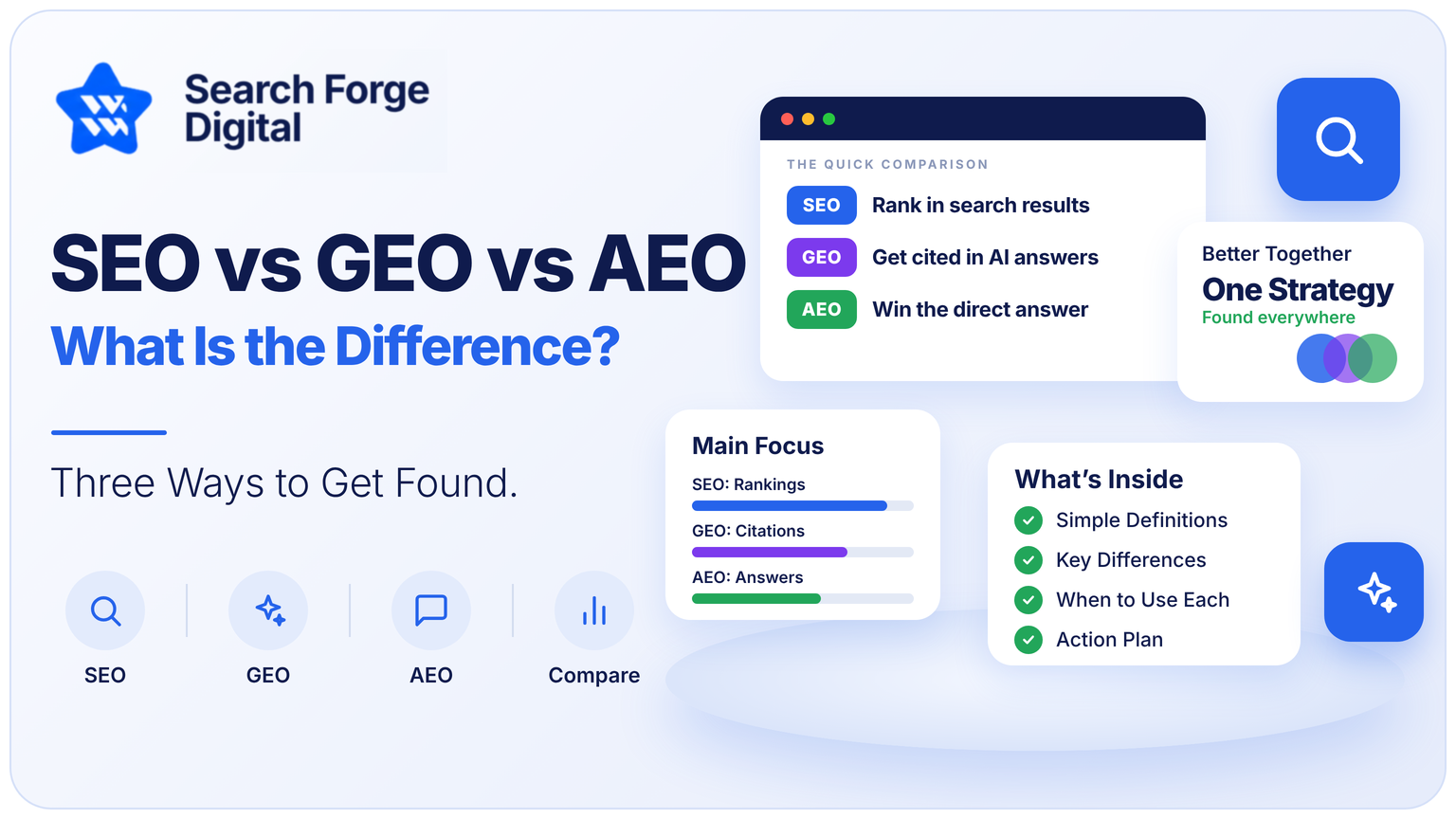
If you work in marketing you have probably heard three acronyms in the same meeting: SEO, GEO and AEO. One person says they are three strategies. Another says it is all SEO with a new name. A third says AEO and GEO are the thing. They are all partly right which is why the confusion exists. The three terms overlap,. Each one aims at a different kind of result: a ranked link, an AI-generated answer or a direct answer box. This article defines each term in language compares them side, by side and shows how to combine them without tripling your workload.
Quick Definitions: SEO, GEO and AEO
What is SEO? Search Engine Optimization (SEO) is the practice of improving your website so it ranks higher in search engine results, mainly on Google and Bing. The goal is to earn a position on the results page so people click through to your site. SEO covers technical health, content quality, keyword targeting, internal linking and authority built through backlinks.
What is GEO? Generative Engine Optimization (GEO) is the practice of improving your chances of being mentioned, cited or recommended inside answers written by generative AI tools. These include ChatGPT, Google Gemini, Perplexity, Microsoft Copilot, Claude and Google’s AI Overviews. The term gained attention after a 2023 academic paper on optimizing content for generative search engines. The goal is not a click on a list of links. It is to become part of the answer itself.
What is AEO? Answer Engine Optimization (AEO) is the practice of structuring your content so it can be used as the direct answer to a question. Think of featured snippets, “People also ask” boxes, knowledge panels and voice assistant replies. If you are searching for “what is AEO”, this is the core idea: give the clearest, shortest, most trustworthy answer to a specific question, so that any system that delivers answers picks yours.
A quick note on language. These labels are still settling. Some people use AEO as an umbrella term that includes AI chat answers, which makes it nearly the same as GEO. Others keep AEO for snippets and voice, and GEO for generative AI. In this guide, we use the narrower definitions above because they make the differences easier to see.
Side-by-Side Comparison Table
| SEO | GEO | AEO | |
|---|---|---|---|
| Main goal | Rank pages high in search results | Get your brand mentioned or cited in AI-generated answers | Be the direct answer to a specific question |
| Where results appear | Search engine results pages (blue links, local pack, shopping) | Inside AI responses in ChatGPT, Gemini, Perplexity, Copilot, AI Overviews | Featured snippets, People Also Ask, knowledge panels, voice assistants |
| Success metric | Rankings, organic traffic, clicks, conversions | Mention rate, citation rate, sentiment, share of voice | Snippet ownership, answer box appearances, voice answer selection |
| Content style | Comprehensive pages built around keywords and search intent | Clear, specific, well-sourced content backed by strong third-party presence | Short, direct answers to one question, followed by supporting detail |
| Key signals | Backlinks, relevance, page experience, technical health | Brand reputation across the web, consistent facts, original data, crawlability for AI tools | Clear structure, concise answers, structured data, topical accuracy |
| Typical time to see results | Months | Weeks to months, depending on the platform | Weeks to months |
| Click-through behaviour | Users click through to your site | Users may get what they need without clicking | Users often get the answer without clicking |
The table shows a simple pattern. SEO is about position. AEO is about the answer. GEO is
about being part of the conversation an AI is having with the user.
Where They Overlap
The three disciplines are closer cousins than rivals. Most of the foundations are shared.
- Quality content comes first. Helpful, accurate, original content is the base of all three. Thin or copied pages struggle everywhere.
- Technical health matters. If search engines or AI tools cannot crawl and understand your site, none of the three will work. Fast pages, clean structure and sensible internal links help across the board.
- Search intent drives everything. Whether someone types a query, asks a chatbot or speaks to a voice assistant, they have a need. Understanding that need is the starting point.
- Trust and authority count. Author expertise, reliable sources, reviews and a strong reputation help you rank, get quoted by AI and win answer boxes.
- Structured content is easier to use. Clear headings, direct answers and structured data make your content easier for people, search engines and AI models to read.
- They support each other. Pages that rank well are more likely to be found by AI tools that search the web live. Content that wins answer boxes often gets reused in AI answers too.
In short, if you already do SEO properly, you have done a large part of the work for GEO and AEO as well.
Where They Differ
The differences are real, though. They show up in four main places.
1. The unit of success In SEO, you win a page position. In AEO, you win a single answer. In GEO, you win a mention inside a longer, written response, often alongside competitors. A page ranking number three in Google may still get decent traffic. A brand mentioned fifth in an AI answer may get very little attention.
2. Where your reputation is built SEO rewards what happens on your site and in your link profile. GEO leans heavily on what the wider web says about you: reviews, industry articles, comparison pages, discussions and mentions on trusted sites. A brand with a weaker website but strong third-party coverage can still appear often in AI answers.
3. How content is written SEO content often covers a topic in depth and targets several related keywords. AEO content puts a clear, concise answer near the top, ideally in the first one or two sentences under a question-style heading. GEO content works best when it is specific and factual, stating plainly who you serve, what you offer and what makes you different, so a model can describe you accurately.
4. How you measure it SEO has mature tools and metrics: rankings, impressions, clicks and conversions. AEO can be tracked partly through snippet and answer box reports in SEO tools. GEO measurement is newer and less standardised. It usually means running a set of prompts across AI tools and recording mentions, citations and sentiment. The numbers can also change between runs, so patterns matter more than any single result.
Another practical difference is traffic. SEO is designed to send visitors to your site. AEO and GEO may build awareness and trust even when nobody clicks. That means your reporting needs to look beyond website visits.
Do You Need All Three?
The honest answer is: it depends on your business, but most brands should at least consider all three.
You should prioritise SEO if:
- Most of your leads still come from Google and Bing
- You run a local business, an online shop or a content site that relies on search traffic
- Your site has technical problems or thin content that need fixing first
You should add AEO if:
- Your audience asks lots of direct questions (how, what, why, how much)
- You want to win snippets and appear in voice search
- You have strong informational content that can be tightened into clear answers
You should add GEO if:
- Your customers research products or services by asking AI assistants
- You operate in a competitive category where shortlists matter, such as software, finance, travel or professional services
- You sell across several countries and want to understand how AI describes your brand in different markets
The key point is the order of priority. If your SEO foundations are weak, fix those first, because they feed the other two. If they are solid, adding GEO and AEO is a smaller step than it looks.
A Simple Combined Strategy
You do not need three separate teams or three content calendars. Here is a practical way to cover all of them with one workflow.
Step 1: Start with one list of customer questions. Gather the questions your audience asks. Use search suggestions, People Also Ask boxes, sales calls, support tickets and AI tools themselves. This single list feeds all three strategies.
Step 2: Build each page around one clear question and a strong answer. Put the question in a heading. Give a direct answer in the first one or two sentences. Then add the depth, examples and evidence below. The top supports AEO, the depth supports SEO, and the clarity helps GEO.
Step 3: Be specific and consistent about your brand. State what you do, who it is for and where you operate. Use the same facts on your website, social profiles and business listings. Consistency helps both search engines and AI models trust what they read.
Step 4: Strengthen your technical base. Keep your site fast, crawlable and well organised. Add structured data where it fits, and check that your robots.txt file is not blocking the crawlers you want to reach.
Step 5: Earn mentions beyond your own site. Seek reviews, expert quotes, guest articles, partnerships and genuine coverage on respected sites. These help your authority in SEO and are often a key source for AI answers.
Step 6: Publish something original. Data, case studies and expert opinions give search engines and AI models a reason to choose you over a page that repeats what everyone else says.
Step 7: Measure all three together. Track rankings and organic traffic for SEO, snippet and answer box appearances for AEO, and mention rate, citations and sentiment for GEO. Review them monthly and look for gaps. If you rank well but are never mentioned by AI tools, that is your next opportunity.
This approach keeps the workload manageable. Most of the effort goes into the same asset: well-structured, trustworthy, genuinely useful content.
Final Thoughts
SEO, GEO and AEO are not competing ideas. They are three views of one goal: being the brand people find, trust and choose, whether they find you through a list of links, a quick answer or an AI conversation.
Start with strong SEO foundations, write content that answers real questions clearly, build your reputation beyond your own website and measure all three together. That is a manageable plan, and it prepares you for how people search today and how they will search tomorrow.
Not sure where your brand stands in search and AI answers? The team at SearchForge Digital can review your current SEO, answer-box presence and AI visibility, then build a practical plan to improve all three. Contact us today to get started.


