An SEO strategy template is a structured document that turns your search goals into a repeatable plan: what you will target, what you will publish, what you will fix, and how you will measure it. Without one, SEO becomes a list of disconnected tasks. With one, every page, link and report ties back to a business goal.
This template is built for how search works today. It covers traditional rankings and AI-generated answers in a single plan, runs over five months, and works with free data from Google Search Console as well as Semrush or Ahrefs exports. Below you will find the eight sections to fill in, a worked example, a KPI table and the mistakes that most often derail a plan.
What an SEO Strategy Template Should Include
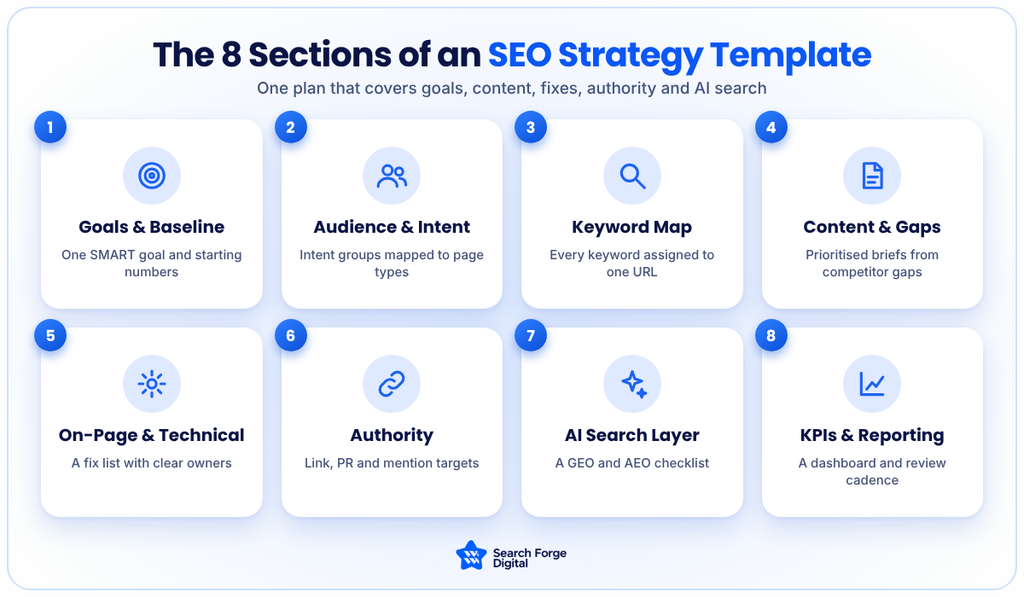
A useful template answers eight questions. If a section does not produce a clear output, it is not doing its job.
#
Section
Question it answers
Output
1
Goals and baseline
Where are we, and where do we need to be?
One SMART goal and baseline numbers
2
Audience and intent
Who is searching, and what do they want?
Intent groups mapped to page types
3
Keyword map
Which keyword belongs to which page?
A keyword-to-URL table
4
Content and gaps
What do competitors rank for that we do not?
Prioritised content briefs
5
On-page and technical
What stops our pages from ranking?
A fix list with owners
6
Authority
Why should search engines trust us?
Link and mention targets
7
AI search layer
Can AI systems understand and cite us?
A GEO and AEO checklist
8
KPIs and reporting
Is the plan working?
Step 1: Set Your Goal and Baseline
Before changing anything, record where you stand. Without a baseline, you cannot prove progress five months from now.
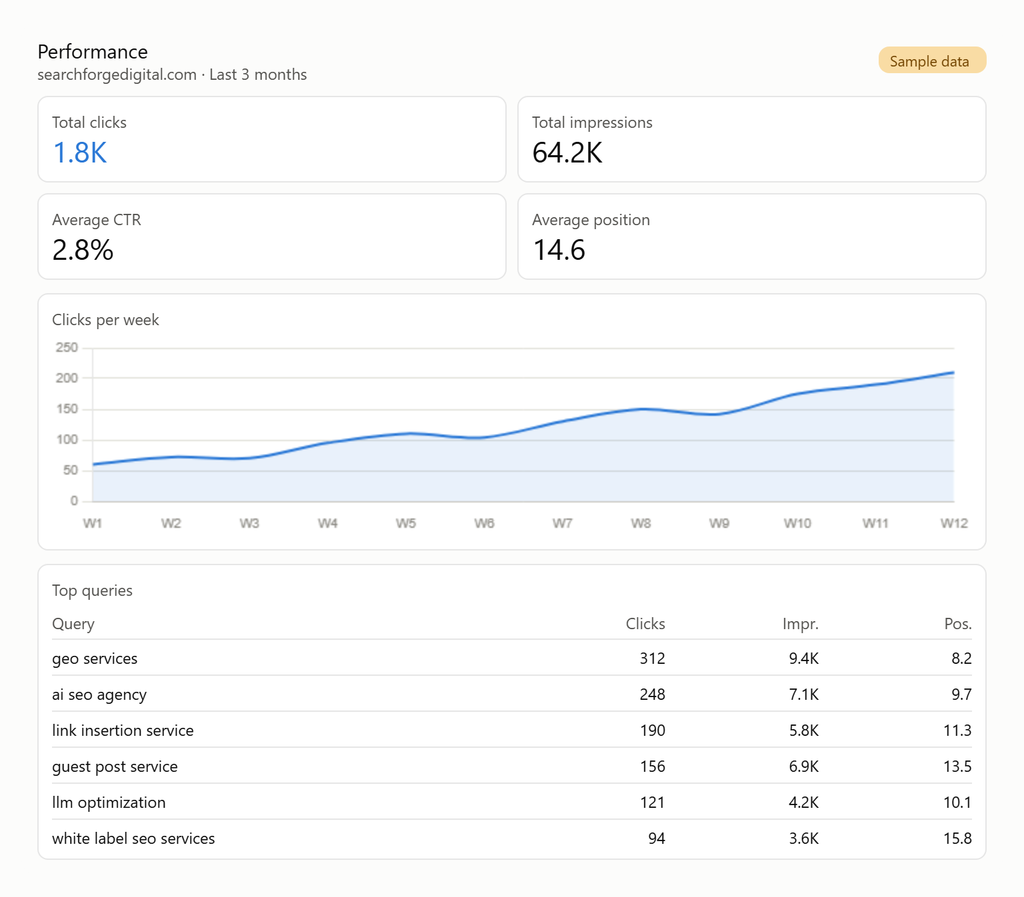
Total clicks and impressions for the last 28 days and the last 3 months
Average position and click-through rate
Your top 50 pages and top 50 queries
Indexed pages and any coverage errors
Core Web Vitals status
Then write one SMART goal. Make it specific, measurable, realistic for your current traffic, relevant to revenue, and time-bound.
A small site can often double its traffic. A site with millions of visits will find a 50% lift far harder. Set the target against your starting point, not against someone else’s case study.
Step 2: Define Your Audience and Search Intent
Keywords only rank when the page type matches the intent behind them. Before mapping anything, search your target phrase in Google and study the first page of results. If it shows guides, write a guide. If it shows service pages, build a service page. Publishing the wrong format is one of the most common reasons good content fails to rank.
Record each audience segment with its main question, the intent behind it and the page type that serves it.
Audience segment
Typical search
Intent
Best page type
Small business owner
What is an SEO strategy?
Informational
Guide or explainer
Marketing manager
Best SEO strategy template
Commercial
Comparison or listicle
Ecommerce store owner
Hire a Shopify SEO agency
Transactional
Service page
Existing prospect
Search Forge Digital reviews
Navigational
Homepage or case studies
Step 3: Build a Keyword Map
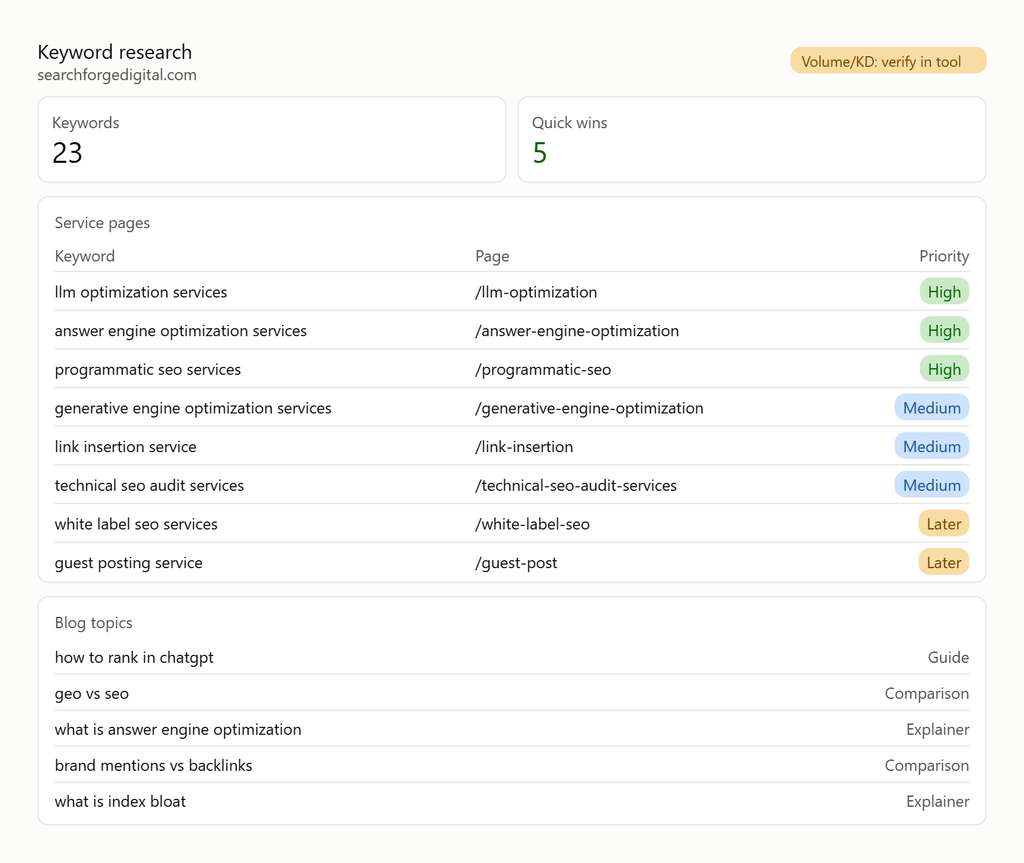
A keyword list is research. A keyword map is a plan. Assign every target keyword to exactly one page, and make sure that page matches the intent you identified in Step 2.
Keyword
Intent
Volume (relative)
Difficulty (relative)
Target URL
Status
what is an seo strategy
Informational
Medium
Low
/what-is-seo-strategy
Not started
seo strategy template
Informational
Medium
Medium
/seo-strategy-template
In progress
link building services
Transactional
Medium
High
/link-building
Done
Follow these three rules to keep the map useful:
One keyword, one page. If two pages compete for the same query, merge them or differentiate their intent.
Group by topic cluster. A pillar page supported by focused articles signals depth better than isolated posts.
Start with winnable terms. Long-tail phrases with lower difficulty and clearer intent give a new or mid-authority site a realistic route to early traffic before it competes on broader terms.
Your money pages, such as Premium SEO and Local SEO service pages, should sit at the centre of each cluster, with informational articles linking into them.
Step 4: Plan Content and Close Content Gaps
A content gap is a topic your competitors rank for and you do not. To find them, take the top 10 ranking URLs for each priority cluster and compare their coverage with yours. Score each gap on three factors: traffic potential, ranking difficulty and business value. Turn the top eight to twelve into briefs.
Every brief should contain:
Target keyword and secondary keywords
Search intent and page type
Working title, slug and meta description
Outline with H2 and H3 headings
Questions to answer, taken from People Also Ask and competitor pages
Internal links to include and the call to action
Owner and publishing date
If you do not have a publishing system yet, our content marketing service builds this workflow for you. The brief is what turns research into pages that actually get published.
Step 5: Fix On-Page and Technical SEO
Content cannot rank on a site that search engines struggle to crawl. Run the on-page checks on every target page and the technical checks across the site.
On-page checklist
Title tag under 60 characters with the primary keyword near the start
Meta description written to earn the click
One H1 that matches the search intent
Descriptive internal links with natural anchor text
Image alt text and compressed file sizes
Article, FAQ or Service schema where it fits
Our on-page SEO service covers each of these signals in detail.
Indexation: no important pages blocked or marked noindex
Core Web Vitals: loading, interactivity and layout stability within recommended thresholds
Redirects: no chains or loops, no broken internal links
Mobile usability and HTTPS
If you want a specialist to work through this list, see our technical SEO service, our technical SEO audit or our Core Web Vitals optimization. Budget time for this step in the plan. Technical fixes rarely look impressive in a report, but they set the ceiling for everything else.
Step 6: Plan Your Authority Building
Rankings last when other trusted websites point to your content. Authority work sits outside your site, so it needs its own section in the plan.
Quality matters more than volume. A handful of links from relevant, trusted publications will do more than hundreds from low-quality sites. Link to the pages that earn revenue, and use internal links to pass authority from your strongest informational articles to those pages.
Step 7: Add the AI Search Layer
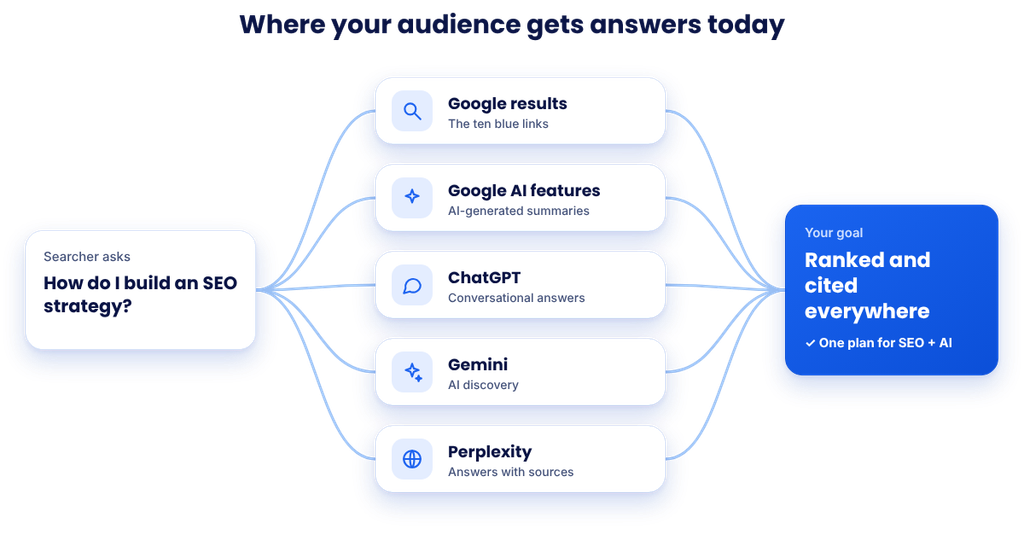
People now get answers from ChatGPT, Gemini, Perplexity and Google’s AI features as well as from ten blue links. Most strategy templates ignore this. Yours should not.
The practical difference is structure. AI systems tend to draw on pages that answer a question clearly, come from a trusted source and use consistent information about the brand. Add this checklist to your plan:
Open each section with a direct, one or two sentence answer to the question in the heading
Use tables, lists and FAQ blocks that are easy to extract
Keep your brand name, services and descriptions consistent across your site and profiles
Add schema markup so machines can read your content type
Earn mentions on trusted third-party sites
Test your priority questions in AI tools each month and record whether you are cited
Separate early signals you watch often from outcomes you report to stakeholders.
KPI
Type
Source
Cadence
Indexed pages
Leading
Google Search Console
Weekly
Pages ranking in positions 5 to 20
Leading
Search Console or rank tracker
Weekly
Click-through rate by query
Leading
Search Console
Monthly
New referring domains
Leading
Backlink tool
Monthly
AI citations for priority questions
Leading
Manual prompt checks or visibility tool
Monthly
Organic sessions
Lagging
GA4
Monthly
Organic leads or sales
Lagging
GA4 and CRM
Monthly
Branded search volume
Lagging
Search Console
Quarterly
Pages ranking between positions 5 and 20 are usually where the quickest gains sit, so review them first. Hold a short weekly check, a monthly readout against this table and a quarterly review that decides what changes next.
Filled-In Example: A 5-Month SEO Plan
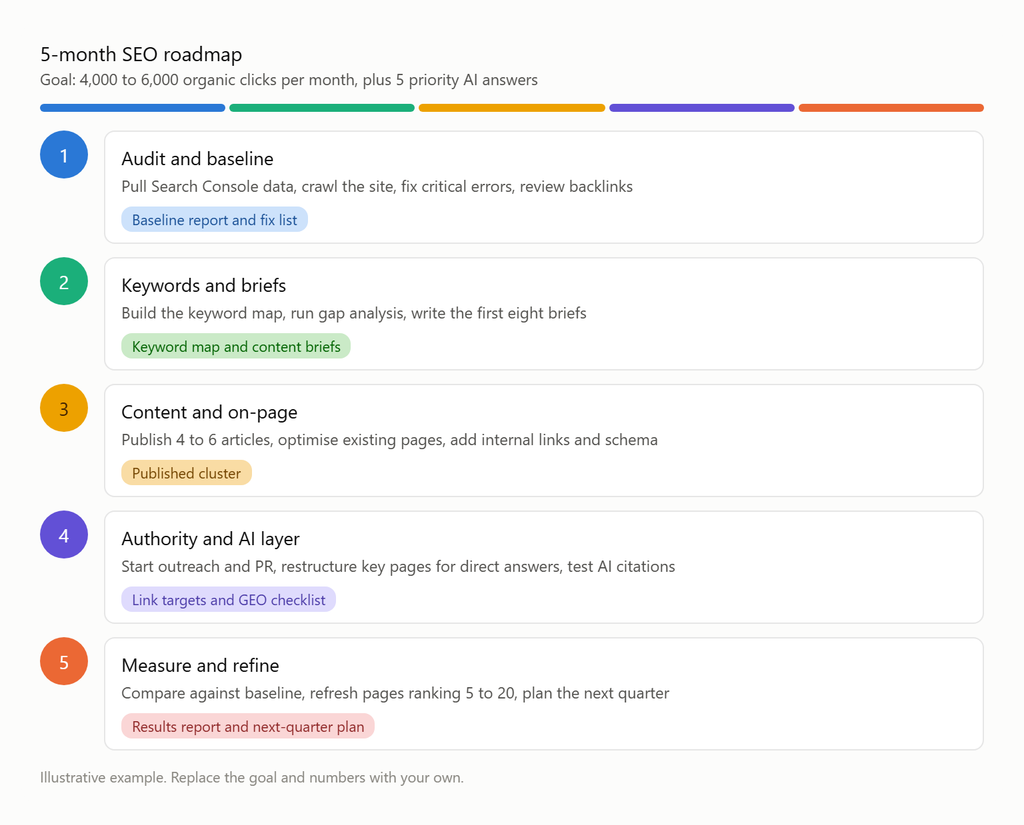
The example below is illustrative. It shows how the template looks for a fictional B2B accounting software company. Replace the numbers with your own.
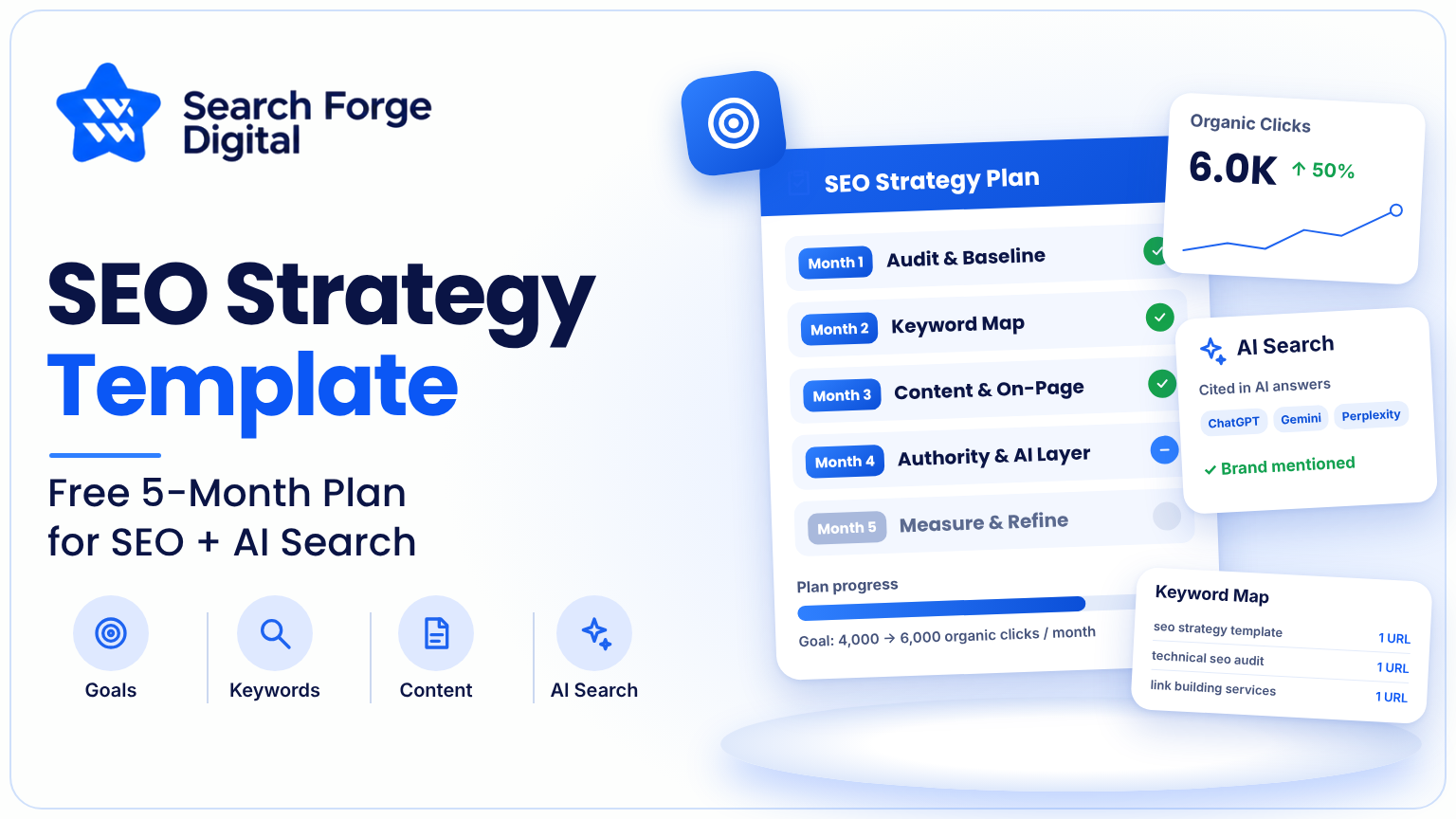
SMART goal: Grow organic clicks from 4,000 to 6,000 per month in five months, and appear in AI answers for five priority questions.
Build the keyword map, run gap analysis, write the first eight briefs
Keyword map and content briefs
3
Content and on-page
Publish four to six articles, optimise existing pages, add internal links and schema
Published cluster
4
Authority and AI layer
Start outreach and PR, restructure key pages for direct answers, test AI citations
Link targets and GEO checklist
5
Measure and refine
Compare against baseline, refresh pages ranking 5 to 20, plan the next quarter
This is the same structure we use when we build a growth roadmap for clients. If you want ours applied to your site, request a free SEO audit and we will map the opportunities.
Common Mistakes When Using an SEO Strategy Template
1. Choosing keywords by volume alone. High-volume terms are often the hardest and have the vaguest intent. Balance volume with difficulty, intent and business value.
2. Skipping the baseline. If you do not record where you started, you cannot show what changed.
3. Leaving out technical work. It has no flashy deliverable, so it is the first thing cut. It is also what caps your results.
4. Having no reporting rhythm. A plan that nobody reviews turns into a document nobody opens within a few months.
5. Planning only for Google rankings. Search now includes AI answers. A plan with no GEO or AEO layer is already out of date.
Build Your SEO Strategy With Confidence
A good SEO strategy template gives you a clear order of work: measure, map, publish, fix, build authority, prepare for AI search and review. Fill in the eight sections, assign an owner to every task and keep the review cadence.
If you would rather have experts build and run the plan, explore our SEO services or request a free SEO audit. We will review your site and show you where the biggest opportunities are.
An SEO strategy template is a ready-made framework for planning search optimisation. It organises goals, keyword research, content, on-page and technical fixes, link building and reporting into one document so a team can follow the same plan.
How long should an SEO strategy cover?
A 90-day plan is the shortest period in which results become measurable. We prefer five months because it allows time for audit, publishing, authority building and a proper review. Treat the end of the period as input for the next plan, not the finish line.
What should an SEO strategy include?
It should include goals and a baseline, audience and intent research, a keyword map, a content plan, on-page and technical fixes, authority building, an AI search layer and a KPI dashboard with a review cadence.
Can I use the template without paid SEO tools?
Yes. Google Search Console and Google Analytics provide the baseline and tracking data. Paid tools such as Semrush or Ahrefs speed up keyword and competitor research, but the structure works without them. You can also try our free SEO tools for quick checks.
How is an SEO strategy different from an SEO plan?
The strategy explains why you will win and where you will compete. The plan lists what the team will do, when and who owns each task. This template combines both so the plan always traces back to the strategy.
Rate the article
MUHAMMAD REHMAN
Founder & CEO, Search Forge Digital
Copy our SEO strategy template with goals, keyword mapping, content plan, technical checklist and AI search KPIs. Includes a filled-in example.