Generative Engine Optimization (GEO) has become an important part of modern search strategy as more people use AI platforms to discover brands, products, services, and information. Instead of relying only on traditional search results, users can now ask detailed questions through ChatGPT, Perplexity, Gemini, Google AI Overviews, Google AI Mode, Claude, and other AI-powered search experiences.
That creates a different visibility challenge for businesses. A company can rank well in Google and still have limited visibility in AI-generated answers. Conversely, a brand that does not dominate traditional search rankings may still appear frequently in AI recommendations if its information is well represented across authoritative websites and other sources.
This is why GEO tools have become useful. They help marketers understand where a brand appears in AI answers, which prompts trigger mentions, which websites are being cited, how competitors are performing, and where content or authority gaps may exist.
However, there is no single GEO tool that does everything perfectly. Some platforms are built primarily for monitoring. Others focus more heavily on citations and competitive intelligence, while some combine GEO with content creation, technical SEO, or broader digital marketing workflows.
Below are 10 Generative Engine Optimization tools worth knowing in 2026 and what makes each one different.
1. Profound
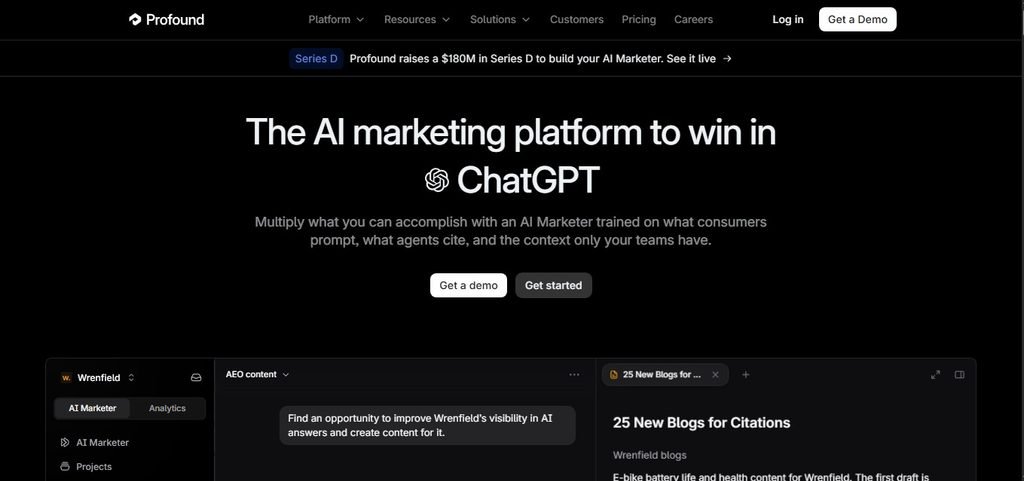
Profound is designed for organizations that need deeper AI-search intelligence rather than simple manual prompt checking. Its platform monitors how brands appear across AI answer engines and provides data around visibility, citations, sentiment, competitors, and prompts.
One of Profound’s notable features is its prompt research capability. The platform says its Prompt Volumes dataset now covers more than 1.3 billion real-user AI conversations, allowing teams to validate potential prompts before adding them to a monitoring strategy. This is important because creating hundreds of random prompts does not necessarily produce useful GEO data. The quality and relevance of the prompt set matter.
Profound also tracks prompts daily and captures the generated answers, citation sources, and visibility data. Marketers can examine visibility score, visibility rank, share of voice, citation behavior, and sentiment across different platforms, regions, topics, and audience segments.
Its citation analysis is another major component. Teams can see which pages and publishers AI systems cite, categorize those sources, compare citation share against competitors, and identify publishers that influence AI answers in a particular industry.
Profound has also expanded beyond monitoring. Its 2026 product updates include agent-based workflows designed to turn AI-search insights into content, optimization, outreach, and reporting actions.
For large marketing teams, enterprises, and organizations that need detailed AI-search intelligence across markets, Profound is particularly relevant.
2. OtterlyAI
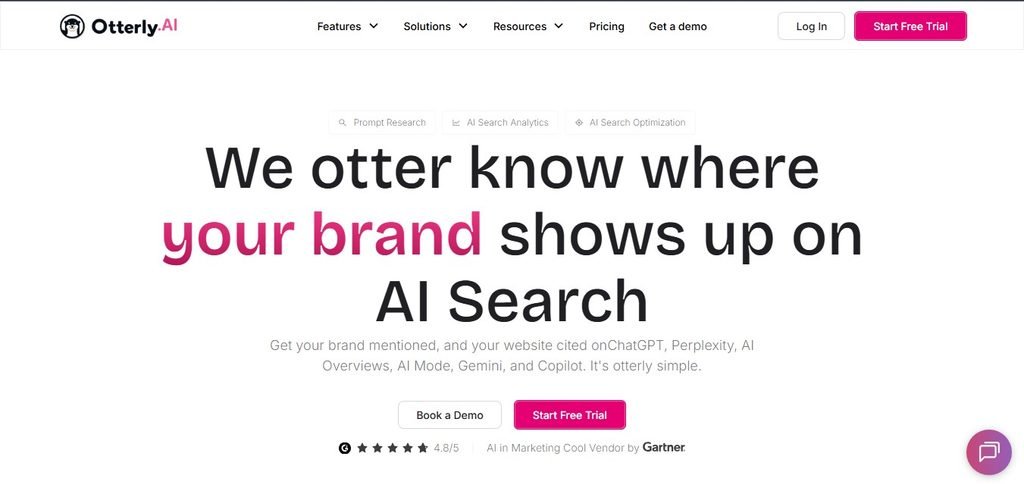
OtterlyAI takes a more accessible approach to AI visibility monitoring. It is designed to help marketers track how their brands appear in AI-generated answers and understand which websites and pages are being cited.
The platform currently tracks major AI search environments including ChatGPT, Google AI Overviews, Google AI Mode, Gemini, Perplexity, Microsoft Copilot, and Claude. It also supports monitoring across multiple countries and languages.
One of its core features is prompt monitoring. A marketer can define questions that potential customers might ask and then monitor how AI systems answer those questions over time. The platform reports whether the brand was mentioned, which competitors appeared, and which sources were cited.
OtterlyAI also provides citation tracking. Instead of looking only at whether a brand appears, marketers can investigate the actual URLs and domains that AI systems reference. This can reveal opportunities where competitors are being cited repeatedly while the target brand is absent.
Another useful feature is its competitive benchmarking. Brands can be compared through metrics such as mentions, coverage, citations, and visibility. OtterlyAI also offers sentiment analysis to help identify whether AI-generated descriptions of a brand are positive, neutral, or negative.
For agencies managing multiple clients, its workspace functionality is particularly useful because different brands can be managed separately within the same subscription.
The main difference is that OtterlyAI is strongly focused on making AI visibility tracking practical and accessible rather than positioning itself purely as a large enterprise intelligence platform.
3. Peec AI
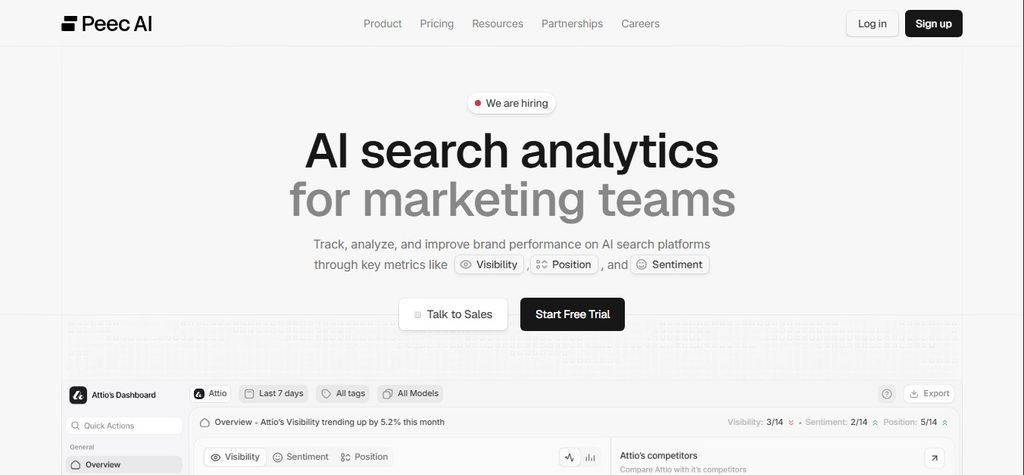
Peec AI is another dedicated AI-search analytics platform focused on understanding how brands are represented in generative search.
The platform tracks metrics such as visibility, position, sentiment, and citations across AI search environments. Its documentation currently lists ChatGPT, Google AI Overviews, Google AI Mode, Gemini, Perplexity, and other AI engines among its monitored platforms.
One useful aspect of Peec AI is that it treats AI visibility as more than a simple mention/no-mention measurement. A brand can appear in an answer without necessarily receiving a strong position or favorable description. Monitoring position and sentiment therefore provides additional context.
Citation analysis is also important because a brand may be discussed by AI while another website receives the actual citation. That distinction matters. Being mentioned and being used as a source are not always the same thing.
Peec AI is therefore useful for teams that want to monitor how their brand and competitors appear across specific AI prompts and understand changes over time.
Its practical role is largely around measurement and insight: identify where the brand appears, where competitors appear, what sources are being used, and which opportunities deserve attention.
4. Scrunch AI
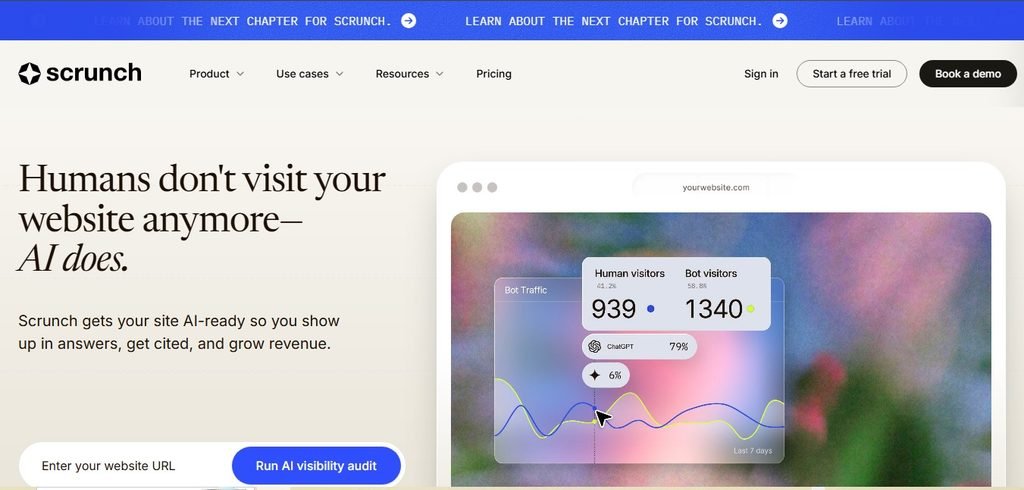
Scrunch AI approaches GEO from the perspective of AI visibility and how AI systems interpret, retrieve, and represent a brand.
Traditional SEO platforms are usually built around keywords, rankings, backlinks, and search-engine results pages. Scrunch focuses more directly on prompts and AI-generated answers. Its platform tracks metrics including brand presence, competitive presence, share of voice, response position, sentiment, citations, AI bot traffic, AI referrals, and AI search trends.
This makes Scrunch useful when a business wants to understand not just whether it appears in AI answers but how AI systems are representing it.
Another relevant feature is geographic monitoring. Scrunch supports country-level geographic targeting and allows marketers to compare AI responses across different markets. This matters because AI-generated answers can change depending on the user’s location.
Scrunch is particularly interesting for companies operating across multiple markets or organizations that want a more dedicated AI-search visibility platform rather than simply adding one GEO feature to an existing SEO tool.
Its core difference is its focus on the AI-search layer itself, including how brands are represented, cited, and accessed by AI systems.
5. Semrush AI Visibility Toolkit
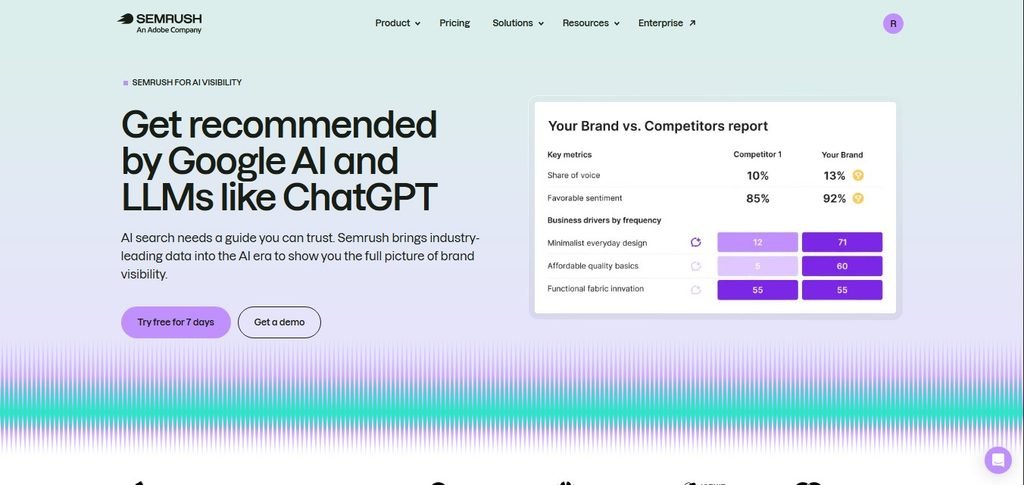
Semrush is different from dedicated GEO-first platforms because AI visibility is part of a much larger SEO and digital marketing ecosystem.
For teams already using Semrush, this can be a major advantage. Instead of maintaining completely separate workflows for traditional SEO and AI search, marketers can analyze both areas within the broader Semrush environment.
The AI Visibility Toolkit provides visibility benchmarking, brand mentions, sentiment analysis, competitor comparisons, prompt research, citation analysis, and AI-search tracking. Semrush currently tracks AI environments including ChatGPT, Gemini, Google AI Mode, Google AI Overviews, and Perplexity within its AI visibility workflows.
Its competitor research feature allows marketers to compare their AI visibility against multiple competitors and examine differences in mentions, citations, and topic coverage.
Semrush also connects AI visibility with content optimization. Its Content Toolkit includes AI-search optimization functionality that evaluates content against factors associated with citation performance and provides recommendations around structure, clarity, and entity signals.
That makes Semrush particularly useful for SEO teams that do not want to separate traditional search strategy from GEO.
The difference is straightforward: Semrush brings GEO into an established SEO platform, while tools such as Profound, Peec AI, and OtterlyAI are more directly centered around AI visibility.
6. Ahrefs Brand Radar
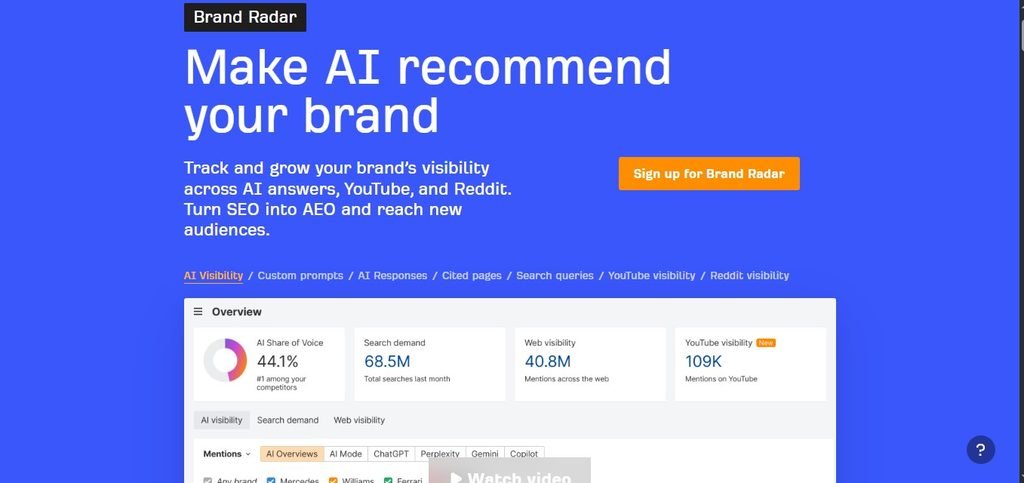
Ahrefs Brand Radar adds AI visibility monitoring to the Ahrefs ecosystem.
Its approach is interesting because it uses a very large prompt database modeled from search demand. Ahrefs currently says Brand Radar can analyze hundreds of millions of search-backed prompts and track brand visibility across AI platforms. Its supported AI surfaces include Google AI Overviews, Google AI Mode, ChatGPT, Perplexity, Gemini, Copilot, and Claude, with availability varying by feature.
Brand Radar measures several important metrics, including mentions, citations, impressions, and AI Share of Voice. This lets marketers move beyond the simple question of whether a brand was mentioned and instead examine its relative visibility against competitors.
Another useful feature is custom prompt tracking. Businesses can monitor specific questions that matter to their audience rather than relying only on a broad prebuilt dataset. Ahrefs also provides insights into cited pages and domains, helping users understand which sources influence AI answers.
Ahrefs also connects AI visibility with other discovery channels such as search, YouTube, Reddit, and TikTok. That is important because AI visibility does not necessarily come only from a company’s own website. Third-party content and community sources can also influence what AI systems surface.
For companies already using Ahrefs for traditional SEO, Brand Radar provides a natural way to extend their existing workflow into AI search.
7. AthenaHQ
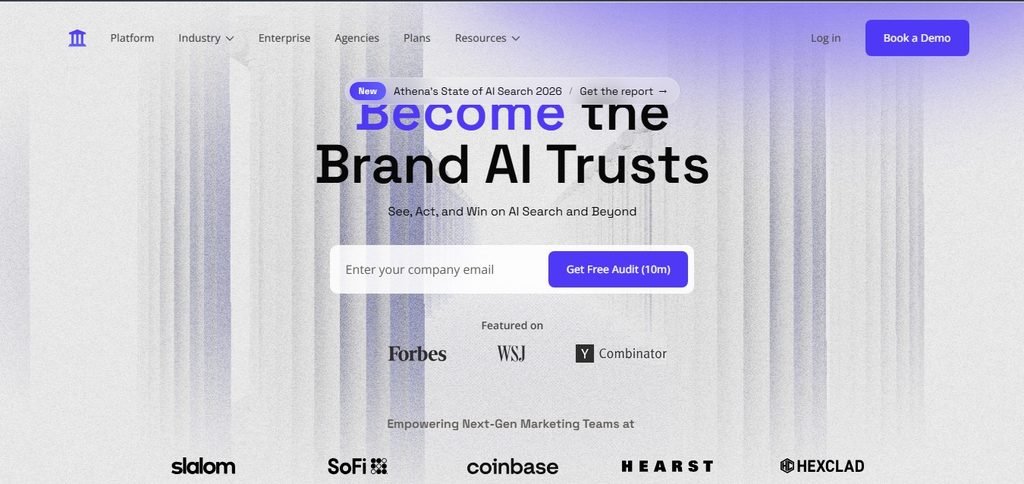
AthenaHQ is positioned as a dedicated AI-search optimization platform that combines monitoring with optimization workflows.
Its platform currently tracks visibility across more than eight major AI platforms, including ChatGPT, Perplexity, Gemini, Claude, Copilot, Grok, Google AI Overviews, and Google AI Mode.
The platform focuses on metrics such as brand mentions, citations, share of voice, and competitive visibility. It also provides source analysis to help marketers understand which websites influence AI-generated responses.
Where AthenaHQ becomes more interesting is the optimization side. Its workflow includes content gap analysis, AI-friendly content templates, citation optimization, and reporting intended to help teams move from monitoring to actual GEO execution.
This distinction is important because a dashboard alone does not improve visibility. A tool can tell you that a competitor is cited more frequently, but the marketing team still needs to determine why and what action should follow.
AthenaHQ is therefore relevant for teams looking for a platform that combines AI visibility measurement with optimization workflows.
8. Writesonic GEO
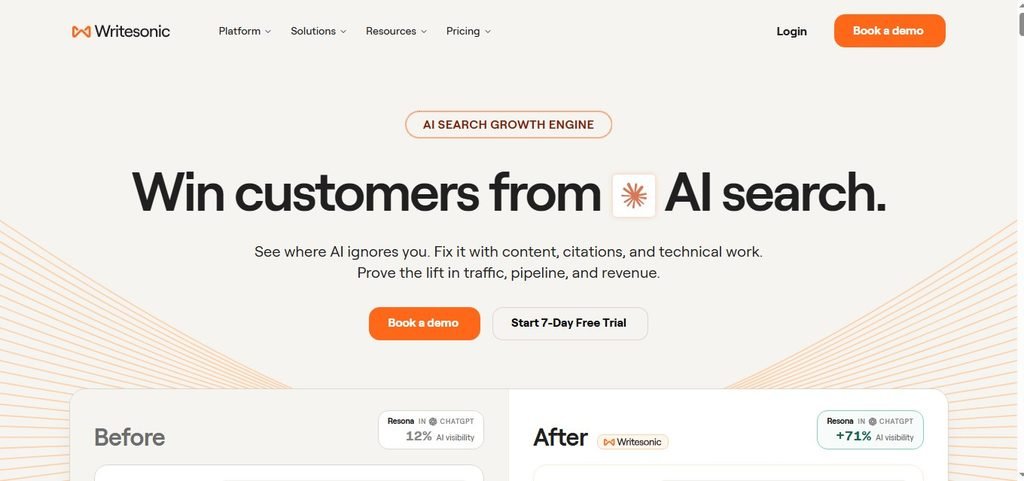
Writesonic has traditionally been associated with AI-assisted content creation, but its platform has expanded significantly into AI visibility and GEO.
Its GEO capabilities allow marketers to track how brands appear across AI search platforms, including ChatGPT, Claude, Perplexity, Gemini, Google AI Overviews, and other AI environments. The platform tracks visibility, citations, competitors, sentiment, and other AI-search metrics.
What separates Writesonic from a pure monitoring tool is its emphasis on execution.
Its platform is designed to connect visibility data with content creation and optimization workflows. For example, a marketer can identify a citation gap, examine competitor visibility, discover a content gap, and then move into content creation or optimization rather than stopping at the reporting stage.
Writesonic also provides AI bot analytics, allowing teams to examine how AI crawlers interact with their websites, including which pages they access and how AI platforms discover content.
For agencies and content-heavy marketing teams, this execution layer can be useful because GEO often requires more than simply monitoring AI responses.
The key difference is that Writesonic attempts to connect AI visibility → diagnosis → content/technical action → measurement within a single workflow.
9. SE Visible
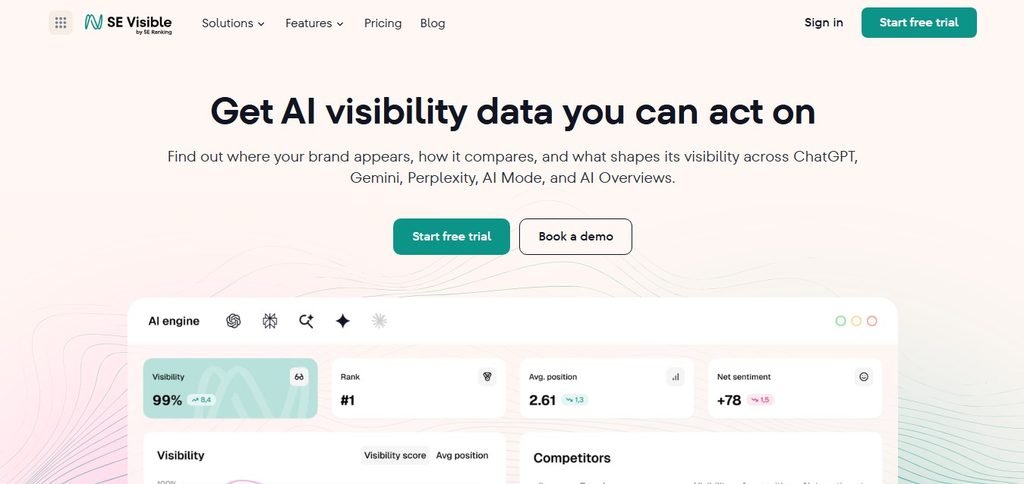
SE Visible is the dedicated AI-search visibility solution from the SE Ranking ecosystem.
While SE Ranking remains focused on traditional SEO workflows, SE Visible concentrates specifically on how brands appear across AI search systems. The platform provides metrics around visibility, competitor presence, average position, sentiment, and citations.
Its Sources view is particularly useful for understanding which domains and URLs are influencing AI responses for tracked prompts. It can identify websites that mention competitors but not the target brand, which can reveal potential content, PR, partnership, or outreach opportunities.
SE Visible is also developing deeper competitive intelligence and gap-analysis capabilities as part of its 2026 roadmap, alongside improved reporting, source analysis, team collaboration, and prompt management.
For SEO professionals already familiar with SE Ranking, SE Visible provides a more specialized route into AI-search visibility without abandoning the broader SEO ecosystem.
Its main distinction is the separation between traditional SEO management in SE Ranking and strategic AI visibility analysis in SE Visible.
10. Goodie AI
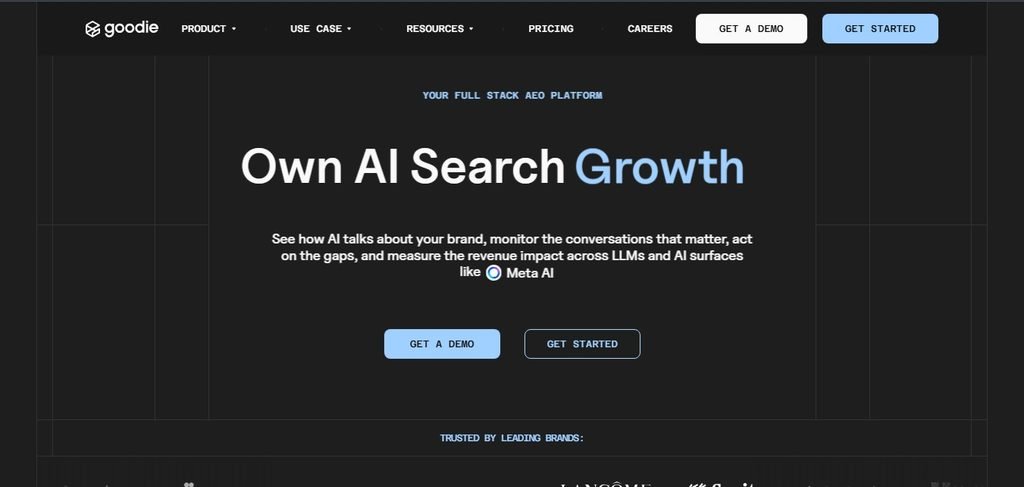
Goodie AI is another name appearing in the growing GEO and AI-visibility software category in 2026.
Unlike traditional SEO platforms, tools in this category are designed around the problem of understanding how AI systems discover and describe brands. Goodie AI is generally positioned around AI-search visibility and helping marketers understand how brands are represented in generative answers.
Its relevance comes from the broader shift in GEO software: marketers increasingly need tools that do more than measure Google rankings. They need to monitor AI mentions, citations, competitor visibility, and the sources that influence generated answers.
Goodie AI is therefore worth evaluating alongside dedicated GEO platforms when building a broader AI-search technology stack. However, because this market is changing quickly, marketers should verify current engine coverage, prompt limits, reporting depth, integrations, and pricing before selecting it for a long-term workflow.
That is an important point with GEO tools generally. The category is still evolving rapidly, and features that are available today may change substantially over the next few months.
What Makes These GEO Tools Different?
At first glance, many GEO platforms look almost identical. Most talk about AI visibility, citations, prompts, competitors, and share of voice.
The real differences appear when you look at what happens after the data is collected.
Some tools are primarily monitoring platforms. They answer questions such as: “Did my brand appear?” “Which competitor appeared?” “Which URL was cited?” and “How did visibility change?”
Other platforms are stronger in citation intelligence. They help identify the domains and pages that AI systems repeatedly use as sources, which can be valuable for content strategy, digital PR, and outreach.
Some tools are designed around content execution. They take visibility gaps and turn them into content briefs, optimization recommendations, or publishing workflows.
Then there are broader SEO platforms such as Semrush and Ahrefs. Their advantage is that they connect GEO data with traditional search data. This can be useful because SEO and GEO are not isolated disciplines.
A company does not necessarily need ten GEO tools.
In fact, buying several overlapping platforms can create more confusion than value.
The better approach is to start with the business objective. If the primary need is prompt-level visibility monitoring, a dedicated monitoring platform may be enough. If the goal is large-scale competitive intelligence, an enterprise-focused platform may make more sense. If the team already relies heavily on Ahrefs or Semrush, adding their AI visibility capabilities may be more efficient than introducing another complete platform.
What Should You Track With a GEO Tool?

The first metric to monitor is brand visibility. This tells you how frequently your brand appears in the AI answers generated for the prompts you are tracking.
The second is citation visibility. A brand can be mentioned without its website being cited. Tracking citations helps reveal whether AI systems are actually using the firm’s own content as a source.
The third is competitive visibility. You need to know not only whether your brand appears, but which competitors appear when it does not.
The fourth is source visibility. Look at the domains and pages that AI systems cite repeatedly. These sources can reveal what types of content, publications, directories, communities, and websites are influencing your market’s AI answers.
The fifth is sentiment or brand representation. Being mentioned is not automatically positive. AI systems can describe a company with favorable, neutral, or negative language depending on the available sources and context.
Finally, track changes over time.
AI search is dynamic. An answer that appears today may change after an AI model update, a new source becomes prominent, or the underlying web content changes. GEO should therefore be treated as an ongoing measurement and optimization process rather than a one-time technical task.
Do You Actually Need a GEO Tool?
Not every business needs an expensive GEO platform immediately.
A smaller business can begin by creating a carefully selected set of commercially relevant prompts and manually checking how different AI systems respond. This can provide an initial understanding of the competitive landscape.
However, manual checking becomes inefficient when the number of prompts, competitors, markets, and AI platforms increases.
That is where specialized tools become valuable.
Instead of manually repeating the same questions every week, a GEO platform can automate monitoring, store historical results, identify citations, compare competitors, and highlight changes.
For an agency managing multiple clients, this becomes even more important. Client reporting requires repeatable data, consistent measurement, and clear explanations of what changed and why.
The tool should support the strategy, not become the strategy.
A GEO dashboard full of impressive metrics is useless if the marketing team does not know which content to improve, which sources to pursue, or which technical problems to fix.
How Search Forge Digital Can Use GEO Tools
At Search Forge Digital GEO should not be treated as simply adding another software subscription to an SEO campaign.
The more useful approach is to combine AI visibility data with traditional SEO, technical optimization, content strategy, entity development, citation analysis, and authority building.
GEO tools can help identify where a brand is appearing, where competitors are being cited, which sources influence AI answers, and which prompts represent meaningful opportunities. The strategy then turns those insights into practical SEO, content, digital PR, and authority-building actions.
That is where the value of an agency comes in. The software provides data, but the strategy determines what to do with that data.
Final Thoughts
Generative Engine Optimization is still a developing discipline, and the software landscape is changing quickly.
The most useful GEO tools in 2026 are not necessarily the ones with the longest feature lists. The important question is whether a platform gives your team reliable visibility data and helps you understand what is actually influencing AI-generated answers.
Profound provides deep prompt, citation, and competitive intelligence. OtterlyAI focuses heavily on accessible AI visibility monitoring and citation tracking. Peec AI provides prompt-level visibility, position, sentiment, and citation analysis. Scrunch focuses on AI representation, visibility, citations, and AI-agent interaction. Semrush combines GEO with traditional SEO. Ahrefs Brand Radar connects AI visibility with its broader search and content ecosystem. AthenaHQ combines monitoring with optimization workflows. Writesonic places a stronger emphasis on turning GEO insights into content and technical actions. SE Visible provides dedicated AI visibility analysis within the SE Ranking ecosystem, while Goodie AI represents the growing category of specialized GEO platforms.
The right choice depends on what your business actually needs.
Most importantly, a GEO tool should not be treated as a magic button that makes AI systems recommend a brand. No legitimate platform can guarantee that outcome. AI responses depend on the query, model, available sources, location, freshness of information, and many other variables.
The real purpose of GEO software is to make that environment less of a black box.
Once you can see where your brand appears, which competitors are visible, what sources are being cited, and where the gaps exist, you have something much more valuable than a dashboard: you have information that can guide an actual search strategy.
And in 2026, that is becoming an increasingly important part of building visibility beyond the traditional search results page.