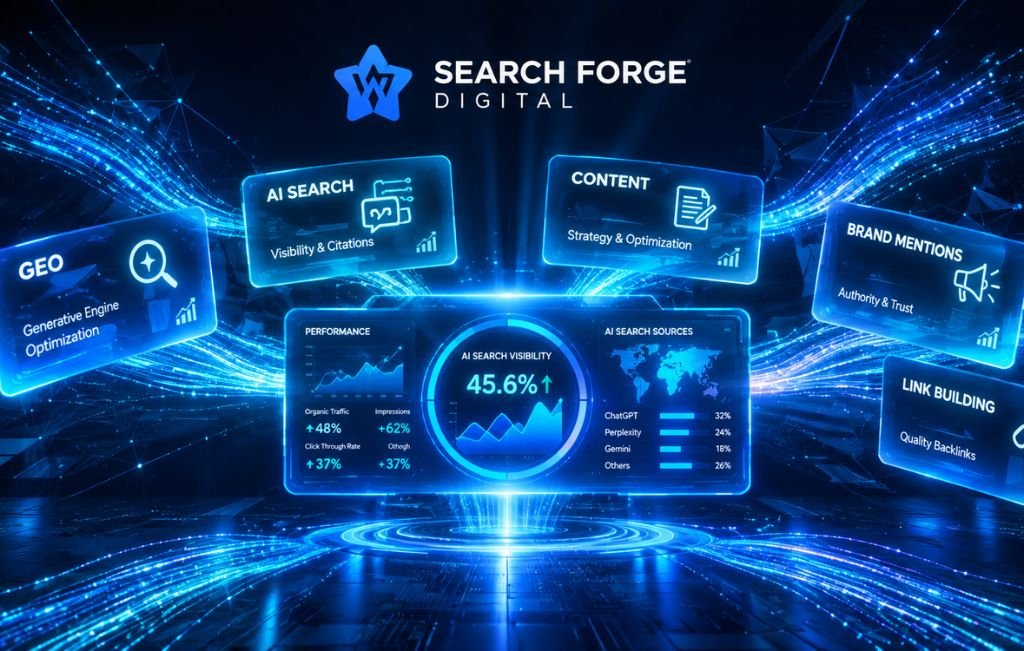

Search is changing. For years, businesses optimized their websites around a familiar model: a user entered a query into Google, search results appeared as a list of blue links, and the goal was to earn one of the highest positions. Today, users can ask the same question directly inside AI-powered experiences such as ChatGPT, Perplexity, Gemini, and Google’s AI search features and receive a synthesized answer instead of a traditional list of websites. This shift has created a new visibility challenge for businesses: it is no longer enough to be discoverable in conventional search results. Brands increasingly need to become sources that AI systems can understand, retrieve, cite, and potentially recommend.
This is where Generative Engine Optimization, or GEO, comes into the picture. GEO is the practice of improving a brand’s visibility and representation in answers generated by AI-powered search and generative engines. The concept was formally introduced in research published in 2023, which described GEO as a framework for improving the visibility of content within generative engine responses.
For technology companies, SaaS businesses, and B2B brands, this creates a significant strategic opportunity. A potential customer may no longer search only for “best CRM software” or “top cybersecurity platforms.” They may ask an AI system, “Which CRM is best for a 50-person B2B SaaS company?” or “What are the best cybersecurity vendors for a mid-market technology company?” The answer may contain a short list of companies, explanations, comparisons, and citations. If your brand is absent from that answer, traditional search visibility alone may not tell the whole story.
What Is Generative Engine Optimization?
Generative Engine Optimization is the process of making a brand, website, and supporting digital ecosystem more understandable, credible, retrievable, and citable across AI-powered search experiences.
Traditional SEO primarily focuses on helping search engines discover, understand, and rank web pages. GEO extends that visibility objective into environments where AI systems retrieve information from multiple sources and then synthesize that information into an answer.
The distinction matters because a generative engine does not necessarily behave like a traditional search results page. Instead of simply returning ten blue links, an AI system can combine information from different websites, interpret the user’s intent, summarize relevant information, and provide a direct response. Academic research on generative search describes these systems as synthesizing information from multiple sources to produce answers rather than simply displaying ranked documents.
That means GEO is not simply about inserting the phrase “Generative Engine Optimization” into more pages. It is about building enough topical relevance, factual clarity, authority, and digital evidence for AI systems to understand what a company does and why it should be considered relevant to a particular question.
For a SaaS company, for example, this could mean creating authoritative resources around its category, publishing original insights, developing clear product information, earning relevant third-party coverage, and building a consistent brand identity across the web. The objective is to make the company easier for both humans and machines to understand.
Why GEO Matters in Modern SEO

The growth of AI-powered search does not mean traditional SEO has suddenly become irrelevant. In fact, Google’s current documentation explicitly states that SEO best practices remain relevant for its generative AI search experiences because those experiences rely on Google’s core Search ranking and quality systems. Google also recommends unique, useful, people-first content and clear technical foundations for visibility in generative AI features.
The more accurate way to understand GEO is therefore as an evolution of search visibility rather than a replacement for SEO.
SEO helps establish discoverability and authority across conventional search. GEO focuses more specifically on how that information can be surfaced and represented when an AI system generates an answer. The two disciplines overlap heavily because AI systems still need accessible, useful, relevant information to retrieve and process.
For B2B companies, the difference becomes especially important because buying journeys are increasingly research-heavy. A potential customer can use AI to investigate vendors, compare technologies, understand unfamiliar categories, evaluate alternatives, and identify industry leaders before ever visiting a company’s website.
If your brand consistently appears in those research conversations, it can enter the buying journey earlier. If competitors repeatedly appear while your brand does not, you can lose visibility before a conventional search even begins.
GEO vs SEO: What Changes?

The relationship between SEO and GEO is best understood as complementary rather than competitive. SEO remains responsible for strong technical foundations, crawlability, indexing, relevance, content quality, and organic search visibility. GEO adds a stronger focus on how information about a brand can be retrieved, interpreted, cited, and represented by generative systems.
| Traditional SEO | Generative Engine Optimization |
|---|---|
| Primarily targets search engine results | Targets visibility inside AI-generated answers and generative search experiences |
| Focuses heavily on rankings and organic clicks | Focuses on mentions, citations, representation, and inclusion in relevant answers |
| Optimizes pages for search intent | Optimizes the broader information ecosystem around a brand and topic |
| Relies heavily on keywords, content, links, and technical SEO | Combines content, authority, entity clarity, citations, digital PR, and technical accessibility |
| Measures rankings, traffic, CTR, and conversions | Can additionally measure AI mentions, citations, answer presence, sentiment, and brand accuracy |
| Strongly connected to conventional search results | Strongly connected to AI retrieval and answer-generation environments |
The important point is that GEO should not encourage companies to abandon the fundamentals that made SEO effective. Google’s current guidance specifically warns against chasing supposed “GEO hacks” and emphasizes useful content, technical accessibility, and established SEO practices instead.
How Generative Search Engines Understand Brands
AI systems need context. A company name by itself does not tell an engine what the business does, who it serves, which category it belongs to, or when it should be recommended.
Consider a SaaS company that describes itself differently across its website, LinkedIn profile, industry publications, review platforms, and partner websites. One source calls it an “AI analytics platform,” another calls it a “business intelligence tool,” and another describes it as a “data visualization company.” Humans may understand the relationship, but inconsistent signals can make automated interpretation more difficult.
GEO therefore places significant importance on entity clarity. A brand should have a consistent and understandable identity across its website and the wider web. Its products, services, categories, leadership, expertise, and use cases should connect logically.
This does not mean publishing the same description everywhere. It means ensuring that the underlying facts remain consistent while different sources provide independent context.
The Role of Content in Generative Engine Optimization
Content remains one of the most important components of GEO, but the objective should be deeper than producing large volumes of keyword-focused articles.
Generative systems need information they can use to construct useful answers. Content that clearly explains concepts, answers specific questions, provides evidence, presents original research, and demonstrates real expertise gives AI systems more meaningful information to work with.
For example, instead of publishing ten shallow articles targeting variations of “best CRM,” a B2B SaaS company could develop a comprehensive resource explaining CRM selection for different company sizes, sales models, industries, integrations, security requirements, and implementation scenarios.
The second approach gives the brand a broader topical footprint while also creating information that can answer multiple related questions.
Google similarly emphasizes creating unique, useful content for people rather than producing pages primarily to manipulate search visibility. Its current guidance also warns against creating large volumes of low-value AI-generated pages simply to influence search systems.
Why Third-Party Authority Matters
One of the biggest differences between simply publishing content and building a strong GEO strategy is the importance of the broader web.
A company can claim that it is an industry leader on its own website. That claim carries a different type of weight when independent publications, industry organizations, analysts, partners, experts, and relevant websites discuss the company in their own contexts.
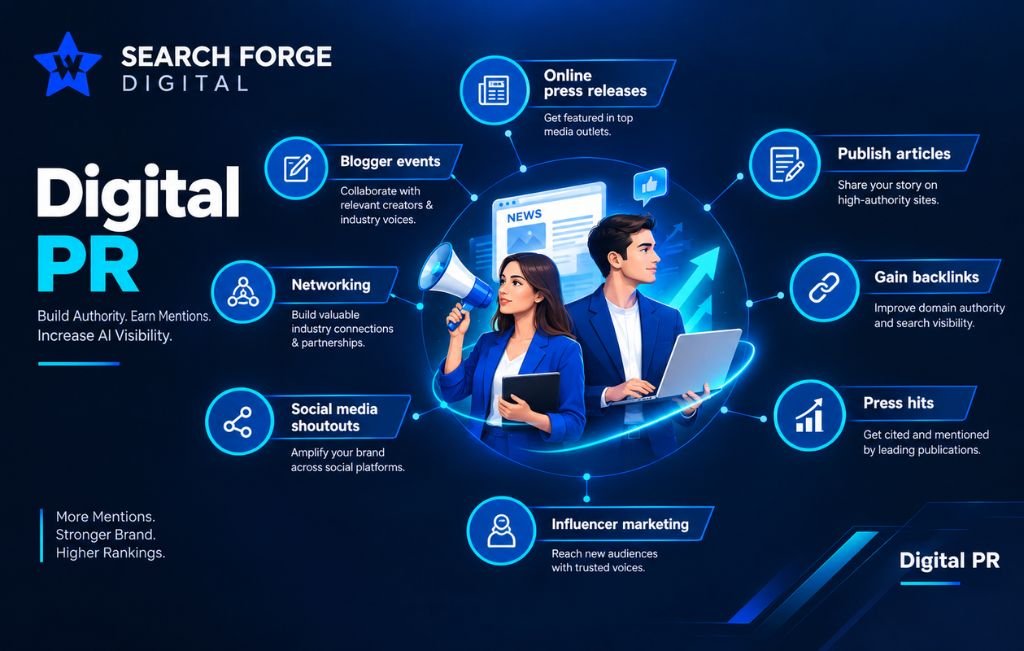
This is why digital PR, authoritative mentions, expert contributions, relevant backlinks, reviews, interviews, and third-party coverage can become valuable components of a GEO strategy.
Recent research into generative search has specifically investigated the role of earned media and third-party sources in AI-generated answers, while also highlighting that AI search services can behave differently from one another.
The practical implication is straightforward: your website should not be the only place where your brand exists as an authority.
The Core GEO Framework
A practical GEO strategy should begin with the fundamentals and then expand outward. First, a company needs a technically accessible website with clear information architecture and indexable content. Without discoverable information, there is little for search or retrieval systems to process.
The second layer is topical authority. A brand should demonstrate genuine expertise around the subjects for which it wants to be recognized. This requires more than publishing isolated blog posts. The site should establish meaningful relationships between core topics, supporting topics, use cases, questions, and expert insights.
The third layer is entity clarity. The company should be clearly associated with its products, services, industry, audience, expertise, and relevant concepts. Consistency across the website and external sources strengthens this understanding.
The fourth layer is authority beyond the website. Relevant publications, industry websites, expert interviews, partnerships, reviews, and earned media can provide independent signals about the brand.
The fifth layer is measurement. GEO should not be treated as a one-time optimization project. AI responses can change based on query wording, source availability, model behavior, location, freshness, and other factors. Research published in 2026 highlights this variability and argues that GEO measurement needs repeated observations rather than relying on a single AI response.
Key GEO Elements Every B2B Brand Should Consider
- Entity clarity: Make it obvious what the company is, what it offers, who it serves, and which category it belongs to.
- Topical authority: Build comprehensive expertise around the subjects relevant to the company’s market.
- Useful original content: Publish information that contributes something beyond generic summaries already available online.
- Third-party authority: Build relevant mentions, citations, digital PR coverage, expert contributions, and industry references.
- Technical accessibility: Ensure important pages can be crawled, rendered, indexed, and understood.
- Clear information architecture: Organize content so related concepts and entities are easy to understand.
- Brand consistency: Keep important facts about products, services, positioning, and expertise consistent across major sources.
- AI visibility monitoring: Regularly test relevant queries across different generative search environments and track whether the brand is mentioned, cited, accurately represented, or omitted.
- Continuous improvement: Update important content as products, markets, statistics, and industry information change.
How to Optimize for ChatGPT, Perplexity, Gemini, and AI Overviews
There is no universal “submit your website to AI” button that guarantees inclusion in generative answers. That is an important distinction for companies evaluating GEO services.
Different AI search systems can use different retrieval mechanisms, indexes, sources, models, and ranking processes. Consequently, a tactic that appears useful for one environment may not produce the same result in another.
The more durable approach is to strengthen the underlying information ecosystem. Your important pages should be accessible and useful, your brand should have clear topical associations, and credible external sources should reinforce the same facts.
Google’s AI search documentation makes a similar point: optimizing for its generative AI features still involves established SEO fundamentals, including useful content and technical accessibility.
For AI Overviews specifically, Google says its generative search experiences can use web sources and continue to operate within Google’s broader Search systems. Google also provides Search Console reporting for measuring performance in its generative AI features.
For systems such as Perplexity and other AI answer engines, the strategic objective is not to chase a single ranking position. Instead, the goal is to increase the probability that your brand and relevant content are retrieved and used when the system answers questions related to your category.
GEO in SEO: Why the Two Strategies Should Work Together
Treating GEO and SEO as completely separate disciplines is usually a mistake.
A website with excellent GEO positioning but poor technical SEO can still have serious discoverability problems. Likewise, a technically perfect SEO website with weak brand authority and generic content may struggle to become a meaningful source in AI-generated answers.
The strongest approach connects both.
Technical SEO makes information accessible. Content strategy establishes topical relevance. Digital PR creates external authority. Entity optimization clarifies brand relationships. Internal linking connects concepts. Structured data can help search engines understand supported information, although Google explicitly says there is no special schema markup required specifically for generative AI search.
This integrated approach is what makes AI Search Engine Optimization more than another acronym. It is fundamentally about making a company’s information ecosystem easier for modern search systems to discover, understand, verify, and use.
LLM Optimization and Brand Representation
LLM Optimization is often used to describe efforts designed around how large language models understand and represent information. In practice, it overlaps substantially with GEO.
The important distinction is that a brand cannot simply “optimize the model” in the same way it can optimize its own website. Businesses influence the information ecosystem from which models and retrieval systems can draw, but they do not directly control the generated answer.
That is why a strong GEO strategy focuses on evidence rather than tricks. The goal is to create a consistent body of useful, authoritative, independently supported information that accurately explains the brand.
This is particularly important for B2B companies because incorrect or incomplete AI-generated descriptions can create commercial problems. If an AI system misidentifies a product category, misunderstands pricing, confuses two companies, or describes an outdated service, the issue is not merely an SEO ranking problem. It is a brand accuracy problem.
How to Improve the Chances of Being Recommended
A company that wants to be mentioned in AI-generated recommendations needs to establish a clear reason for being relevant to the recommendation.
Suppose an AI user asks for “B2B SEO agencies experienced with SaaS companies.” A brand is more likely to be understood correctly when its website, industry coverage, expert content, service pages, case studies, and third-party mentions consistently establish its relationship with B2B SEO and SaaS.
That does not guarantee inclusion. AI systems can change their sources and outputs from one query to another. But it gives the system a stronger information foundation from which to make a relevant connection.
This is why GEO should focus on being genuinely relevant, not attempting to manufacture artificial signals.
Common GEO Mistakes
One common mistake is treating GEO as a keyword replacement exercise. Adding phrases such as “AI search optimization” or “GEO agency” repeatedly throughout a page does not automatically make the content more likely to appear in AI answers.
Another mistake is creating huge amounts of low-quality AI-generated content. Google’s current spam policies explicitly address scaled content abuse when large volumes of content are produced primarily to manipulate rankings rather than provide value.
A third mistake is obsessing over supposed technical shortcuts. Google’s current guidance specifically says that special files such as llms.txt are not required for Google Search visibility, including its generative AI features.
Another mistake is measuring GEO from a single AI query. A brand appearing once in ChatGPT or Perplexity does not prove that the strategy works consistently. Generative systems can produce different answers based on query phrasing, sources, freshness, and other variables. Recent GEO research emphasizes the need for repeated measurements and more rigorous evaluation.
A Practical GEO Strategy for SaaS and Technology Companies
A serious GEO campaign should start with a visibility audit. The first step is identifying the questions potential customers ask AI systems throughout the research journey. These should include informational, commercial, comparison, category, problem-solving, and vendor-selection questions.
The next step is to test how the brand currently appears. Does the AI system mention the company? Does it describe the company accurately? Which competitors appear? Which sources are cited? Are the same publications repeatedly influencing answers?
Once these patterns are understood, the company can identify gaps in its information ecosystem. Some gaps may exist on the website. Others may involve missing third-party coverage, unclear positioning, weak topical authority, outdated information, or insufficient evidence connecting the company to a particular category.
The strategy can then combine technical SEO, content development, digital PR, authority building, entity optimization, and ongoing AI visibility monitoring.
This is where an experienced GEO agency can add value. The work is not simply writing articles. It involves understanding how search visibility, content, authority, entities, external sources, and AI retrieval interact.
How Search Forge Digital Approaches GEO
Search Forge Digital can position GEO as an extension of a broader search visibility strategy rather than a disconnected AI trend.
For technology and B2B brands, the practical objective is to build a stronger digital information ecosystem around the company. That can include technical SEO, topical content, entity-focused optimization, authoritative third-party placements, digital PR, and monitoring of how the brand appears across AI search experiences.
The important distinction is between simply producing content and building searchable authority. A company does not become a trusted AI source because it publishes hundreds of pages. It needs useful information, consistent positioning, credible external references, and a technically sound website that search systems can access.
How to Measure GEO Performance
GEO measurement should go beyond asking whether a website ranks for a particular keyword.
A business can monitor how often its brand appears in relevant AI answers, whether those answers accurately describe the company, whether the brand is cited as a source, which external websites are associated with it, how competitors appear in the same prompts, and whether visibility changes over time.
The exact metrics will depend on the business and platform. For example, a SaaS company may track AI visibility for category questions, comparison searches, product-specific questions, and high-intent buyer prompts.
Google has also introduced Search Console reporting for generative AI features, giving site owners a way to evaluate performance in Google’s AI-driven Search experiences.
The key is consistency. Run a defined set of prompts repeatedly, across relevant platforms, and compare the results over time rather than treating one generated answer as definitive evidence.
The Future of GEO
Generative search is still developing, which means GEO should not be treated as a fixed checklist.
The terminology, retrieval systems, model behavior, interfaces, and measurement methods will continue to evolve. Research published in 2026 describes GEO as a multi-stage process involving discovery, retrieval, reranking, context allocation, citation, factual representation, and downstream user behavior rather than a simple ranking task.
That has an important implication for businesses: the strongest long-term GEO strategy is unlikely to be based on one temporary hack.
Instead, companies should invest in the fundamentals that remain valuable regardless of how AI search interfaces evolve: useful original information, clear brand positioning, technical accessibility, strong topical authority, credible external references, and accurate representation across the web.
Final Takeaway
Generative Engine Optimization is not simply the next version of keyword SEO. It represents a broader shift in how brands compete for visibility when search systems generate answers instead of only displaying ranked pages.