

Table of Contents
Table of Contents
Share This Post
Search is changing faster than it has in years. For a long time, people searched for something on Google, looked through a list of blue links, opened several websites, compared the information, and then decided what to trust.
Generative AI search is changing that process.
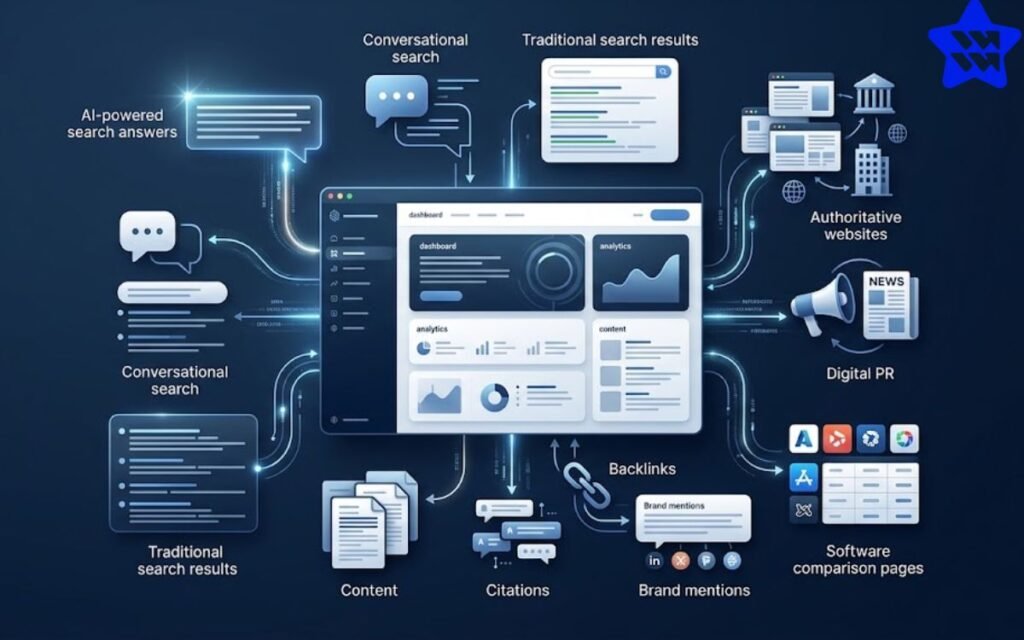
Instead of simply showing users a list of webpages, AI-powered search can understand a question, analyze information from multiple sources, and generate a direct answer in a conversational format. Users can ask detailed questions, follow up with additional questions, and receive responses that are more focused on their specific intent.
For businesses, this change is important because being visible in search is no longer only about ranking in traditional search results. Brands increasingly need to become trusted, relevant, and recognizable sources of information that AI systems can understand and reference.
This is where modern SEO and Generative Engine Optimization (GEO) become increasingly important.
What Is Generative AI Search?
Generative AI search is a type of search experience that uses artificial intelligence and large language models to understand a user’s query and generate an answer rather than simply returning a traditional list of search results.
Traditional search generally works by matching a user’s query with webpages that appear relevant. Search engines then rank those pages based on numerous signals, including relevance, content quality, authority, links, technical factors, and user experience.
Generative AI search takes this process further.
Instead of asking users to find the answer themselves across different websites, an AI-powered search system can interpret the meaning behind a query, retrieve relevant information, process that information, and provide a synthesized response.
For example, imagine someone searches:
What are the best ways for a SaaS company to increase organic traffic in 2026?
A traditional search engine may provide links to SEO agencies, SaaS blogs, marketing publications, and guides.
A generative AI search experience may instead provide a summarized answer covering technical SEO, content strategy, backlinks, topical authority, product-led content, and other relevant strategies. It may also provide citations or references to sources used to support the response.
This means the user’s journey can move from search → click → research toward question → AI-generated answer → deeper exploration.
How Does Generative AI Search Work?
Generative AI search combines search technology with artificial intelligence.
When a user enters a question, the system first attempts to understand what the person actually wants. This is more sophisticated than simply matching keywords.
For example, a user might search:
How can a small accounting firm get more clients from Google without spending heavily on ads?
The important information isn’t just the individual keywords. The system needs to understand the context, the business type, the goal, the audience, and the underlying search intent.
The AI system can then retrieve relevant information from available sources and use that information to construct a response.
This is why creating content only around individual keywords is becoming less effective as a standalone strategy.
Search systems increasingly need to understand topics, entities, relationships, context, credibility, and intent.
A strong piece of content therefore needs to do more than repeat a keyword. It needs to provide useful information that genuinely answers the question and establishes the website as a credible source.
Generative AI Search vs Traditional Search
The biggest difference is how information is presented to the user.
Traditional search primarily acts as a discovery system. It helps users find webpages that may contain the information they need.
Generative AI search increasingly acts as an information synthesis system. It can combine information from multiple sources and generate a response based on the user’s question.
This does not mean traditional search is disappearing. Google, Bing, and other search platforms continue to rely heavily on webpages, websites, links, structured information, and traditional ranking signals.
Instead, the search experience is evolving.
Users can now discover information through traditional organic listings while also encountering AI-generated summaries, conversational answers, recommendations, and citations.
For businesses, this creates another layer of visibility to compete for.
A company may rank well for a keyword but still have limited visibility within an AI-generated answer. At the same time, a company with strong topical authority and useful content may be referenced when an AI system answers a relevant question.
That distinction matters.
Why Is Generative AI Search Important?
Generative AI search is important because it is changing how people discover information, businesses, products, and services.
People are becoming more comfortable asking AI systems complex questions instead of breaking those questions into multiple searches.
Someone researching software might ask an AI system to compare different platforms.
Someone looking for a marketing agency might ask which agencies specialize in SaaS SEO.
Someone researching financial services might ask what factors they should consider before choosing a provider.
Someone planning a purchase might ask for product recommendations based on specific requirements.
In each situation, the user isn’t necessarily asking for ten links.
They want an answer.
That creates a major opportunity and challenge for businesses.
If your company is consistently absent from the information that AI systems use or reference, you may lose visibility even if your website performs reasonably well in traditional search.
Generative AI Search Is Changing SEO
SEO is not becoming irrelevant because of AI search.
In many ways, the fundamentals are becoming more important.
Search engines and AI systems still need reliable information. They still need to understand websites. They still need to determine whether a source is relevant and trustworthy.
What is changing is the way businesses need to think about optimization.
Old-school SEO often focused heavily on individual keywords and rankings.
Modern SEO needs to consider the entire topic and the authority of the brand behind the content.
For example, suppose a company wants to become visible for SaaS SEO.
Publishing one article targeting “SaaS SEO” probably isn’t enough.
A stronger strategy could cover SaaS keyword research, SaaS content strategy, technical SEO, SaaS link building, product-led SEO, SaaS topical authority, SaaS conversion optimization, and the relationship between SEO and AI search.
Over time, this creates a much stronger information ecosystem around the topic.
The objective isn’t simply to publish more content.
The objective is to demonstrate genuine expertise and relevance.
Why Content Quality Matters More
Generative AI systems have access to enormous amounts of information.
That means producing generic content is becoming less valuable.
If hundreds of websites publish essentially the same article explaining “What Is SEO?”, another generic article is unlikely to provide a meaningful competitive advantage.
Businesses need content with stronger value.
That could mean original research, expert insights, real examples, detailed explanations, unique data, case studies, practical experience, or a genuinely useful perspective.
For example, an SEO agency could publish a generic article about link building.
Or it could publish an in-depth analysis explaining how it evaluates websites for link opportunities, what makes a backlink valuable, which types of placements it avoids, and what businesses should consider before purchasing a link.
The second approach demonstrates considerably more expertise.
AI search makes this distinction increasingly important because systems need useful and trustworthy information from credible sources.
The Importance of Brand Authority
Generative AI search also increases the importance of brand authority.
Think about it this way.
If an AI system needs to answer a question about SEO, it has many potential sources to consider.
Which sources are consistently associated with the topic?
Which websites publish detailed and useful information?
Which brands are mentioned across reputable websites?
Which companies have established expertise?
Which sources provide original information instead of simply rewriting what everyone else has already published?
These factors contribute to how a brand can become recognizable within a particular subject area.
This is one reason why businesses should not treat SEO as nothing more than a keyword-ranking exercise.
Your goal should be to build a brand that search engines, users, publishers, and AI systems can associate with a specific area of expertise.
Backlinks Still Matter
The rise of AI search does not mean backlinks suddenly stop mattering.
If anything, strong digital authority can become even more valuable.
Quality backlinks can help demonstrate that other websites recognize and reference your content or brand.
But there is an important distinction between building authority and simply collecting backlinks.
Buying hundreds of low-quality links may increase the number of backlinks in a tool, but that doesn’t automatically make a brand more credible.
A stronger approach focuses on relevant, authoritative, contextually appropriate placements.
For example, a SaaS company should ideally build visibility through websites and publications that are relevant to technology, software, business, startups, or its specific industry.
This is where digital PR, strategic outreach, guest posting, and high-quality link building can support a broader SEO strategy.
How Search Forge Digital Can Help
At Search Forge Digital, the focus is on helping businesses build stronger online authority through strategic SEO and off-page optimization.
Rather than treating link building as a numbers game, the goal is to help businesses earn or secure relevant placements that support their broader search visibility.
A strong off-page strategy can include authoritative guest post placements, contextual backlinks, digital PR opportunities, and targeted outreach.
For a business trying to compete in traditional Google search while also preparing for AI-driven search experiences, this matters because authority cannot be built overnight.
Your website needs useful content, but your brand also needs recognition beyond its own website.
When reputable and relevant websites discuss, mention, and link to your brand, you create a stronger digital footprint.
That broader footprint can support your overall search presence.
Generative AI Search and the Future of Online Visibility
The biggest mistake businesses can make is treating generative AI search as just another temporary SEO trend.
The technology will continue to evolve, and the exact way AI systems select, summarize, and cite information will change.
But the underlying direction is clear.
People want faster answers.
They want useful information.
They want recommendations that understand context.
And search platforms are increasingly using AI to deliver those experiences.
That means businesses need to think beyond ranking for individual keywords.
They need to build topical relevance, brand authority, trustworthy content, and a strong digital presence.
This does not mean abandoning traditional SEO.
It means expanding the strategy.
Technical SEO still matters. Content still matters. Internal linking still matters. Backlinks still matter. User experience still matters. Brand recognition matters.
The difference is that all of these elements need to work together.
Final Thoughts
Generative AI search is changing the way people discover and consume information online. Instead of relying entirely on traditional search results, users can increasingly ask complex questions and receive AI-generated answers based on information gathered from multiple sources.
For businesses, this creates a new competition for visibility.
The goal is no longer simply to appear somewhere on a search results page. Businesses need to build websites and brands that are relevant, authoritative, useful, and trustworthy enough to be recognized within modern search experiences.
Companies that continue producing generic content and chasing rankings without building real authority may struggle as search evolves.
Companies that invest in valuable content, strong brand signals, digital authority, relevant backlinks, and a comprehensive SEO strategy will be better positioned for both traditional search and AI-driven discovery.
Generative AI search is not replacing SEO. It is changing what effective SEO needs to accomplish.
Comments
Related posts

AI SEO, SaaS, SEO
September 4, 2026