

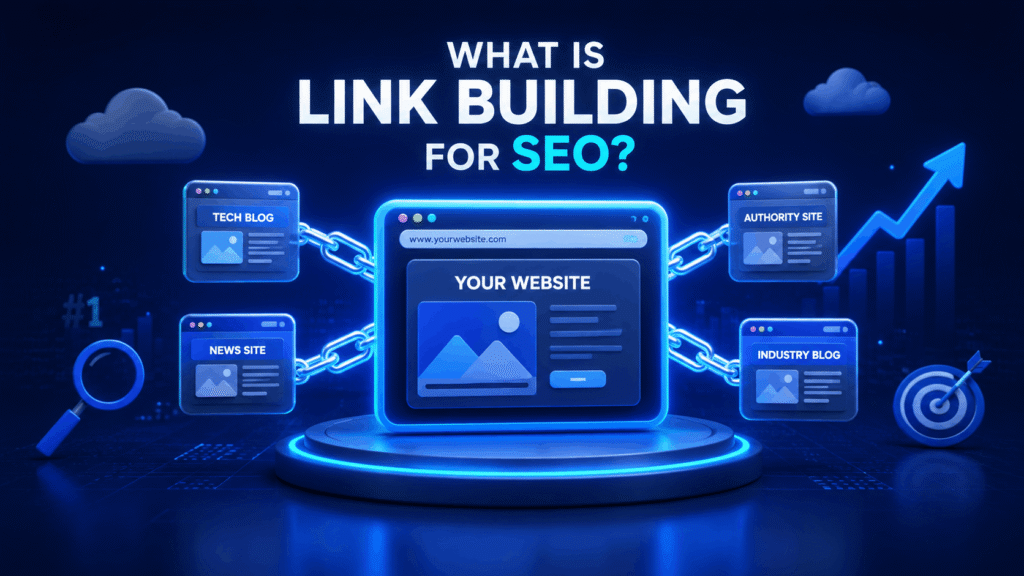
Link building is one of the most important parts
of off-page SEO. It is the process of acquiring links from other websites that point to pages on your own website. These links are commonly called backlinks.
But link building is not simply about getting as many links as possible
. A strong link building strategy focuses on earning backlinks from relevant, trustworthy, and authoritative websites that make sense for your business and audience.
Search engines use many signals to determine which pages should rank in search results, and backlinks remain an important part of that process. When reputable websites link to your content, those links can help search engines understand that your website is worth discovering and considering for relevant searches.
How Does Link Building Work?
Imagine that you own an eCommerce website selling running shoes.
If a respected fitness or sports website publishes an article about running and naturally references your website as a useful resource, that link can send two useful signals:
- It can introduce your brand to a relevant audience.
- It can contribute to your website’s authority and search visibility.
This is why the source of the backlink matters.
A backlink from a relevant, established website can be considerably more valuable than dozens of links from unrelated or low-quality websites. Modern link building therefore focuses more on quality and relevance than simply increasing backlink numbers.
Why Is Link Building Important?
1. It Can Support Higher Search Rankings
Backlinks are one of the signals search engines use when evaluating webpages. Links from authoritative and relevant websites can strengthen the authority of the pages receiving those links.
However, backlinks alone do not guarantee a first-page ranking. SEO also depends on content quality, technical SEO, search intent, competition, website experience, and other ranking signals.
That is why professional link building should be treated as part of a broader SEO strategy rather than a shortcut to rankings.
2. It Builds Website Authority
When other credible websites reference your content, your business gains an additional layer of online credibility.
For example, a backlink from a respected website within your industry is generally more meaningful than a random backlink from a completely unrelated website.
The goal is not to collect links.
The goal is to build a strong and relevant backlink profile.
3. It Can Increase Referral Traffic
Backlinks are not only useful for search engines.
A relevant link placed inside a useful article can bring real visitors directly to your website. If those visitors are already interested in your industry, products, or services, referral traffic can become a valuable source of potential customers.
This makes a good backlink useful even beyond its SEO value.
4. It Helps Your Brand Get Discovered
Getting mentioned on established websites puts your business in front of audiences that may never have discovered you through search alone.
Consistent mentions across relevant websites can help increase brand exposure and establish your company as a recognizable name within its industry.
5. It Helps You Compete in Search Results
If competitors ranking for your target keywords have strong backlink profiles, publishing good content alone may not be enough to close the gap.
A backlink analysis can help identify:
- Which websites are linking to competitors
- Which pages attract the most backlinks
- Which relevant websites may be worth approaching
- Where your website has authority gaps
- Which link opportunities are realistic for your industry
This information can then be used to build a more targeted outreach strategy.
What Makes a Good Backlink?
Not every backlink has the same value.
A quality backlink should ideally come from a website that is:
Relevant:
The website or page should have a logical connection to your industry or topic.
Trustworthy:
The linking website should look legitimate and provide genuine value to its audience.
Authoritative:
Established websites with a strong reputation can provide more meaningful signals than weak or spammy websites.
Contextual:
A link placed naturally within relevant content is generally more useful than a random link placed somewhere with no context.
Useful to readers:
The best links make sense from a user’s perspective. If clicking the link helps the reader learn more or find a useful resource, the placement has genuine value.
Quality and relevance should come before simply chasing a high number of backlinks.
Common Link Building Strategies
There are several legitimate ways to build backlinks.
Guest Posting
Guest posting involves creating useful, original content for another relevant website and including a contextual link to an appropriate page on your website.
When done properly, guest posting can combine SEO value with brand exposure and referral traffic.
Link Insertions
A link insertion involves adding a relevant link to an existing article or webpage where the link genuinely improves the content for readers.
The placement should be relevant to the surrounding topic rather than forced into unrelated content.
Digital PR and Outreach
Digital PR focuses on getting your business, expertise, research, products, or content mentioned by relevant publications and websites.
This can be particularly valuable for building brand authority and earning natural mentions.
Resource Link Building
If your website contains a genuinely useful guide, study, tool, research piece, or resource, you can reach out to websites that may find it useful for their readers.
The strongest link building campaigns give publishers a legitimate reason to link.
Why Cheap and Spammy Backlinks Can Be a Problem
One of the biggest mistakes in SEO is assuming that more backlinks automatically mean better rankings.
It doesn’t.
Building large numbers of irrelevant, manipulative, or low-quality links can create a weak backlink profile and may work against your long-term SEO goals. Google’s systems are designed to evaluate links in the broader context of a website and its content, so link building should be approached carefully rather than as a numbers game.
A professional campaign should focus on:
- Relevant websites
- Real editorial value
- Natural placement
- Useful content
- Appropriate anchor text
- A diverse backlink profile
- Long-term SEO value
How Link Building Fits Into a Complete SEO Strategy
Link building should not operate independently.
A strong SEO campaign normally combines:
Technical SEO — making sure search engines can crawl and understand your website.
On-page SEO — optimizing pages around relevant search intent and topics.
Content — publishing useful information that deserves visibility.
Link building — developing authority and relationships through relevant external websites.
Performance tracking — monitoring rankings, organic traffic, backlinks, and conversions.
If your website has technical problems or poor content, simply building backlinks will not magically solve everything.
The best results come when link building supports a well-structured SEO strategy.
Is Link Building Still Important?
Yes, but the way businesses approach it has changed.
Modern SEO is not about building thousands of random backlinks. It is about building a credible, relevant, and sustainable backlink profile.
A smaller number of strong, relevant links can be more useful than a huge collection of low-quality links. Search engines have become increasingly sophisticated, which means businesses should focus on genuine relevance, useful content, and trustworthy websites rather than outdated link-building shortcuts.
Final Thoughts
Link building is not a magic button that guarantees higher rankings overnight.
It is a long-term SEO strategy designed to improve your website’s authority, visibility, discoverability, and potential to compete in search results.
The most effective approach is simple:
Build fewer bad links. Build more relevant, trustworthy, and useful links.
At Search Forge Digital, our approach to link building focuses on relevant websites, quality placements, original content, and long-term SEO value rather than spammy link networks or meaningless backlink volume.
If your website needs a stronger off-page SEO strategy, professional link building can help you build the authority needed to compete more effectively in organic search.