For years, SaaS companies have built their organic growth strategies around a familiar formula: identify valuable keywords, create optimized landing pages, publish educational content, build backlinks, improve technical SEO, and compete for higher positions in Google. That approach still matters. But the way potential software buyers discover, compare, and evaluate products is expanding.
AI-powered search has introduced a different kind of search experience. Instead of receiving ten blue links and deciding which pages to open, users can ask a conversational question and receive a synthesized response with supporting sources. OpenAI introduced SearchGPT as a prototype in July 2024 and later brought the strongest parts of that experience into ChatGPT Search. Current ChatGPT Search responses can include inline citations and links to web sources.
That difference creates a new challenge for SaaS companies. Ranking a page is no longer the only visibility objective. A SaaS brand also needs to become a credible source that AI-powered search systems can discover, understand, trust, and potentially cite when answering relevant questions.
This is where a specialized SearchGPT SEO Agency becomes valuable.
What Is a SearchGPT SEO Agency?
A SearchGPT SEO Agency focuses on improving how a brand and its content are discovered and represented within AI-powered search experiences. The work overlaps with traditional SEO, but it extends beyond conventional rankings.
The objective is not simply to make a SaaS website appear for a keyword. It is to build an information ecosystem around the company so that search engines and AI systems can clearly understand what the company does, which problems it solves, who it serves, what makes its product different, and which external sources support its authority.
The term SearchGPT SEO is often used to describe this emerging discipline because SearchGPT helped popularize the conversational search model. Today, however, the broader environment includes ChatGPT Search, Google AI experiences, Perplexity, Gemini, and other generative search systems.
That makes SearchGPT Optimization part of a wider strategy commonly described as Generative Engine Optimization (GEO).
The important distinction is that GEO is not a replacement for SEO. A SaaS company still needs crawlable pages, strong technical foundations, useful content, relevant links, and clear information architecture. GEO adds another layer focused on how that information can be retrieved, interpreted, selected, and cited in generated answers.
Why Traditional SaaS SEO Is No Longer the Whole Picture
Traditional SEO is built around a relatively visible journey. A person searches for a phrase, Google returns results, and the user chooses a page.
AI search compresses part of that journey.
A potential customer might ask:
What are the best workflow automation platforms for a 100-person SaaS company?
Instead of opening multiple product pages, the user may receive a conversational answer that compares several solutions and links to selected sources.
The next question might be:
Which one is better for teams that need Salesforce integration?
Then:
How does that platform compare with its competitors?
Then:
What do customers say about it?
The search journey becomes conversational and cumulative.
OpenAI describes ChatGPT Search as an experience where users can ask questions naturally and continue with follow-up questions while the conversation retains context.
For SaaS brands, this matters because the customer journey is rarely one-dimensional. Buyers investigate features, integrations, pricing, security, alternatives, implementation, reviews, use cases, and industry fit.
A page optimized for one keyword may not be enough to establish authority across that entire journey.
The New Search Objective: Become a Citable Source
One of the biggest differences between conventional SEO and AI search is the role of citations.
Traditional SEO generally asks:
Can this page rank?
AI search introduces another question:
Can this source contribute useful evidence to the answer?
ChatGPT Search can provide links to the sources it uses, allowing users to inspect where information came from.
This creates what can be called a citation economy.
For SaaS companies, visibility is increasingly about more than owning a position in search results. It is also about appearing in the source ecosystem that AI systems use when generating answers.
That does not mean there is a simple formula where adding a few keywords guarantees a citation. There is no reliable way to guarantee that an AI platform will select a particular website for every query.
Instead, the strategic goal is to increase the quality, clarity, relevance, discoverability, and authority of the information surrounding the brand.
A specialized SearchGPT SEO agency approaches this problem from that broader perspective.
SearchGPT Optimization Starts With Entity Clarity
AI systems need to understand entities and relationships.
For a SaaS company, that means making the company’s identity and positioning clear across its website and external ecosystem.
For example, an AI system should be able to understand:
Brand → SaaS category → core problem → target audience → features → integrations → use cases → competitors → industry → evidence
If those relationships are unclear, inconsistent, or poorly documented, the brand becomes harder to interpret.
This is why SearchGPT Optimization should not begin with simply inserting phrases such as “best SaaS platform” into articles.
It should begin with a much more fundamental question:
What should an AI system understand about this company?
That answer then needs to be reflected across product pages, solution pages, author information, documentation, comparison content, industry resources, third-party publications, reviews, and other credible sources.
GEO Services for SaaS Need More Than Content
Generative Engine Optimization is sometimes reduced to “write content that AI likes.”
That is too simplistic.
A serious Generative Engine Optimization (GEO) Services strategy for SaaS should combine content, technical SEO, entity optimization, authority building, structured information, and external validation.
The website needs to be technically accessible. Important information should be easy to find. Content should answer real questions directly. Definitions, comparisons, facts, statistics, product information, and procedures should be presented clearly enough for both users and machines to interpret.
Structured data can also help search engines understand entities and page relationships, although schema markup by itself should not be treated as a guarantee of AI visibility.
The broader principle is simple: make the important information easy to discover, easy to understand, and easy to verify.
Why Original Information Matters for SaaS Brands
SaaS markets are crowded with repetitive content.
Hundreds of companies can publish another article explaining what CRM software is. Hundreds more can write about project management, marketing automation, cybersecurity, customer support, analytics, or workflow software.
Publishing another generic article rarely creates a meaningful authority advantage.
Original information can.
A SaaS company might have access to proprietary usage data, anonymized customer trends, survey results, product research, industry benchmarks, or internal analysis. Turning that information into useful public resources can give the brand something genuinely distinctive to contribute.
For example, instead of publishing another generic article about remote work software, a company could publish research showing how distributed teams actually use collaboration tools across different company sizes.
That creates a potential source that journalists, analysts, bloggers, researchers, and other websites can reference.
This is where SEO, Digital PR, and GEO begin to overlap.
The company is not simply creating content for its own website. It is creating information that can travel across the web.
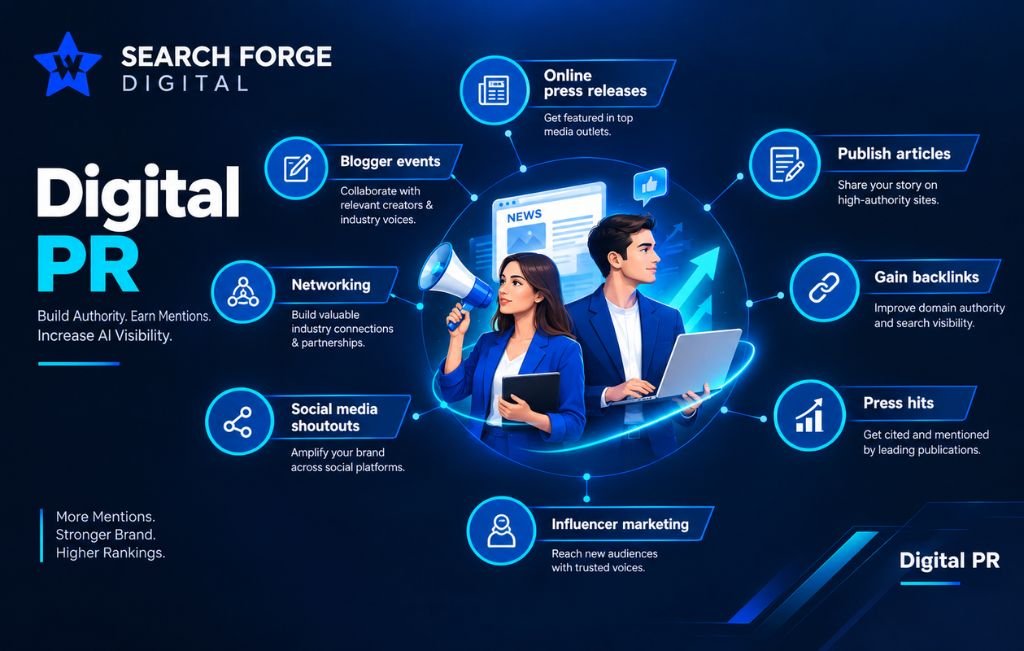
Digital PR Can Strengthen a SaaS AI Search Strategy
A SaaS website can make strong claims about its own product.
But third-party sources can provide a different type of validation.
An independent publication mentioning the company, an industry expert discussing its technology, a journalist referencing its original research, or a respected website linking to its resources can expand the brand’s digital footprint beyond its own domain.
Research into generative search has increasingly examined the role of third-party and earned sources in AI-generated results. A 2025 study on generative search reported differences between traditional web search and generative systems and emphasized the importance of earned media and external authority in AI-search visibility.
For a SaaS company, this means Digital PR should not be treated as a separate branding activity.
It can become part of the broader search authority strategy.
A specialized agency can identify data stories, create research-led campaigns, pitch relevant journalists, secure editorial coverage, and build a network of credible references around the brand.
The result is not simply more backlinks.
The larger objective is a stronger authority footprint.
SearchGPT SEO vs Traditional SEO
The two approaches should not be treated as enemies.
Traditional SEO remains the foundation.
SearchGPT Optimization and GEO build on that foundation.
| Traditional SEO | SearchGPT SEO / GEO |
|---|---|
| Focuses heavily on rankings | Focuses on visibility within generated answers |
| Targets keywords and search queries | Targets questions, topics, entities, and user journeys |
| Optimizes pages for search engines and users | Optimizes information for retrieval, interpretation, and citation |
| Measures rankings and organic traffic | Adds citation visibility, mentions, and AI-answer presence |
| Primarily emphasizes owned content and links | Combines owned content with third-party authority |
| Often focuses on individual queries | Can address broader conversational journeys |
The most effective SaaS strategy is therefore not “SEO or GEO.”
It is SEO plus GEO.
How to Rank on SearchGPT: A More Accurate Way to Think About It
The phrase “How to rank on SearchGPT” is useful as a search query, but the concept needs clarification.
AI search does not operate exactly like a traditional ten-result ranking page.
A better question is:
How can a SaaS brand increase its chances of being discovered, mentioned, or cited in relevant AI-generated answers?
There is no universal ranking formula and no agency should promise guaranteed inclusion.
Instead, SaaS companies can work on several connected areas.
First, the website should have strong technical accessibility and clear information architecture.
Second, important product and business information should be explicit rather than buried in vague marketing language.
Third, content should answer real customer questions with direct, evidence-based information.
Fourth, the brand should develop topical depth around its category rather than publishing disconnected keyword-targeted articles.
Fifth, the company should build external authority through relevant publications, expert contributions, digital PR, reviews, and other legitimate third-party references.
Sixth, the brand’s identity should remain consistent across important online sources.
These activities create a stronger foundation for AI search visibility without pretending that any tactic guarantees a citation.
SaaS Content Needs to Follow the Buyer’s Conversation
A common SaaS SEO mistake is building content around keywords without understanding the buyer’s complete decision process.
Consider a company selling project management software.
A potential customer may begin with:
What is project management software?
Then:
What features should a project management platform have?
Then:
What is the best project management software for a remote team?
Then:
Which platforms integrate with Slack and Salesforce?
Then:
What are the alternatives to Product X?
Then:
How much does Product X cost?
Then:
Is Product X suitable for a 200-person company?
These are not six unrelated searches.
They are stages of one research journey.
A strong SearchGPT SEO Agency builds content around that journey.
Instead of creating isolated pages simply because each keyword has search volume, the strategy connects informational, commercial, comparison, product, industry, and decision-stage content.
This gives users and AI systems a clearer picture of the brand’s expertise.
Follow-Up Questions Change the Content Strategy
Conversational search makes follow-up questions particularly important.
A user may ask an initial question and then narrow it based on the answer. That means SaaS content needs to anticipate the next logical question.
For example, an article answering “What is customer data software?” could naturally address who needs it, how it works, common integrations, security considerations, implementation requirements, alternatives, and evaluation criteria.
This does not mean stuffing every possible question into one page.
It means building a connected content ecosystem where each important question has a useful answer and the relationship between those answers is clear.
That is a more sophisticated approach to topical authority.
Technical SEO Still Matters
There is a temptation to assume that GEO makes technical SEO irrelevant.
It does not.
A SaaS website still needs a technically sound foundation.
Important pages should be crawlable and indexable. Internal linking should help search engines discover related resources. Canonicalization, page performance, structured data, rendering, redirects, duplicate content management, and information architecture still matter.
If the underlying website is difficult for search systems to discover or interpret, adding AI-focused content on top of it will not solve the fundamental problem.
GEO should therefore be treated as an extension of modern search optimization, not a replacement for technical SEO.
Building a SaaS Knowledge Graph Around the Brand
One of the strongest long-term concepts for SaaS AI visibility is entity consistency.
Imagine an AI system encountering the same company across multiple sources.
Its official website describes the company as a workflow automation platform.
A respected software directory categorizes it similarly.
An industry publication discusses its workflow technology.
A customer review explains the same core use case.
A founder interview provides additional context.
A technical article references its integrations.
These sources do not need to repeat identical sentences.
They should, however, reinforce a coherent understanding of what the company is and why it matters.
This creates a stronger digital identity than relying entirely on the company’s own marketing pages.
Why Third-Party Mentions Matter
A brand saying “we are an industry leader” is a marketing statement.
An independent publication discussing the company’s technology is external evidence.
That distinction matters in an environment where AI systems need to synthesize information from multiple sources.
This is one reason a specialized SearchGPT SEO strategy should include more than owned content.
Relevant editorial mentions, expert quotations, industry publications, research references, reviews, and authoritative links can all contribute to the broader information environment around a SaaS brand.
The goal should not be to manufacture mentions or manipulate AI systems.
The goal is to make the company genuinely present in the conversations and sources that matter to its market.
What a Specialized SearchGPT SEO Agency Actually Does
A specialized agency should start with research rather than immediately producing hundreds of articles.
The first stage is understanding the SaaS company’s market, audience, competitors, product category, customer problems, existing authority, search visibility, and current AI presence.
The next stage is identifying the questions that matter.
This includes commercial questions, informational questions, comparison searches, category questions, product alternatives, integration searches, industry-specific problems, and high-intent buyer conversations.
The agency can then map those questions against existing content and identify gaps.
From there, the strategy can combine technical SEO, content architecture, entity optimization, Digital PR, link acquisition, original research, expert commentary, and external authority building.
Finally, the agency should monitor performance and refine the strategy based on what actually changes.
This is fundamentally different from selling a fixed number of blog posts every month.
Measuring SearchGPT SEO Results
Measurement is still developing because AI search does not provide one universal equivalent of a Google ranking position.
A SaaS company can nevertheless build a practical measurement framework.
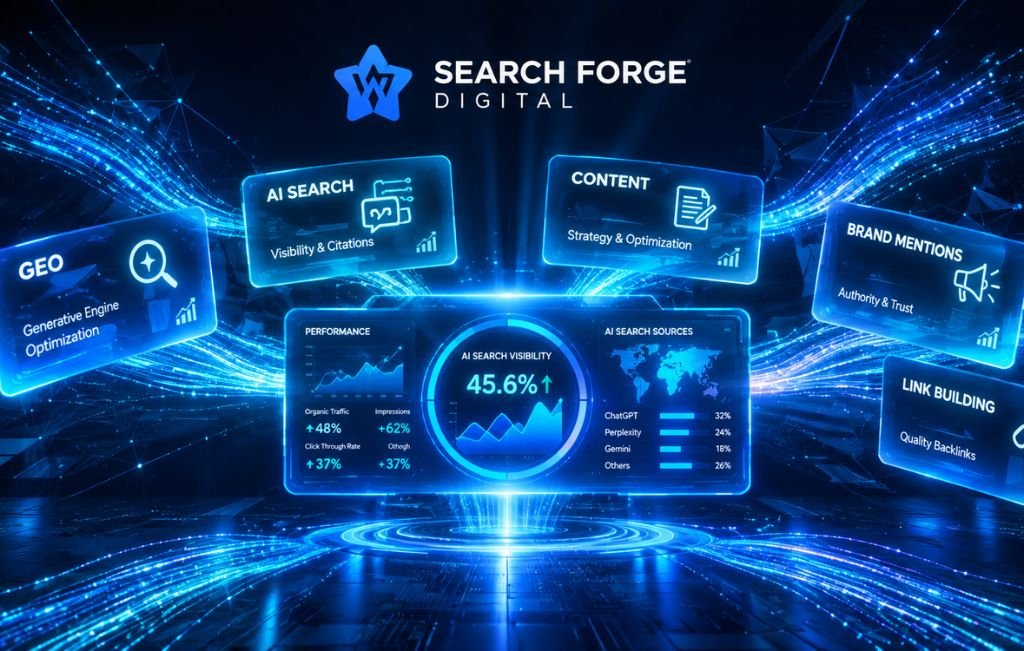
It can monitor whether the brand appears in relevant AI responses, how frequently it is cited, which pages are cited, which competitors appear alongside it, what questions trigger visibility, and how that visibility changes over time.
Traditional metrics should remain part of the dashboard as well.
Organic rankings, non-branded traffic, branded searches, referral traffic, backlinks, media mentions, conversions, and qualified leads still matter.
The important point is to avoid reducing GEO to one vanity metric.
A citation is useful, but a citation that appears for an irrelevant query may have little commercial value.
The strongest measurement framework connects AI visibility → relevant audience exposure → website engagement → commercial outcomes.
Recent research is also exploring more detailed ways to distinguish between being cited and actually influencing the generated answer, suggesting that citation count alone may not capture the full value of AI visibility.
Common SearchGPT SEO Mistakes SaaS Companies Should Avoid
One common mistake is assuming that adding “AI” or “SearchGPT” to existing SEO pages automatically creates GEO visibility.
It does not.
Another mistake is publishing large volumes of generic AI-written content without original information, evidence, expertise, or a clear reason for the page to exist.
A third mistake is focusing entirely on the company’s own website while ignoring the external sources that shape its reputation.
Another problem is treating schema markup as a shortcut. Structured data can help machines understand information, but it cannot compensate for weak content, poor authority, or an unclear brand entity.
Finally, SaaS companies should avoid agencies that promise guaranteed ChatGPT or SearchGPT citations. AI-generated search results can vary by query, context, freshness, location, available sources, and platform behavior. Even OpenAI’s own documentation notes that search results and citations can sometimes be incomplete or incorrect.
Why SaaS Companies Need a Specialized Approach
SaaS SEO is already more complex than many traditional SEO campaigns because software buyers evaluate products through multiple dimensions.
They care about integrations, pricing, security, implementation, features, use cases, competitors, customer experience, scalability, and business outcomes.
AI search adds another layer because those questions can be compressed into conversational research.
A generic SEO campaign may optimize the website for keywords.
A specialized SearchGPT SEO strategy asks a broader question:
What information does a potential customer need, and what evidence would make an AI-powered search system confident enough to include this brand in the conversation?
That requires SEO knowledge, content strategy, technical understanding, entity optimization, Digital PR, authority building, and ongoing AI-search monitoring.
The Future of SaaS Search Is Not SEO vs AI
The future is not about abandoning Google and moving everything to AI search.
SaaS companies still need strong organic search foundations.
Instead, search is becoming more fragmented.
A potential customer may discover a brand through Google, validate it through ChatGPT, compare it through Perplexity, read third-party reviews, watch a product demonstration, return to Google, and finally visit the company’s website.
The winning strategy therefore needs to work across the entire information ecosystem.
SearchGPT SEO and GEO are part of that evolution.
Final Thoughts
For SaaS companies, the search landscape is moving from a simple ranking model toward a broader visibility model.
The objective is no longer limited to getting one page into one position for one keyword.
It is about becoming a recognizable, understandable, credible source across the questions that influence a buyer’s journey.
A specialized SearchGPT SEO Agency can help connect the pieces: technical SEO, content architecture, entity clarity, conversational search optimization, original research, Digital PR, editorial mentions, authoritative links, and AI visibility measurement.
SearchGPT itself has evolved into the broader ChatGPT Search experience, but the underlying shift remains important: users can increasingly ask questions conversationally and receive synthesized answers supported by web sources.
For SaaS brands, that means the opportunity is not simply to optimize for another search engine.
It is to build enough useful information, authority, and external evidence that the brand can become part of the answer when potential customers start asking AI-powered search systems what they should buy, compare, trust, or investigate next.
That is the real purpose of SearchGPT Optimization.
And that is why SaaS SEO strategies increasingly need to think beyond rankings and toward search authority, AI visibility, and citation-ready digital presence.