Search is changing from a system where people mainly browse a list of blue links into an experience where users increasingly ask complete questions and expect a direct, useful answer. Google is expanding AI Overviews and AI Mode, while platforms such as ChatGPT and Perplexity can search the web, analyze multiple sources, and present answers with links to supporting information. Google itself says its generative AI search features rely on core Search systems and relevant web content, while ChatGPT and Perplexity both use web sources and citations to support answers.
This shift creates a different challenge for businesses. Ranking a webpage for a conventional keyword is no longer the only visibility goal. A B2B SaaS company, agency, technology brand, or professional service business also needs to become a credible source that AI systems can understand, retrieve, reference, and potentially recommend when users ask relevant questions. This is where Digital PR becomes increasingly valuable. Digital PR can create authoritative third-party coverage, strengthen brand recognition, earn meaningful mentions, and build the broader web presence that supports a strong GEO strategy.
However, it is important to clear up one misconception from the beginning. Digital PR does not provide a secret shortcut that automatically moves a company to the top of ChatGPT, Google AI Mode, or Perplexity. There is no guaranteed “AI ranking” formula that a PR campaign can manipulate. Google specifically states that there are no special technical requirements or special markup required to appear in AI Overviews or AI Mode, and that foundational SEO and helpful, reliable content remain important.
The real value of Digital PR is more strategic. It helps build the authority, relevance, recognition, and third-party information ecosystem around a brand. Those signals can support organic search performance while also giving AI-driven search systems more credible information from which to understand a company and its expertise.
What Is Digital PR in the Context of AI Search?
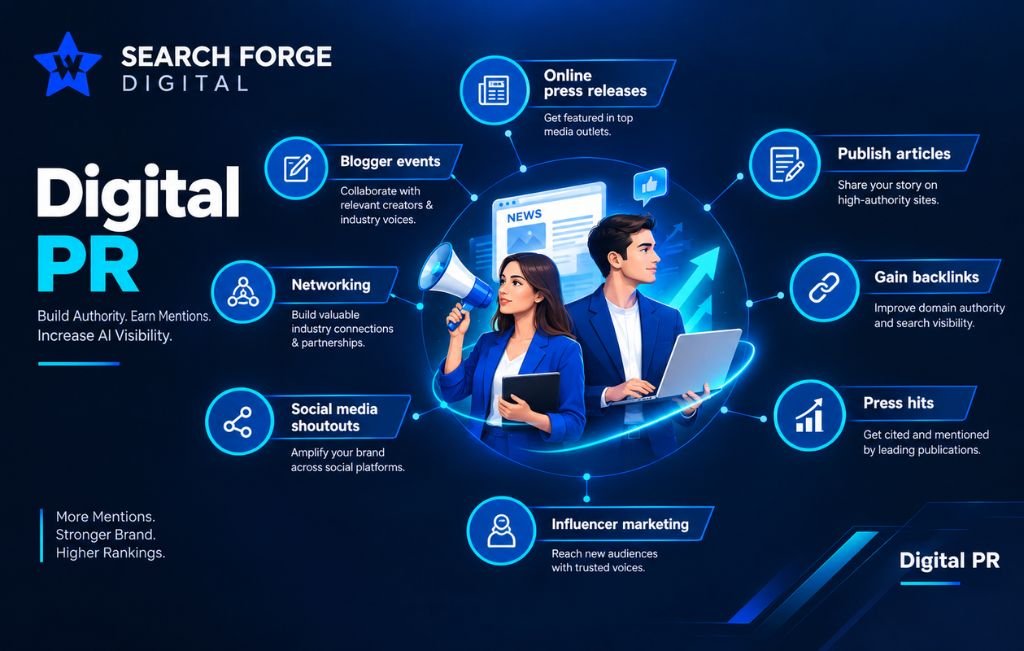
Digital PR is the process of earning online exposure for a brand through editorial coverage, expert commentary, original research, industry publications, interviews, newsworthy campaigns, thought leadership, and other forms of credible third-party visibility. Traditional public relations may focus heavily on reputation and media relationships, while Digital PR connects those activities with the modern web, search visibility, content discovery, and brand authority.
For AI-driven search, the most important difference is that a brand is no longer competing only for a page-one position. It is also competing to become part of the information environment that AI systems use when constructing answers. Perplexity, for example, explains that its search experience gathers information from the web, analyzes multiple sources, and provides answers supported by citations. ChatGPT Search likewise provides links to web sources and can search the internet for current information.
That means a company with a strong website but almost no credible third-party footprint may have a weaker overall authority profile than a competitor that is consistently mentioned by relevant publications, experts, industry websites, and other trusted sources. Digital PR helps close that gap.
Why Brand Authority Matters for AI-Driven Search
AI systems need context. When a user asks which software platform is suitable for a particular business, which agency specializes in a certain service, or which company is a credible source in a specific industry, the system has to interpret relationships between businesses, topics, products, people, and sources.
A brand’s own website is obviously important, but it is only one part of the wider web ecosystem. Third-party coverage can provide additional evidence about what a company does, who it serves, what it is known for, and how it is discussed within its industry. This is one reason Digital PR can play an important supporting role in GEO.
For example, imagine a SaaS company that publishes excellent product pages but has almost no external coverage. Its website may explain the product clearly, but there may be limited independent information confirming its position within the market. Now imagine another SaaS company with expert interviews, industry articles, original research, relevant editorial mentions, conference coverage, and commentary from recognized professionals. The second company has a much broader digital footprint.
That does not mean the second company will automatically be recommended by an AI engine. It means the AI system potentially has more external context available when evaluating the company. That distinction matters because responsible GEO strategy should focus on improving the information available to search systems rather than making unrealistic promises about guaranteed AI rankings.
How Digital PR Supports GEO
Generative Engine Optimization, commonly referred to as GEO, focuses on improving a brand’s visibility across AI-powered search and answer experiences. Although the terminology is relatively new, Google’s own guidance makes an important point: optimizing for generative AI search largely continues the fundamentals of good SEO, including crawlable websites, useful content, strong technical foundations, and unique information that serves users.
Digital PR fits into this framework because it expands the brand’s presence beyond its own website. A successful PR campaign can create a network of relevant references surrounding the business. These references may come from industry publications, technology websites, business media, expert interviews, podcasts, research articles, news coverage, and other editorial environments.
For GEO, this matters because AI search is fundamentally about understanding information and relationships. A company should not simply say that it is an expert in a specific field on its own homepage. Ideally, the wider web should also contain credible evidence of that expertise.
This is why the strongest GEO strategies do not treat Digital PR as a completely separate activity. They connect technical SEO, content quality, brand positioning, entity signals, expert-led content, and third-party authority into one broader search visibility strategy.
Digital PR Can Increase the Number of Quality Brand Mentions
Brand mentions are particularly valuable when they occur in relevant contexts. A random mention on an unrelated website has limited strategic value. A detailed editorial reference on a respected publication that discusses a company’s expertise, research, product category, or leadership can contribute far more to the brand’s overall online presence.
For a B2B SaaS business, this could mean being referenced in an industry publication discussing software trends. For a cybersecurity company, it could mean providing expert commentary to technology media. For a marketing agency, it might involve original research about search behavior or digital marketing performance.
These mentions help create a clearer association between the brand and the topics it wants to own. Over time, a consistent pattern of relevant coverage can make the company’s positioning more obvious across the wider web.
Digital PR Can Support Traditional SEO at the Same Time
One of the biggest mistakes businesses make is treating GEO and traditional SEO as completely separate disciplines. They are not identical, but they overlap significantly.
Google states that its AI search features are built on core Search systems and that existing SEO fundamentals remain relevant. Pages still need to be crawlable, indexable, useful, and technically accessible. Google also emphasizes unique, helpful, people-first content rather than artificial optimization tricks.
Digital PR can support these foundations by earning authoritative links and exposure to relevant audiences. A strong editorial mention may generate referral traffic, improve brand discovery, support link acquisition, and contribute to a broader authority-building strategy.
The important point is that the objective should not be “get as many backlinks as possible.” The better objective is to earn credible attention from sources that are relevant to the market and meaningful to the audience.
Why Original Research Is Powerful for Digital PR and GEO
Original research is one of the strongest ways to connect PR with search visibility because it gives journalists, publishers, analysts, and industry professionals something they can actually reference.
A company that publishes genuinely useful market data can become the source behind multiple articles. For example, a B2B SaaS business might publish research on software adoption, AI usage, customer acquisition costs, or productivity trends. An SEO company could study search behavior across a specific industry. A technology consultancy could analyze a major trend affecting enterprise buyers.
The value comes from the fact that the research creates an information asset that other websites may independently discuss and cite. Instead of repeatedly asking publishers to “mention your brand,” you create something worth mentioning.
That type of PR can be especially useful for GEO because it increases the amount of original, attributable information associated with the company. Search systems increasingly emphasize useful and original content, and Google specifically advises site owners to prioritize non-commodity information that adds unique value.
Expert Commentary Makes a Brand More Discoverable
Thought leadership is another area where Digital PR and GEO naturally overlap. Businesses often publish generic blog content but fail to build recognizable experts around their brand.
An executive, founder, subject-matter expert, or senior specialist can become an identifiable source of knowledge within a particular niche. When that person contributes expert commentary to industry publications, discusses current topics, participates in interviews, or publishes original insights, the business gains another layer of authority.
For B2B brands, this can be extremely important because buyers often want to know not just what a company sells but whether its people actually understand the problem they are solving. Strong expert visibility can strengthen both human trust and the broader digital footprint surrounding the company.
Digital PR Helps Build a More Complete Brand Entity
AI search is increasingly conversational and context-driven. Users may not ask for a company’s homepage. They may ask which companies are respected in a market, which software options are suitable for a specific use case, which agencies have expertise in a particular field, or which brands are worth considering.
In such situations, brand identity needs to be clear across multiple sources. The company website should clearly explain its services and expertise, but external sources should ideally reinforce the same positioning.
When the information is consistent across authoritative sources, it becomes easier for both people and search systems to understand what the company represents. Digital PR can therefore help strengthen the overall digital entity of a brand rather than simply generating isolated links.
What Kind of Digital PR Works Best for AI Visibility?
Not every PR placement is equal. A high-volume campaign based on generic press releases may create a lot of URLs without creating meaningful authority. For AI visibility, relevance and informational value are more important than raw publication count.
A technology SaaS brand will generally benefit more from credible technology and business publications than from unrelated websites with no connection to its market. An agency specializing in enterprise SEO should ideally earn coverage where business leaders, marketers, technology professionals, or SEO practitioners actually consume information.
The same principle applies to the story itself. A publication is more likely to discuss an original dataset, strong expert opinion, useful industry finding, or genuinely newsworthy development than a generic promotional announcement.
This is why modern Digital PR should begin with the question, “Why would someone outside this company want to talk about this?” The answer determines whether the campaign has real media value.
Digital PR Alone Is Not a GEO Strategy
Businesses should also avoid the opposite mistake of assuming that PR can replace everything else.
A company with excellent media coverage but a technically weak website still has a problem. If important information cannot be crawled, indexed, or clearly understood, external authority cannot completely solve the issue. Google’s guidance explicitly emphasizes crawlability, technical accessibility, useful content, internal linking, and other established SEO fundamentals for its AI search experiences.
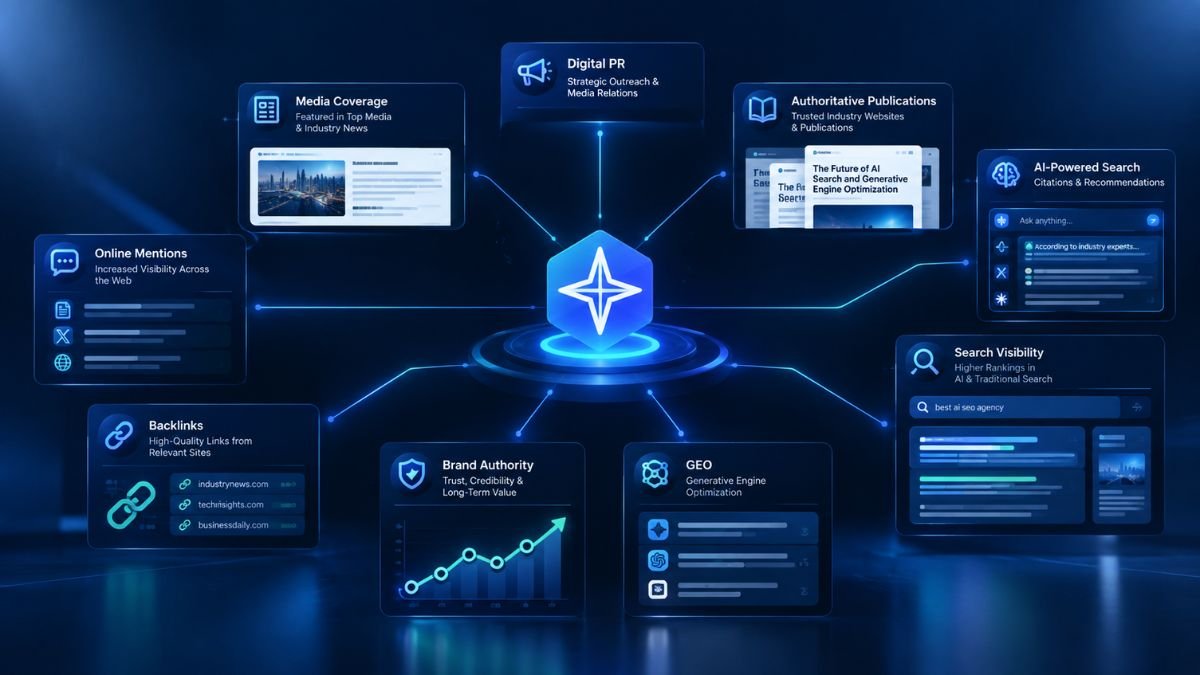
The stronger approach is integrated. Technical SEO makes the site accessible. Content gives search systems useful information. Entity-focused brand development creates clarity around the organization and its expertise. Digital PR expands third-party authority. GEO measurement shows whether that combined strategy is increasing visibility across AI search experiences.
How Businesses Should Measure Digital PR for AI Search
Traditional PR measurement often focuses on impressions, publication counts, brand mentions, and estimated reach. Those metrics can still be useful, but businesses pursuing AI visibility should look beyond them.
The first consideration should be whether the coverage is relevant. A small number of highly relevant industry references can be more valuable than hundreds of weak mentions. Businesses should also evaluate whether the campaign increases branded search activity, referral traffic, quality backlinks, expert visibility, and visibility for important commercial topics.
For Google’s generative AI experiences, measurement is also becoming more sophisticated. Google introduced dedicated Search Console reporting for visibility within generative AI features, including AI Overviews and AI Mode, with the broader rollout completed worldwide by August 31, 2026.
That creates a more practical way for businesses to connect their SEO work with AI search performance rather than relying entirely on assumptions.
A Practical Digital PR and GEO Strategy for B2B Brands
A strong strategy should begin with the company’s commercial positioning. Before launching PR campaigns, a business should define the topics, services, products, and problems it wants to be associated with. The goal is not to generate mentions everywhere. The goal is to build authority around the areas that actually matter to the business.
Next, the business should identify information gaps that can be transformed into useful PR assets. Original research, proprietary data, expert commentary, market analysis, case studies, surveys, and strong industry opinions can all provide reasons for publishers to reference the brand.
The campaign should then focus on relevant publications and journalists rather than pursuing volume for its own sake. Every placement should strengthen the relationship between the brand and its expertise.
At the same time, the business website should reinforce the same positioning. The service pages, about page, expert profiles, research content, case studies, and thought-leadership articles should be consistent with the topics being promoted through PR.
The final step is measurement. Brands should monitor traditional organic visibility, referral traffic, brand searches, third-party mentions, and relevant AI search visibility. The purpose is not to chase a single AI ranking number but to determine whether the business is becoming more visible and credible across the search ecosystem.
The Future of Digital PR Is Closely Connected to Search Visibility
The separation between PR, SEO, content marketing, and brand building is becoming less useful. Search engines are evolving into answer engines, while AI systems are increasingly capable of retrieving, analyzing, and synthesizing information from multiple sources.
Google’s current guidance makes clear that generative AI search still depends heavily on the foundational principles of search: accessible websites, useful information, original content, and strong technical implementation. At the same time, ChatGPT and Perplexity demonstrate how modern search experiences can gather information from external sources and present it with citations or links.
That makes Digital PR a valuable part of a modern search strategy because it helps a brand become visible beyond its own domain.
The businesses that benefit most will not necessarily be the ones publishing the most content or buying the most links. They will be the businesses that consistently create valuable information, demonstrate expertise, earn credible third-party recognition, and maintain a strong technical and content foundation.
Conclusion
Digital PR services can improve AI-driven search visibility by strengthening the digital authority and third-party credibility surrounding a brand. Their value is not based on a simplistic promise that media coverage automatically produces higher AI rankings. Instead, Digital PR creates the external evidence, mentions, expertise, and information relationships that can support a brand’s broader SEO and GEO strategy.
For B2B SaaS companies, agencies, technology businesses, and professional service brands, this approach is becoming increasingly important. AI search experiences can pull information from multiple sources, compare perspectives, and provide users with direct recommendations or synthesized answers. A brand that exists only on its own website has a narrower information footprint than one that is consistently represented across credible, relevant sources.
This is where Digital PR becomes more than a branding exercise. Combined with technical SEO, high-quality content, entity optimization, and GEO, it can become a strategic channel for building long-term search visibility.
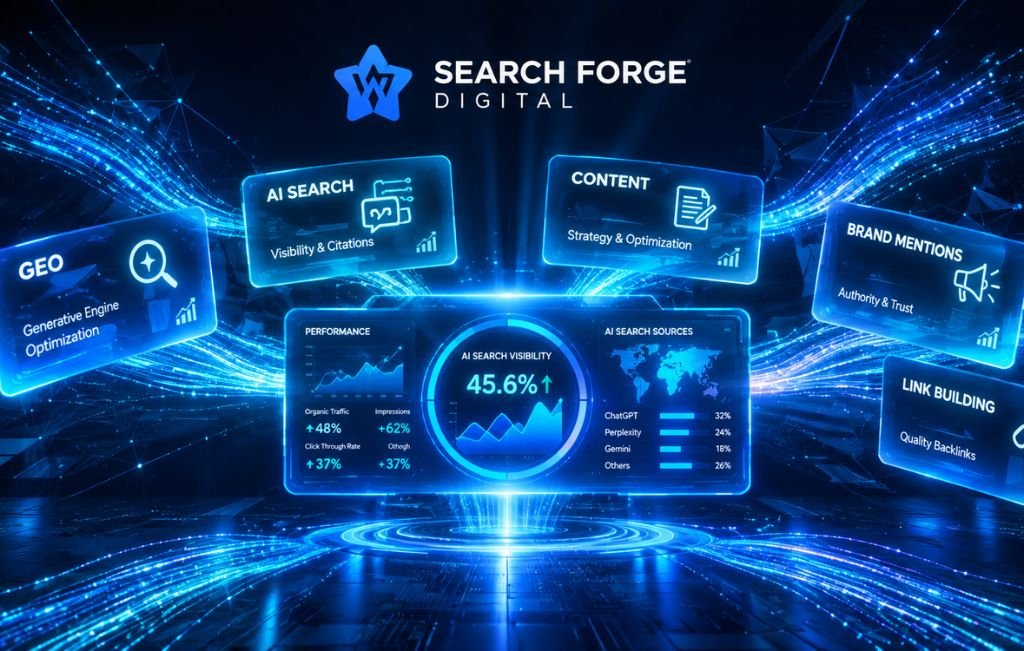
At Search Forge Digital the focus is on connecting traditional search visibility with the way people increasingly discover businesses through AI-powered search. By combining technical SEO, GEO, Digital PR, content strategy, and authority building, Search Forge Digital helps brands strengthen their presence across traditional search and emerging AI-driven discovery channels.
Frequently Asked Questions
Can Digital PR directly improve AI search rankings?
Digital PR should not be presented as a direct ranking manipulation technique. AI-driven search systems use different retrieval, ranking, and generation processes, and there is no guaranteed PR formula that automatically places a brand at the top of ChatGPT, Perplexity, Gemini, or Google AI features. The practical value of Digital PR is that it can strengthen brand authority, create relevant third-party references, earn quality links, and expand the information available around a business. Those improvements can support the wider SEO and GEO ecosystem.
Why is Digital PR important for GEO?
Digital PR is important for GEO because AI visibility depends on more than the content a company publishes on its own website. Relevant third-party coverage can provide additional context about a brand’s expertise, products, leadership, research, and market position. When that information is accurate, consistent, and published by credible sources, it can contribute to a stronger overall online presence. Digital PR is therefore best viewed as one component of a broader GEO strategy rather than a standalone optimization tactic.
Is traditional link building still useful for AI-driven search?
Yes. Traditional SEO and link acquisition remain relevant, particularly because Google states that its generative AI search features are grounded in core Search systems and established SEO fundamentals. The mistake is focusing only on link quantity. For modern search visibility, businesses should prioritize relevant, authoritative links and editorial mentions that strengthen topical relevance, credibility, referral visibility, and brand recognition.
What type of Digital PR content works best for B2B SaaS companies?
B2B SaaS companies should focus on PR stories that provide genuine informational value. Original research, industry data, customer insights, expert commentary, technology trends, proprietary findings, strong executive opinions, and detailed case studies can all create better media opportunities than generic promotional announcements. The best campaigns give publishers a reason to reference the company because the company has contributed something useful to the broader conversation.
Should businesses invest in Digital PR, SEO, and GEO together?
For businesses that want long-term search visibility, combining these activities is generally stronger than treating them as isolated channels. Technical SEO helps search engines access and understand the website, content provides useful information, Digital PR builds external authority and recognition, and GEO focuses attention on visibility within AI-driven search experiences. Google’s guidance also reinforces that foundational SEO remains important for generative AI search. The objective should be an integrated search visibility strategy rather than chasing a single ranking metric.
About Search Forge Digital
Search Forge Digital is a search marketing company focused on helping businesses build stronger visibility across traditional search engines and emerging AI-driven search experiences. Its approach combines technical SEO, Generative Engine Optimization (GEO), Digital PR, content strategy, and authority building to help brands become more discoverable, credible, and competitive in an increasingly AI-powered search environment.